
In the Song of Solomon, the bride is described as saying, “My beloved is unto me as a cluster of camphire in the vineyards of Engedi,” Son 1:14; and again, “Thy plants are an orchard of pomegranates, with pleasant fruits, camphire with spikenard,” Son 4:13.
Cam´phire occurs twice in the Song of Solomon (Son 1:14; Son 4:13). The Hebrew word is Kopher, and has been supposed by some to denote in these places a bunch of grapes, and by others camphor. The word camphire is the old mode of spelling camphor; but this substance does not appear to have been known to ancient commerce. The word Kopher is certainly very like Kafoor, the Eastern name for camphor, but it also closely resembles the Greek Kupros, usually written Cypros. Indeed, as has been observed, it is the same word, with the Greek pronunciation and termination. The Kupros of the Greeks is, no doubt, the Lawsonia inermis of botanists. If we examine the works of Oriental travelers and naturalists, we shall find that this plant is universally esteemed in Eastern countries, and appears to have been so from the earliest times, both on account of the fragrance of its flowers, and the coloring properties of its leaves.
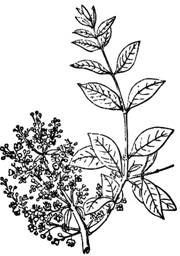
Fig. 112—Lawsonia inermis
Thus Rauwolff, when at Tripoli, ’found there another tree, not unlike unto our privet, by the Arabians called Alcana, or Henna, and by the Grecians, in their vulgar tongue, Schenna, which they have from Egypt, where, but above all in Cayre, they grow in abundance. The Turks and Moors nurse these up with great care and diligence, because of their sweet-smelling flowers. They also, as I am informed, keep their leaves all winter, which leaves they powder and mix with the juice of citrons, and stain therewith against great holidays the hair and nails of their children of a red color, which color may perhaps be seen with us on the manes and tails of Turkish horses.’ This custom of dyeing the nails and the palms of the hands and soles of the feet, of an iron-rust color, with henna, exists throughout the East, from the Mediterranean to the Ganges, as well as in Northern Africa. In some parts the practice is not confined to women and children, but is also followed by men, especially in Persia. In dyeing the beard, the hair is turned to red by this application, which is then changed to black by a preparation of indigo. In dyeing the hair of children, and the tails and manes of horses and asses, the process is allowed to stop at the red color which the henna produces. In reference to this universal practice of the East, Dr. Harris observes that ’the expression in Deu 21:12, “pare her nails,” may perhaps rather mean “adorn her nails,” and imply the antiquity of this practice. This is a universal custom in Egypt, and not to conform to it would be considered indecent. It seems to have been practiced by the ancient Egyptians, for the nails of the mummies are most commonly of a reddish hue.’
In Son 1:14 4:13, is not the gum Camphor of our apothecaries, but the Cyprus-flower, as it is sometimes called, the Athena of the Arabs, a whitish fragrant flower, hanging in clusters like grapes. Oriental ladies make use of the dried and powdered leaves to give their nails, feet, and hands a reddish orange tinge. The nails of Egyptian mummies are found thus dyed. See EYELIDS. The flowers of the Alhenna are fragrant; and being disposed in clusters, the females of Egypt are fond of carrying it in their bosoms.\par
Camphire. There can be no doubt that "camphire" is the Lawsonia alba of botanists, the henna of Arabian naturalists. The henna plant grows in Egypt, Syria, Arabia and northern India. The flowers are white and grow in clusters, and are very fragrant. The whole shrub is from four to six feet high, Son 4:13.
Son 1:14; "My beloved is unto Me as a cluster of camphire" (Son 4:13). The shrub Lawsonia. inermis of Linnaeus, or alba, a kind of privet, having bunches of scented, small, lilac and yellowish white flowers, the bark dark, the foliage light green. Hebrew
(
If we examine the works of Oriental travelers and naturalists, we shall find that this plant is universally esteemed in Eastern countries, and appears to have been so from the earliest times, both on account of the fragrance of its flowers and the coloring properties of its leaves (see Prosp. Alpin.100:13). It was especially abundant near Ashkelon (Pliny, 12:51; Josephus, War, 4:8, 3). Thus Rauwolff, when at Tripoli (Travels, iv), “found there another tree, not unlike unto our privet, by the Arabians called A lcana or Henna, and by the Grecians, in their vulgar tongue, Schenna, which they have from Egypt, where, but ‘above all’ in Cayre, they grow in abundance. The Turks and Moors nurse these up with great care and diligence because of their sweet-smelling flowers.They also, as I am informed, keep their leaves all winter, which leaves they powder and mix with the juice of citrons, and stain therewith against great holidays the hair and nails of their children of a red color; which color may perhaps be seen with us on the manes and tails of Turkish horses” (see also Belon, 2:74). The variety called Lawsonia spinosa is larger than the other, growing to a height of from four to six feet; its flowers are less abundant and less fragrant, but have a more powerfully coloring property. In appearance both plants resemble myrtle; the flowers (which grow in clusters) are small and beautifully white, and exhale an agreeable odor. The women take great pleasure in them. They hold them in their hand, carry them in their bosom, and keep them in their apartments to perfume the air (comp. Son 1:13).
To prepare the leaves for the use to which the plant is so generally applied by the women of Egypt, they are gathered about the commencement of spring, and, having been exposed to the air. till thoroughly dry, are reduced to powder, which being afterward made into a paste, is then fit for use. This paste requires about five hours to dry upon whatever part it may be laid, and the red tinge it imparts is durable. It was anciently applied to the nails of the hands and feet, to the soles of the feet and the palms of the hands, and sometimes to the hair. Brides in Persia are still thus ornamented on the night before marriage (Sir Wm. Ouseley’s Travels in Persia, 3:565). From the appearance of the nails of mummies, there can be no doubt that it was used in the same manner by the Egyptians as it is by their descendants in the present day. Theexpression rendered in Deu 21:12, in directing the treatmentof a female captive, “pare her nails,” is supposed to mean “adorn her nails,” and would imply the antiquity of this practice, although others are of opinion that the marginal reading, “suffer to grow,” is the more correct sense, as an act of mourning. SEE PAINT.
For the scientific classification of this plant, see the PennyCyclopeadiads.v. Lawsonia. The shrub is figured and described by Sonnini,Travels, 1:164; see also Oedmann, Samlt. 1:91; 6:102 sq.; Hasselquist, Trav. p. 503; Shaw, Trav. p. 103; Hartmann, Hebraer. 2:356 sq.’; Russel,Aleppo, 1:134; Mariti, p. 541; Forskal, Flor. p. 55; Burckhardt, Arabia, p.442; Lane, Mod. Eg. 1:52; Rosenmüller, Bib. Bot. p. 133; Wilkinson, Anc. Eg 2:345. SEE BOTANY.
CAMPHIRE (kôpher, Son 1:14; Son 4:13) is the henna plant (Lawsonia alba), a small shrub which may still be found at Engedi. It is a great favourite with the people of Palestine to-day, and a ‘cluster’ of the flowers is often put in the hair; the perfume is much admired. It is also extensively used for staining the hands (especially the nails), the feet, and the hair; it stains an ochre-red, but further treatment of the nails with a mixture of lime and ammonia turns the colour almost black. Old women frequently redden their hair, and Moslems their beards, by means of henna.
E. W. G. Masterman.
See Henna