
the, was an image of polished brass, in the form of one of those fiery serpents which were sent to chastise the murmuring Israelites in the wilderness, and whose bite caused violent heat, thirst, and inflammation. By divine command “Moses made a serpent of brass,” or copper, and “put it upon a pole; and it came to pass, that if a serpent had bitten any man, when he beheld the serpent of brass, he lived,”
Num 21:6-9. This brazen serpent was preserved as a monument of the divine mercy, but in process of time became an instrument of idolatry. When this superstition began, it is difficult to determine; but the best account is given by the Jewish rabbi, David Kimchi, in the following manner: From the time that the kings of Israel did evil, and the children of Israel followed idolatry, till the reign of Hezekiah, they offered incense to it; for it being written in the law of Moses, “Whoever looketh upon it shall live,” they fancied they might obtain blessings by its mediation, and therefore thought it worthy to be worshipped. It had been kept from the days of Moses, in memory of a miracle, in the same manner as the pot of manna was: and Asa and Jehoshaphat did not extirpate it when they rooted out idolatry, because in their reign they did not observe that the people worshipped this serpent, or burnt incense to it; and therefore they left it as a memorial. But Hezekiah thought fit to take it quite away, when he abolished other idolatry, because in the time of his father they adored it as an idol; and though pious people, among them accounted it only as a memorial of a wonderful work, yet he judged it better to abolish it, though the memory of the miracle should happen to be lost, than suffer it to remain, and leave the Israelites in danger to commit idolatry hereafter with it. On the subject of the serpent-bitten Israelites being healed by looking at the brazen serpent, there is a good comment in the book of Wisdom, chap. Num 16:4-12, in which are these remarkable words:—”They were admonished, having a sign of salvation,” that is, the brazen serpent, “to put them in remembrance of the commandments of thy law. For he that turned himself toward it, was not saved by the THINGS that he saw, but by THEE, that art the Saviour of all,” Num 16:6-7. To the circumstance of looking at the brazen serpent in order to be healed, our Lord refers, Joh 3:14-15: “As Moses lifted up the (brazen) serpent in the wilderness, even so must the Son of man be lifted up, that whosoever believeth in him should not perish, but have eternal life.”
An image in brass prepared by Moses, resembling the fiery serpents so destructive to Israel in the desert, and set up in the midst of the camp in the view of all, that whosoever would evince penitence, faith, and obedience by looking to it, might live, Num 21:6-9 . Our Savior has shown us that this was typical of himself and of salvation through him—a gratuitous salvation, free to all, on the easy terms of faith and obedience, Joh 3:14,15 . The brazen serpent was long preserved, as a memorial of the gracious miracle wrought in connection with it; but being regarded as an object of worship, it was broken to pieces by king Hezekiah, as Nehushtan—a mere piece of brass, 2Ki 18:4 .\par
(
See SERPENT OF BRASS.
By: Kaufmann Kohler, Isaac Husik, Morris Jastrow, Jr., J. Frederic McCurdy
—Biblical Data:
An image set up by Moses which is said to have healed those who looked upon it. When the people of Israel, near the close of the desert wanderings, were marching southward to go around Edom to the east of Palestine, they murmured against God and against Moses. As a punishment "fiery serpents" (compare Isa. xiv. 29; xxx. 6) of the region were sent against them, and very many died of their poisonous bites. On their showing repentance Moses was bidden to put upon a lofty pole an image in bronze of such a serpent, which, according to II Kings xviii. 4, was known as "neḥushtan." The sufferers, when they looked upon the image from any part of the camp, were healed of their sickness (Num. xxi. 4-9). This "brazen serpent" became an object of adoration to Israel, and so remained until Hezekiah destroyed it by breaking it into fragments (II Kings xviii. 4).
—In Rabbinical Literature:
Inasmuch as the serpent in the Talmud stands for such evils as talebearing and defamation of character (Gen. iii. 4, 5), the Midrash finds in the plague of the fiery serpents a punishment for sins of the evil tongue (Num. xxi. 5). God said: "Let the serpent who was the first to offend by 'evil tongue' inflict punishment on those who were guilty of the same sin and did not profit by the serpent's example."
The Brazen Sea of Solomon's Temple.—With View of Section.(Restored according to Calmet.)
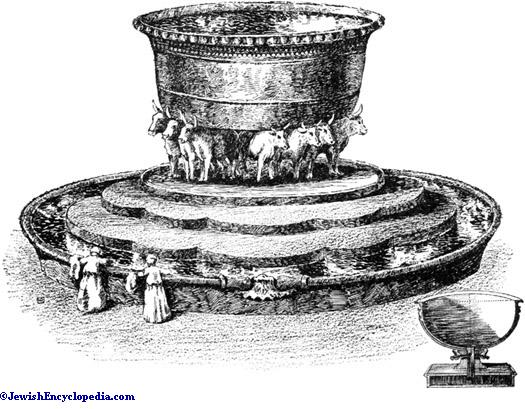
One of the complaints in this case was dissatisfaction with the manna. Whereas the manna is believed to have had any taste desired by the person eating it, to the serpent all things had the taste of dust, in accordance with the words: "And dust shalt thou eat all the days of thy life" (Gen. iii. 14). It was very appropriate, therefore, that they who loathed the food which had given any taste desired, should be punished by means of that creature to which everything has the same taste (Tan., ed. Buber, Ḥuḳḳat, xlv. [337]; Midrash R. Num. xix. 22).
The Mishnah does not take literally the words "Every one who was bitten by a serpent would look at the serpent and live," but interprets them symbolically. The people should look up to the God of heaven, for it is not the serpent that either brings to life or puts to death, but it is God (MishnahR. H. 29a). In the course of time, however, the people lost sight of the symbolical meaning and regarded the serpent itself as the seat of the healing power, and they made it an object of worship, so that Hezekiah found it necessary to destroy it (II Kings xviii. 4; see also Ber. 10a).
K. I. Hu.—Critical View:
It is not necessary to discuss here the nature of the serpents (See Seraphim) that attacked the pilgrims in the desert; for it is not specifically said that one of these, but merely a "serpent," not further defined, was represented in bronze.
The question of the form of representation is, however, of importance as a matter of religious history. In this narrative ascribed to J and E modern criticism sees an account of the way in which the serpent-worship, surviving till the days of Hezekiah, took its rise. What was its motive? Evidently the serpent in this special cult was regarded as beneficent, as was frequently the case among the Semites generally (compare Animal Worship). But at the same time the serpent was becoming odious, as a type of subtlety and seductiveness (Gen. iii.), and the two conceptions were felt to be inconsistent. The wilderness narrative does justice historically to both of these aspects of serpent nature and the corresponding beliefs. Add to this, that all sorts of image-worship were being discouraged by prophetic influence. In this special instance it was particularly obnoxious to the reforming party in Judah; because Isaiah, who was its main inspiration, had already spiritualized the idea of the "flying serpent" (Isa. vi.), seeing in the "seraphim," or swiftly changing lightning and cloud-shapes of the sky, a mode of the divine self-manifestation similar to that of the Cherubs. The name "neḥushtan" suggests some interesting questions. To judge from the form, the name belongs to an old period of the language, but the explanation of it as a "brazen" object appears to be due to a species of popular etymology, "naḥash" signifying in Hebrew "brass" as well as "serpent." It is likely that neḥushtan as an object used in the ancient Semitic cult was a species of totem-pole, surmounted by the reproduction-perhaps in wood—of a serpent, and was placed before tents or rude dwellings as a means of driving off evil spirits, who were supposed to be lurking everywhere.
Bibliography:
Smend, Alttestamentliche Religion, p. 470;
Baudissin, Studien zur Semit. Religionsgeschichte, i. 288 et seq.;
Wellhausen, Reste Arabischen Heidenthums, pp. 137 et. seq.;
Kremer, Kulturgesch. des Orients, ii. 257;
W. R. Smith, Religion of the Semites, 2d ed., p. 133;
Nowack, Hebr. Archäologie, ii. 24;
Benzinger, Arch. p. 383;
Gunkel, Schöpfung und Chaos, pp. 81 et seq., 111 et seq., deals with the serpent-myths generally, as also does Baudissin, op. cit. i. 257 et seq. See also the commentaries of Cheyne, Delitzsch, Duhm on the passages quoted from Isaiah, and the commentaries of Dillmann and Strack.
BRAZEN SERPENT.—See Serpent [Brazen].
See NEHUSHTAN.