
Boz´rah, an ancient city, known also to the Greeks and Romans by the name of Bostra. In most of the passages of the Old Testament where it is mentioned, it appears as a chief city of the Edomites (Isa 34:6; Isa 63:1; Amo 1:12; Jer 49:13; Jer 49:22); but it appears to have been afterwards taken from them by the Moabites, who for a time retained it in their possession.
Bozrah lay southward from Edrei, one of the capitals of Bashan, and, according to Eusebius, 24 Roman miles distant from it. Alexander Severus made it the seat of a Roman colony. In the acts of the Nicene, Ephesian, and Chalcedonian councils mention is made of bishops of Bozrah, and at a later period it became an important seat of the Nestorians. Abulfeda makes it the capital of the Hauran, in which, according to Burckhardt, it is still one of the most important towns. It has recently been visited by various travelers, who give a very ample description of its ruins, the extent and importance of which are alone sufficient to evince the ancient consequence of the place. They are of various kinds, Greek, Roman, and Saracenic, with traces of the native works in the private dwellings.
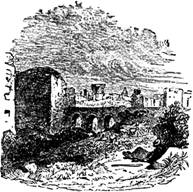
Fig. 100—Bozrah
These monuments of ancient grandeur serve but to heighten the impression which is created by the present desolation and decay. ’Bozrah,’ says Lord Lindsay, ’is now for the most part a heap of ruins, a most dreary spectacle: here and there the direction of a street or alley is discernible, but that is all. The modern inhabitants—a mere handful—are almost lost in the maze of ruins. Olive-trees grew here within a few years, they told us—all extinct now, like the vines for which the Bostra of the Romans was famous. And such, in the nineteenth century, and under Muslim rule, is the condition of a city which even in the seventh century, at the time of its capture by the Saracens, was called by Caled “the market-place of Syria, Iraq, and the Hedjaz.” “I have sworn by myself, saith the Lord of Hosts, that Bozrah shall become a desolation and reproach, a waste and a curse; and all the cities thereof shall be perpetual wastes!” (Jer 49:13). And it is so.’
Gen 36:33, a city of Edom, Isa 34:6 63:1, and the region around it, Jer 49:13,22 . It is associated with Terman, and with the Red sea, Jer 49:20-22 1Sa 1:12 . Its site is found in the modern El-Busaireh, midway between Kir Moab and Mount Hor, south by east of the Dead sea. This is a village of about fifty houses, on a hill crowned by a small castle. The ruins are those of a considerable city. Bozrah of Moab, Jer 48:24, may be the same place with this, or perhaps with Bezer.\par
Boz’rah. (fortress).
1. In Edom, the city of Jobab, the son of Zerah, one of the early kings of that nation. Gen 36:33; 1Ch 1:44. Mentioned by Isaiah, Isa 34:6; Isa 63:1, in connection with Edom, and by Jeremiah, Jer 49:13; Jer 49:22; Amo 1:12, and Mic 2:12. Its modern representative is el-Busaireh, which lies on the mountain district to the southeast of the Dead Sea.
2. In his catalogue of the cities of the land of Moab, Jeremiah, Jer 48:24, mentions a Bozrah as in "the plain country" Jer 48:21, that is, the high level downs, on the east of the Dead Sea.
BOZRAH, from a root "restrain," a sheepfold, Septuagint version of Jer 49:22. Jobab is styled "of Bozrah" (Gen 36:33) among the kings of Edom (1Ch 1:44).
1. Now El-busaireh, containing about 50 houses and a castle on a hill, in the mountain district S.E. of the Dead Sea, half way between Petra and the Dead Sea. Burckhardt saw goats in large numbers there, just as Isaiah (Isa 34:6) describes; compare Isa 63:1; Amo 1:12; Mic 2:12.
2. Another Bozrah in Moab, in "the plain country," i.e. the high level downs E. of the Dead Sea (Jer 48:21-24), enumerated among the cities of Moab. The Bozrah of Edom on the mountains (Jer 49:13) and Edom’s other cities are to be "perpetual wastes"; but the Bozrah of Moab "in the plain" is to be restored "in the latter days" (Jer 48:47). Though not mentioned elsewhere, this Bozrah of Moab, where kings were "sheepmasters" (2Ki 3:4), would be a name ("sheepfold") of probable occurrence. Others identify this Bozrah with the Roman Bostra in Bashan, 60 miles from Heshbon, containing magnificent remains; Jeremiah’s including the cities "far and near’ may favor this view; but Jer 48:21, "in the plain," seems to mark it among the other Moabite cities.
(Heb. Botsrah’,
Bozrah (bŏz’rah), fortress. Two cities. 1. Bozrah in Edom, Isa 34:6; Isa 63:1, which was to become a perpetual waste. Jer 49:13; Amo 1:12; Mic 2:12; perhaps Buseireh, in the mountains of Petra, 20 miles southeast of the Dead Sea. 2. Bozrah in Moab. Jer 48:24. Judgment has surely fallen upon it. Porter thinks it is the same as modern Buzrah, where are the ruins of a magnificent city nearly five miles in circuit, once having 100,000 inhabitants, but now only 20 families. It is near the Hauran, 60 miles south of Damascus. Portions of its massive walls and towers, theatre, temples, stone doors and roofs, some of the ruins of the work of the early inhabitants, perhaps the giants Rephaim, but more likely of the later Roman builders, are still to be seen in good state of preservation.
[Boz’rah]
1. Royal city of Edom, on which the prophets pronounced judgements. Gen 36:31; 1Ch 1:44; Jer 49:13; Jer 49:22; Amo 1:12; Mic 2:12. Christ is represented as coming from thence with dyed garments, having trodden the winepress of His wrath upon the nations (Gentiles). Isa 63:1-4: cf. Isa. 34. Identified with el Buseireh, 30° 50’ N, 35° 35’ E.
2. City in the land of Moab, upon which judgement is pronounced. Jer 48:24.
BOZRAH (‘fortification’).—1. An Edomite city known only as the place of origin of Jobah, son of Zerah, one of the Edomite kings (Gen 36:33, 1Ch 1:44). It was, however, of such importance in the kingdom of Edom that it is coupled with the name of the latter in poetic parallelisms (e.g. the denunciation in Isa 34:6; cf. Jer 49:22). The reference in Isa 63:1 to ‘dyed garments’ of Bozrah, and in Mic 2:12 to ‘sheep of Bozrah,’ may indicate the industries for which it was noted. The guesses that have been made at its identification are of no importance. 2. A Moabite city denounced by Jeremiah (Jer 48:24), and also unknown.
R. A. S. Macalister.
(1) The capital of Edom, a city of great antiquity (Gen 36:33; 1Ch 1:44; Isa 34:6; Isa 63:1; Jer 49:13; Amo 1:12). It may be identical with
(2) A city in Moab mentioned in Jer 48:24. It is probably identical with Bezer, the city of refuge. It may be represented today by