
Be´hemoth (Job 40:15) is regarded as the plural of behemah, but commentators are by no means agreed as to its true meaning. A number of learned men, with Bochart and Calmet at their head, understand the word in the singular number as a specific name, denoting the hippopotamus, seeking to prove, by somewhat forced interpretations of the beautiful poetical allusions in Job 40:15-24, the exactness of the description when compared with the species, which, however, in some respects is more applicable to the elephant, while in others it is equally so to both animals.
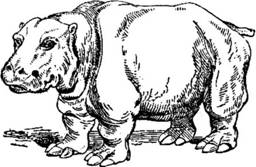
Fig. 91—Hippopotamus
Hence the term behemoth, taken intensely (for in some places it is admitted to designate cattle in general), may be assumed to be a poetical personification of the great Pachydermata, or even Herbivora, wherein the idea of hippopotamus is predominant. This view accounts for the ascription to it of characters not truly applicable to one species; for instance, the tail is likened to a cedar, which is only admissible in the case of the elephant; again, ’the mountains bring him forth food;’ ’he trusteth that he can draw up Jordan,’ a river which elephants alone could reach; ’his nose pierceth through snares,’ certainly more indicative of that animal’s proboscis with its extraordinary delicacy of scent and touch, ever cautiously applied, than of the obtuse perceptions of the river-horse. Finally, the elephant is far more dangerous as an enemy than the hippopotamus, which numerous pictorial sculptures on the monuments of Egypt represent as fearlessly speared by a single hunter standing on his float of log and reeds. Yet although the elephant is scarcely less fond of water, the description referring to manners, such as lying under the shade of willows among reeds, in fens, etc. is more directly characteristic of the hippopotamus. The book of Job appears, from many internal indications, to have been written in Asia, and is full of knowledge, although that knowledge is not expressed according to the precise technicalities of modern science; it offers pictures in magnificent outline, without condescending to minute and labored details. Considered in this light, the expression in Psa 50:10, ’For every beast of the forest is mine, and the cattle (behemoth) upon a thousand hills,’ acquires a grandeur and force far surpassing the mere idea of cattle of various kinds. If, therefore, we take this plural noun to bear the meaning here briefly indicated, we may likewise consider the leviathan, its counterpart, a similarly generalized term with the idea of the crocodile most prominent: but from the very name indicating a twisting animal, and which from various texts evidently include the great pythons, cetacea, and sharks of the surrounding seas and deserts, it conveys a more sublime allusion than if limited to the crocodile, an animal familiar to every Egyptian, and well known even in Palestine.
A huge amphibious animal, described in Job 40:15-24 . Commentators are now generally agreed that it is the hippopotamus, or river horse, which is found only in the Nile and other great rivers of Africa. This is a very large, powerful, and unwieldy animal, which lives in the water, but comes out upon the banks to feed on grass, grain, green herbs, and branches of trees. The appearance of the hippopotamus when on land is altogether uncouth, the body being extremely large, flat, and round, the head enormously large in proportion, and the legs as disproportionately short. Then length of a male has been known to be seventeen feet, the height seven feet, and the circumference fifteen; the head three feet; the mouth in width about two feet. The general color of the animal is brownish; the ears small and pointed; the eyes small and black; the lips very thick and broad; the nostrils small. The armament of teeth is its mouth is truly formidable; more particularly the tusks of the lower jaw, which are of a curved form, somewhat cylindrical; these are so strong and hard that they will strike fire with steel, are sometimes more that two feet in length, and weigh upwards of six pounds each. The other teeth are much smaller. The tail is short and thick; and the whole body is protected by a thick and tough hide, which swords and arrows cannot penetrate, thickly covered with short hair.\par Mr. Ruppell gives the following graphical account of a combat on the upper Nile.\par "One of the hippopotami which we killed was a very old male, and seemed to have reached his utmost growth. He measured, from the snout to the end of the tail, about fifteen feet; and his tusks, from the root to the point, along the external curve, twenty-eight inches. We had a battle with him four hours long, and that too in the night. Indeed, he came very near destroying our large bark; and with it, perhaps, all our lives. The moment he saw the hunters in the small canoe, as they were about to fasten the long rope to the buoy in order to draw him in, he threw himself with on rush upon it, dragged it with him under water, and shattered it to pieces. Out of twenty- five musket ball, which were fired into the monster’s head at the distance of five feet, only on penetrated the hind and the bones near the nose; so that, every time he breathed, he snorted a stream of blood upon the bark. All the other balls remained sticking in the thickness of the hide. We had at last to employ a small cannon; but it was only after five of its balls, fired at the distance of a few feet, had mangled most shockingly the head and body of the monster, that he died. This gigantic hippopotamus dragged our large bark at his will in every direction of the stream."\par
Be’hemoth. (great beasts). There can be little or no doubt that, by this word, Job 40:15-24, the hippopotamus is intended since all the details descriptive of the behemoth accord entirely with the ascertained habits of that animal.
The hippopotamus is an immense creature having a thick and square head, a large mouth, often two feet broad, small eyes and ears, thick and heavy body, short legs terminated by four toes, a short tail, skin without hair, except at the extremity of the tail.
It inhabits nearly the whole of Africa, and has been found of the length of 17 feet. It delights in the water, but feeds on herbage on land. It is not found in Palestine, but may, at one time, have been a native of western Asia.
(Job 40:15-24.) The Egyptian, Coptic,
"He lieth under the lotus bushes," in the covert of the reed and fens (being amphibious). "The lotus bushes cover him with their shadow." "Behold (though) a river be overwhelming, he is not in hasty panic (for he can live in water as well as land); he is secure, though a Jordan swell up to his mouth." Job cannot have been a Hebrew, or he would not adduce Jordan, where there were no river horses. He alludes to it as a name known only by hearsay, and representing any river. "Before his eyes (i.e. openly) will any take him, or pierce his nose with cords?" Nay, he can only be taken by guile. Jehovah’s first discourse (Job 38-39) was limited to land animals and birds; this second discourse requires therefore the animal classed with the crocodile to be amphibious, as the river horse.
(Heb. behemoth,
(1.) The general purpose and plan of Jehovah’s two discourses with Job require that the animal which in this second discourse is classed with the crocodile should be an amphibious, not a terrestrial animal, the first discourse (38, 39) having been limited to land-animals and birds.
(2.) The crocodile and hippopotamus, being both natives of Egypt and AEthiopia, are constantly mentioned together by the ancient writers (see Herod. 2:69-71; Diod. 1:35; Pliny 28:8).
(3.) It seems certain that an amphibious animal is meant from the contrast between Act 12:15; Act 12:20-22, and Act 12:23-24, in which the argument seems to be, “Though he feedeth upon grass,” etc., like other animals, yet he liveth and delighteth in the waters, and nets are set for him there as for fish, which by his great strength he pierces through.
(4.) The mention of his tail in Act 12:17 does not agree with the elephant, nor can
his Maker [only] can supply his sword [i.e. tushes]. For produce will [the] mountains bear for him; Even [though] all [the] animals of the field may spors [there]. Beneath [the] lotuses will he lie, In [the] covert of [the] reedy marsh; Lotuses shall entwine him his shade. Osiers of [the] brook shall enclose him. Lo! [the] liver may swell-he will not start; He will be bold, although a Jordan should rush to his mouth. In his [very] eyes should [one] take him, Through [the] snares would [his] nose pierce.
“But in some respects this description is more applicable to the elephant, while in others it is equally so to both animals. Hence the term behemoth, taken intensively (for in some places it is admitted to designate cattle in general), may be assumed to be a poetical personification of the great Pachydermata, or even Herbivora, wherein the idea of hippopotamus is predominant. This view accounts for the ascription to it of characters not truly applicable to one species; for instance, the tail is likened to a cedar (provided
Behemoth (bç’he-mŏth, or be-hç’moth), the great beast; or, if it be supposed an Egyptian word, it may mean the water-ox. A mammoth animal, described in Job 40:15-24, where the explanation is added in the margin of the R. V., "that is, the hippopotamus." The identification of behemoth has puzzled critics, and the strangest conjectures have been propounded. The mammoth, or other extinct quadruped, has been thought behemoth by some; while others maintain it is the elephant; and some would take the word as having a symbolical meaning. The weight of evidence is in favor of the hippopotamus. As leviathan is most likely the crocodile, it is not unreasonable to suppose that behemoth is, like the crocodile, an inhabitant of the Nile; and that, as leviathan is amphibious, behemoth must be amphibious too, and hence the hippopotamus, a conclusion which is strengthened by the comparison of verses 15, 21, 22 with 24.
This is a Hebrew word and is now very generally believed to refer to the Hippopotamus. Job 40:15. Jehovah calls the attention of Job to this wonderful animal that he might see the wisdom and power of its Creator.
See LEVIATHAN AND BEHEMOTH:
BEHEMOTH.—The hippopotamus (Job 40:15), as leviathan (Job 41:1) is the crocodile. It has been suggested that the ancient Babylonian Creation-myth underlies the poet’s description of the two animals (Gunkel, Schöpf. u. Chaos, 61 ff.). This is doubtful, but the myth undoubtedly reappears in later Jewish literature: ‘And in that day will two monsters be separated, a female named Leviathan to dwell in the abyss over the fountains of waters. But the male is called Behemoth, which occupies with its breast [?] an immeasurable desert named Dendain’ (En 60:7, 8; cf. 2Es 6:49-51, Apoc.
J. Taylor.
Hebrew word for beasts, left untranslated in Job 40, where it indicates a particular animal, probably mythical, in description similar to the hippopotamus and corresponding to the mythical Egyptian water-ox, p-ehe-mu, probably adapted into Hebrew as behemah, plural behemothj hence, monstrous beast.
The remains of a fossil hippopotamus of apparently the same species are found over most of Europe, so that it may have inhabited Palestine in early historical times, although we have no record of it. There is a smaller living species in west Africa, and there are several other fossil species in Europe and India. The remains of Hippopotamus minutus have been found in enormous quantities in caves in Malta and Sicily.
For an elaborate explanation of behemoth and leviathan (which see) as mythical creatures, see Cheyne, EB, under the word
Behemoth. Behemoth could mean elephant, crocodile, hippopotamus, water buffalo, or mythological monster. The word appears in (Job 40:15), where God humbles Job by praising two of His creations, behemoth and Leviathan. Hippopotamus is the best choice for the precise meaning of behemoth. Hippos submerge themselves in rivers and bask in cool marshes. Yet they can climb up riverbanks and hillsides, devouring vegetation. An angered hippo can bite a man in half or crush a canoe with his enormous jaws.