
The Hebrews wore their beards, but had, doubtless, in common with other Asiatic nations, several fashions in this, as in all other parts of dress. Moses forbids them, Lev 19:27, “to cut off entirely the angle, or extremity of their beard;” that is, to avoid the manner of the Egyptians, who left only a little tuft of beard at the extremity of their chins. The Jews, in some places, at this day suffer a little fillet of hair to grow from below the ears to the chin: where, as well as upon their lower lips, their beards are long. When they mourned, they entirely shaved the hair of their heads and beards, and neglected to trim their beards, to regulate them into neat order, or to remove what grew on their upper lips and cheeks, Jer 41:5; Jer 48:37. In times of grief and affliction, they plucked away the hair of their heads and beards, a mode of expression common to other nations under great calamities. The king of the Ammonites, designing to insult David in the person of his ambassadors, cut away half of their beards, and half of their clothes; that is, he cut off all their beard on one side of their faces, 2Sa 10:4-5; 1Ch 19:5. To avoid ridicule, David did not wish them to appear at his court till their beards were grown again. When a leper was cured of his leprosy, he washed himself in a bath, and shaved off all the hair of his body; after which, he returned into the camp, or city; seven days afterward, he washed himself and his clothes again, shaved off all his hair, and offered the sacrifices appointed for his purification, Lev 14:9. The Levites, at their consecration, were purified by bathing, and washing their bodies and clothes; after which, they shaved off all the hair of their bodies, and then offered the sacrifices appointed for their consecration, Num 8:7.
Nothing has been more fluctuating, in the different ages of the world and countries than the fashion of wearing the beard. Some have cultivated one part and some another; some have endeavoured to extirpate it entirely, while others have almost idolized it; the revolutions of countries have scarcely been more famous than the revolutions of beards. It is a great mark of infamy among the Arabs to cut off the beard. Many people would prefer death to this kind of treatment. As they would think it a grievous punishment to lose it, they carry things so far as to beg for the sake of it: “By your beard, by the life of your beard, God preserve your blessed beard.” When they would express their value for any thing, they say, “It is worth more than a man’s beard.” And hence we may easily learn the magnitude of the offence of the Ammonites in their treatment of David’s ambassadors, as above mentioned; and also the force of the emblem used Eze 5:1-5, where the inhabitants of Jerusalem are compared to the hair of his head and beard. Though they had been dear to God as the hair of an eastern beard to its owner, they should be taken away and consumed, one part by pestilence and famine, another by the sword, another by the calamities incident on exile.
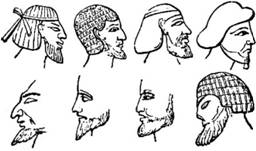
Fig. 87—Bearded heads from Egyptian monuments
Ancient nations in general agreed with the modern inhabitants of the East in attaching a great value to the possession of a beard. The total absence of it or a spare and stinted sprinkling of hair upon the chin, is thought by the Orientals to be as great a deformity to the features as the want of a nose would appear to us; while, on the contrary, a long and bushy beard, flowing down in luxuriant profusion to the breast, is considered not only a most graceful ornament to the person, but as contributing in no small degree to respectability and dignity of character. With this knowledge of the extraordinary respect and value which have in all ages been attached to the beard in the East, we are prepared to expect that a corresponding care would be taken to preserve and improve its appearance; and, accordingly, to dress and anoint it with oil and perfume was, with the better classes at least, an indispensable part of their daily toilet (Psa 133:2). In many cases it was dyed with variegated colors, by a tedious and troublesome operation. On the other hand, the allowing the beard to remain in a foul and disheveled state, or to cut it off, was one of the most striking outward indications of deep and overwhelming sorrow (2Sa 19:24 Ezr 9:13; Isa 15:2; Jer 41:5.
Nor was less jealousy shown in guarding the honor of, than in setting off to advantage, this attribute of manhood. The slightest exhibition of contempt, by sneering, spitting at, pulling, or even pressing against it in a rude and careless manner, was resented as an insult, such as would now, among men of the world, be deemed expiable only by a duel. No one was permitted to touch it except in the way of respectful and affectionate salutation, which was done by gently taking hold of its extremity with the right hand and kissing it; but even in that case it was only wives in approaching their husbands, children their parents, or the nearest and most attached friends, to whom this unusual liberty was granted. The act itself being an expression of kind and cordial familiarity, its performance by Joab shows in a flagrant light the base and unprincipled conduct of that ruthless veteran, when he took Amasa by the beard with his right hand to kiss him (rather it), and then having assumed this attitude under the mask of the most friendly feelings, smote his unsuspecting victim under the fifth rib (2Sa 20:9).
To be deprived of a beard was, and still is, in some places of the East, the badge of servitude—a mark of infamy, that degraded a person from the ranks of men to those of slaves and women. Among people influenced by such ideas, we can easily conceive how deep and intolerable was the affront which the king of the Ammonites put upon the ambassadors of David, when, among other acts of insolence, he shaved off one-half of their beards, and sent them home in that grotesque condition, exposed to the derision of their countrymen (2 Samuel 10). Persons of their high rank, who, in all probability, were fastidious about the orderly state and graceful appearance of their beards, would be even more sensitive as to this ignominious treatment than those of an humbler condition; and, as the shaving off one-half of the beard was among some ancient nations the punishment of cowardice, these circumstances united will help to account for the spirit of determined revenge which the king and the whole nation of Israel breathed, on intelligence of the national outrage.
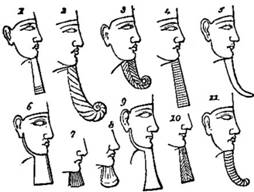
Fig. 88—Beards
2, 3, 5, 11. Gods
1, 4, 6, 9, 10. Kings
7, 8. Private persons
From the above facts it is clear that the Israelites maintained their beard and the ideas connected with it, during their abode among the Egyptians, who were a shaven people. This is not unimportant among the indications which evince that, whatever they learned of good or evil in that country, they preserved the appearance and habits of a separate people. As the Egyptians shaved their beards off entirely, the injunction in Lev 19:27 against shaving ’the corners of the beard’ must have been leveled against the practice of some other and bearded nation. The prohibition is usually understood to apply against rounding the corners of the beard where it joins the hair; and the reason is supposed to have been to preclude a superstition of certain Arabian tribes, who, by shaving off or rounding away the beard where it joined the hair of the head, devoted themselves to a certain deity who held among them the place which Bacchus did among the Greeks (comp. Jer 9:26; Jer 25:23; Jer 49:32). The ultimate effect seems to have been altogether to prevent the Jews from shaving off the edges of their beards. The effect of this prohibition in establishing a distinction of the Jews from other nations cannot be understood, unless we contemplate the extravagant diversity in which the beard was and is treated by the nations of the East. The fig. 87 is very interesting, being a collection of bearded heads of foreigners obtained from the Egyptian monuments, and, without doubt, including the beards, head-dresses, and physiognomies of most of the nations bordering on Egypt and Palestine. In nearly all of them we see that the upper edges of the beard were shaven off, and apparently the hair of the upper lip.
The ancient Egyptians, although they shaved their beards, had the singular custom of tying a false beard upon the chin. This was probably in the way of a compromise between their love of cleanliness and their desire to preserve some trace of the distinguishing sign of manhood. They were made of plaited hair, and had a peculiar form according to the rank of the persons by whom they were worn. Private individuals had a small beard, scarcely two inches long; that of a king was of considerable length and square at the bottom; and the figures of gods were distinguished by its turning up at the end.
The Hebrews regarded a thin, scanty beard as a great deformity; while a long, full, flowing beard was esteemed the noblest ornament of personal beauty and dignity. A man’s honor was lodged, as it were, his beard. To insult it by word or act was the grossest indignity; to take it respectfully in the right hand and kiss it, was a mode of expressing high esteem and love permitted only to the nearest friends. It was cherished with great care, Psa 133:2 Dan 10:3 . To neglect, tear, or cut it, indicated the deepest grief, Ezr 9:3 Isa 15:2 Jer 41:5 48:37; while to be deprived of it was a mark of servility and infamy. Many would prefer death to such a mutilation. These facts explain many passages of Scripture: as the gross insult offered to David’s ambassadors, 2Sa 10:4-14 ; the zealous indignation of Nehemiah, Neh 13:25 ; the mode in which the feigned insanity of David was expressed, 1Sa 21:12, and the grief of Mephibosheth, 1Sa 19:24 ; the treachery of Judas; also several passages in the prophets, Isa 7:20 50:6 Eze 5:1-5 .\par
Beard. Western Asiatics have always cherished the beard as the badge of the dignity of manhood, and attached to it, the importance of a feature. The Egyptians, on the contrary, for the most part, shaved the hair of the face and head, though we find some instances to the contrary. The beard is the object of an oath, and that on which , blessing or shame is spoken of as resting.
The custom was and is to shave or pluck it and the hair out in mourning, Ezr 9:3; Isa 15:2; Isa 50:6; Jer 41:5; Jer 48:37, Bar 6:31; to neglect it in seasons of permanent affliction, 2Sa 19:24, and to regard any insult to it as the last outrage which enmity can inflict. 2Sa 10:4. The beard was the object of salutation. 2Sa 20:9. The dressing, trimming, anointing, etc., of the beard was performed with much ceremony, by persons of wealth and rank. Psa 133:2. The removal of the beard was a part of the ceremonial treatment proper to a leper. Lev 14:9.
With Asiatics, a badge of manly dignity. The Egyptians mostly shaved the hair of the face and head, except in mourning. In consonance with this Egyptian usage, Scripture, with the undesigned propriety of truth, represents Joseph as having "shaved his beard," which he had allowed to grow in prison, before entering Pharaoh’s presence (Gen 41:14). Many Egyptians wore a false beard of plaited hair, private individuals small ones, kings long ones square below, the gods one turning at the end. Their enemies are represented bearded on the monuments.
The Jews were forbidden to "round the corners of their heads or mar (i.e. shave off) the corners of their beards" (Lev 19:27; Lev 21:5). Baal worshippers rounded the beard and hair to make their faces round, like the sun. The Arabs trimmed their beard round in sign of dedication to some idol. Possibly the Israelites retained the hair between the ear and eye, which the Arabs shaved away (Jer 9:26 margin; Jer 25:23; Jer 49:32; compare Herodotus, 3:8).
The beard is sworn by in the E. as an object of veneration. Not to trim it marked affliction, as in Mephibosheth’s case during Absalom’s occupation of Jerusalem (2Sa 19:24). An insult to it was resented as a gross outrage, as David did when Hanun shaved off half the beards of his ambassadors (2Sa 10:4). Compare God’s threat of "shaving" away His people as "hair" with the Assyrian king as His "razor" (Isa 7:20). This was one gross indignity to which Jesus was subjected: "I gave My cheeks to them that plucked off the hair" (Isa 50:6). It was shaved in mourning (Isa 15:2; Jer 41:5; Jer 48:37). Only the nearest friends were permitted to touch the beard, which marks the foul treachery of Joab in taking his cousin Amasa’s beard to kiss him, or rather it (2Sa 20:9). The precious ointment flowed from Aaron’s head at his consecration, upon his beard (Psa 133:2). The leper, at purification, had to shave his head and beard and eyebrows (Lev 14:9).
(
The Egyptians, on the contrary, sedulously, for the most part, shaved the hair of the face and head, and compelled their slaves to do the like. Herodotus (1, 36) mentions it as a peculiarity of the Egyptians that they let the beard grow in mourning, being at all other times shaved. Hence Joseph, when released from prison, “shaved his beard” to appear before Pharaoh (Gen 41:14). Egyptians of low caste or mean condition are represented sometimes, in the spirit of caricature apparently, with beards of slovenly growth (Wilkinson, 2:127). The enemies of the Egyptians, including probably many of the nations of Canaan, Syria, Armenia, etc., are represented nearly always bearded. The most singular custom of the Egyptians was that of tying a false beard upon the chin, which was made of plaited hair, and of a peculiar form, according to the person by whom it was worn. Private individuals had a small beard, scarcely two inches long; that of a king was of considerable length, square at the bottom; and the figures of gods were distinguished by its turning up at the end (Wilkinson, 3, 362). No man ventured to assume, or affix to his image, the beard of a deity; but after their death, it was permitted to substitute this divine emblem on the statues of kings, and all other persons who were judged worthy of admittance to the Elysium of futurity, in consequence of their having assumed the character of Osiris, to whom the souls of the pure returned on quitting their earthly abode. The form of the beard, therefore, readily distinguishes the figures of gods and kings in the sacred subjects of the temples; and the allegorical connection between the sphinx and the monarch is pointed out by its having the kingly beard, as well as the crown and other symbols of royalty (Wilkinson, Anc. Eg. suppl. plate 77, pt. 2).
From the above facts, it is clear that the Israelites maintained their beard and the ideas connected with it during their abode among the Egyptians, who were a shaven people. This is not unimportant as one of the indications which evince that, whatever they learned of good or evil in that country, they preserved the appearance and habits of a separate people. As the Egyptians shaved their beards off entirely, the injunction in Lev 19:27, against shaving “the corners of the beard” must have been levelled against the practices of some other bearded nation. The prohibition is usually understood to apply against rounding the corners of the beard where it joins the hair; and the reason is supposed to have been to counteract a superstition of certain Arabian tribes, who, by shaving off or rounding away the beard where it joined the hair of the head, devoted themselves to a certain deity who held among them the place which Bacchus did among the Greeks (Herodot. 3, 8; comp. Jer 9:26; Jer 25:23; Jer 49:32). The consequence seems to have been altogether to prevent the Jews from shaving off the edges of their beards. The effect of this prohibition in establishing a distinction of the Jews from other nations cannot be understood unless we contemplate the extravagant diversity in which the beard was and is treated by the nations of the East. SEE CORNER. The removal of the beard was a part of the ceremonial treatment proper to a leper (Lev 14:9). There is no evidence that the Jews compelled their slaves to wear beards otherwise than they wore their own; although the Romans, when they adopted the fashion of shaving, compelled their slaves to cherish their hair and beard, and let them shave when manumitted (Liv. 34:52; 45:44).
In 2Sa 19:24, the term rendered “beard” is in the original
II. The 44th canon of the council of Carthage, A.D. 398, according to the most probable reading, forbids clergymen to suffer the hair of their heads to grow too long, and at the same time forbids to shave the beard. Clericus nec comam nutriat nec barbam radat. According to Gregory VII, the Western clergy have not worn beards since the first introduction of Christianity; but Bingham shows this to be incorrect. — Bingham, Orig. Eccl. bk. 6, ch. 4, § 15.
Beard (SUPPLEMENTAL FROM VOLUME 1):
The practice of the clergy in ancient-times in respect to wearing beards was in conformity with the general custom. Long hair and baldness by shaving leing alike in ill-repute as unseemly peculiarities, the clergy were required to observe a becoming moderation between either extreme. The fourth Council of Carthage ordered that the clergy should “neither cultivate the hair, nor shave the beard.” The contrary practice, however, having obtained in the later Roman Church, it has been contended that the word “shave” was an interpolation in the canon. But this has been disproved on the testimony of the Vatican and many other manuscripts; and long after it was the custom of the French bishops to wear short hair and long beards. SEE SHAVING.
Beard. The nations of western Asia paid great attention to their beard. In this respect they differed from the Egyptians, who shaved, except when mourning, Gen 41:14; though they had the custom of wearing false beards, made of plaited hair, and graduated according to rank. For private persons these were small, about two inches long; for kings, much longer and square at the bottom; while gods had beards of which the lower part curled up. The Hebrews probably, allowed their beards to grow when in Egypt; and we find in their subsequent history that neglect of them was a proof of slovenliness, and allowable only in seasons of distress. 2Sa 19:24. They were carefully trimmed and perfumed. Psa 133:2. They were not to be touched by others, except by intimate friends, with the right hand, in a way of affectionate reverence, or to be respectfully kissed, 2Sa 20:9; and any indignity offered to them by pulling, spitting, or the like, was highly resented. Hence there could have been no greater insult than that shown by Hanun to David’s ambassadors. 2Sa 10:4. Shaving the beard, or cutting it off, was a sign of the deepest degradation, Isa 15:2; Jer 41:5, hence the threatening in Isa 7:20 was full of significance. There are some notices of the beard in the Hebrew ritual. Thus, the recovered leper was to shave off his beard on the last day of his cleansing. Lev 14:9; but generally the corners of the beard were not to be marred. Lev 19:27; Lev 21:5. This prohibition is supposed to be directed against shaving the beard where it joins the hair. Some Arabian tribes, it seems, did this in devoting themselves to an idol-god. See Jer 9:26; Jer 25:23; Jer 49:32.
The Israelites always cultivated the beard, and highly valued it. The law forbade them to ’mar the corners of their beards,’ Lev 19:27, and a priest must not shave off the corner of his beard as a sign of mourning. Lev 21:5. King Hanun inflicted a sore indignity when he marred the beards of David’s ambassadors. 2Sa 10:4. Ezra in great grief at the sin of the people plucked off the hair of his head and of his beard. Ezr 9:3: cf. Jer 41:5. God’s judgement on Israel is compared to the beard being consumed by a razor, Isa 7:20; and they were to be scattered as hair that is cut off. Eze 5:1-2; Eze 5:12. Of Moab it was said, every beard should be cut off. Isa 15:2; Jer 48:37.
By: Cyrus Adler, W. Max Muller, Louis Ginzberg
—Biblical Data:
The modern Oriental cultivates his Beard as the sign and ornament of manhood: he swears by his Beard, touching it. The sentiment seems to have been the same in Biblical times. According to the Egyptian and Assyrian monuments, all western Semites wore a full, round Beard, evidencing great care. Long beards, as found on later Babylonian and Assyrian sculptures, representing the highest aristocracy, do not, however, seem to have occurred among the Jews. [The elder ("zaḳēn"), probably received his name from his long Beard, as "bene barbatus."]
The frequent assertion that the upper lip was shaved is incorrect. According to II Sam. xix. 24 (Hebr. 25), the mustache ("safam"; A. V. "beard") received regular "trimming" (thus A. V., after the Vulgate; the Hebrew "doing" is as general as inEnglish). Anointing of the Beard seems to be referred to in Ps. cxxxiii. 2 (contrast the neglect of the Beard in I Sam. xxi. 14 as a sign of madness). In II Sam. xx. 9, taking a man by his Beard is, possibly, a sign of special friendship.
To mutilate the Beard of another by cutting or shaving is, consequently, considered a great disgrace, II Sam. x. 4 ("plucking out," Isa. l. 6). Mourners bring a sacrifice by disfiguring themselves in this way: see references to cutting off, in Isa. xv. 2; to clipping, in Jer. xlviii.37; and plucking off, in Ezra ix. 3 (contrast Jer. xli. 5, where shaving is found even in the presence of the Lord, with the prohibition, Lev. xix. 27, xxi. 5). The latter seems to mean specially the corners; i.e., sides, the clipping or shaving of which produces a pointed Beard. In distinction from the settled Semites, the nomadic tribes of the desert wore such a pointed Beard (compare Jer. ix. 25, xxv. 23, xlix. 32). On Egyptian representations, see W. M. Müller, "Asien und Europa," p. 140. The shaving prescribed for lepers seems intended to call public attention to this dreaded disease (Lev. xiv. 9).
The business of the barber (Ezek. v. 1) may, outside of ceremonial shaving, have consisted in trimming and polling.
Captive Jew with Clipped Beard.(From the British Museum.)
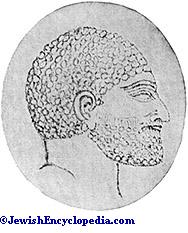
In Gen. xli. 14, Joseph's shaving does not belong to the Palestinian, but to the Egyptian, custom. The Egyptians of the higher classes shaved the Beard carefully; fashion allowing only sometimes a small tuft under the chin. The long, pointed chin-tuft of the primitive Egyptians (preserved among their Hamitic relatives, the Libyans and the inhabitants of Punt) was kept as an artificial Beard, tied to the chin on state occasions and at religious ceremonies. Of the other nations coming in contact with Israel, the Hittites and the Elamitic nations shaved the Beard completely, as the earliest Babylonians had done (in part?).
Bibliography:
Benzinger, Hebräische Archäologie, p. 110;
Nowack, Lehrbuch der Hebräischen Archäologie, p. 134;
W. M. Müller, Asien und Europa, pp. 296 et seq.
A. W. M. M.—In Rabbinical Literature:
That "the adornment of a man's face is his beard" (Shab. 152a) was a favorite saying among the Jews of Palestine in the second century of the common era; two centuries later, the expression "adornment of the face" was current among the Babylonian Jews as a designation for the Beard (B. M. 84a). Intercourse with Greeks and Romans during all this period had evidently not modified Semitic esteem for the Beard: indeed, it had rather the contrary effect; for it led to its consideration as something specifically Jewish (Baruch vi. 31). The Halakah, accordingly, occupied itself in early times with the subject, having reference to the precepts in Lev. xix. 27, xxi. 5. These passages were supposed to contain two prohibitions, the removal of the side-locks ("pe'ot") and the shaving of the Beard. As regards the former, some authorities prohibit not only the total removal of these locks, but even clipping them (see Pe'ot). Concerning the Beard, however, the Halakah only forbids its removal with a razor, and not even by this means except when the hair is removed smoothly and close to the roots (Misknah Mak iii. 5; Sifra, Ḳedoshim, vi.; ed. Weiss, 90c).
Beard of a Semite of the Upper Class.(From the tombs of the Beni-Hassan.)In Talmudic Times.
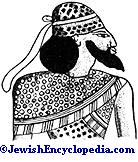
Jewish Envoy with Beard.(From the Black Obelisk of Shalmaneser II.)
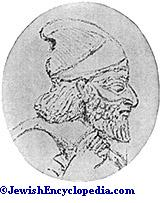
This modification of the actual Biblical prohibition was probably due to Jewish intercourse with the Greeks, as the regulation is expressly made by the Rabbis that any one having constant intercourse with the officers of the government might adopt the heathen tonsure, while to others it remained strictly forbidden (B. Ḳ. 83a). Eliezer b. Hyrcanus, the representative of the old Halakah, opposed this innovation (ib.; the reading "Elazar" is unsupported; compare Rabbinowicz, "Diḳduḳe Soferim," on the passage), and forbade any removal of the Beard whatever, either with forceps or with a cutting instrument. Some of the ancients explain a passage in the Tosefta (Ber. i. 4) as if its removal were the custom of a heretical sect in the second century (Tos. of Judah Ḥasid and Solomon b. Adret, on Ber. 11a). Although this passage admits of another explanation, Epiphanius ("Adversus Hæreses," lxx. 7; ed. Migne, ii. 765) mentions that a certain heretical sect regarded a shaven face as a religious essential. The "Apostolic Constitutions," i. 3, lay insistence upon the Biblical prohibition against the removal of the Beard, as does Clement of Alexandria ("Pædagogus," chap. iii.; ed. Migne, i. 580-592; compare Jerome on Ezek. xliv. 20), and the Jewish sages agree in basing the objectionto such removal on the ground that God gave man a Beard to distinguish him from woman, and that it is therefore wrong to antagonize nature (among Jewish commentators compare Baḥya and Abravanel on Lev. xix. 27). In Palestine, where a large Hellenic population resided, the clipping of the Beard (except in periods of mourning) seems to have been prevalent as early as the third century in learned circles of Jews, who probably respected the above-mentioned tannaite Halakah, while the uninformed people scarcely regarded the distinction between clipping and shaving (Yer. R. H. i. 57b).
Beard of an Assyrian King.(From Botta, "Monuments de Ninève.")
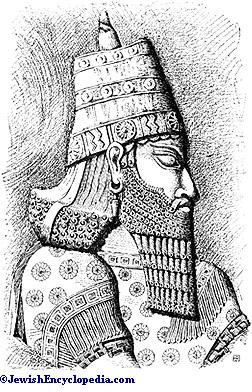
In Medieval Times.
In medieval times, as in the Talmudical period, the custom of the country seems to have been followed in regard to the Beard. In the East, among Mohammedan nations, the Jews wore long beards; in Germany, France, and Italy, it was entirely removed with scissors (Levi, "Tisporet Lulyanit," pp. 70, 71; Ḳimḥi to II Sam. x. 5; Asheri, Makkot iii., beginning; marginal gloss on the Tos. to Shab. 2b, quoted by Isserlein," Terumat ha-Deshen," p. 295; authoritative thus for the period from the twelfth to the fifteenth century). Scrupulous German rabbis, however, sought, as early as the fifteenth century, to forbid the cutting of the Beard, doubtless because the majority paid little attention to the strict letter of the Halakah, and, instead of cutting with the scissors, shaved smooth with a razor (Isserlein, l.c. p. 9). But this rigor was too much even for Isserles (Shulḥan 'Aruk, Yoreh De'ah, 181, 9).
The Cabalists succeeded where the Talmudists failed; they declared even the shortening of the Beard with scissors to be a great sin, and they related of their master, Isaac Luria, that he kept his hands from his Beard lest the contact should cause any hairs to drop from it (Judah Ashkenazi, "Baër Heṭeb," on Yoreh De'ah, l.c.). With the spread of Luria's Cabala in Poland and the Slavonic lands, any trimming of the Beard with scissors was gradually prohibited. The Italians, even the Italian Cabalists, still shaved, according to the custom of the land, one of them even going so far as to demonstrate cabalistically that shaving off the Beard was interdicted only in the Holy Land, and that elsewhere the opposite practise was rather to be recommended (Shabbethai Beër, "Responsa Beër 'Esheḳ," 670).
In Eastern lands the Jews, like their Mohammedan neighbors, did not cut their beards; and in 1720 this led to a violent controversy between Italian Jews who had settled for business purposes in Salonica, Turkey, and the rabbinate there, the latter insisting that the newcomers must wear their beards. The Italian rabbis, called into the discussion by their countrymen, could not decide the matter; for the further question was involved as to the obligation of sojourners to govern themselves by the rules of their temporary abiding-place (Joseph Ergas, "Dibre Yosef," No. 36, decides against the Italians; in their favor were S. Morpurgo and Mordecai Ẓahalon, in the first responsa collection, "Shemesh Ẓedaḳah," No. 61). This "cult of the Beard" had also its opponents, and among them was especially noticeable Joseph Solomon del Medigo, from whom, or from whose pupil, Moses b. Meir  (Metz?), the following epigram is extant:
"If men be judged wise by their beards and their girth, Then goats were the wisest of creatures on earth."
Head Showing Beard of a Judean from Egypt.(From Sayce, "Races of the Old Testament.")
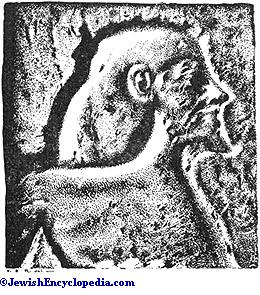
In the second half of the seventeenth century the practise arose among the Jews in Germany and Italy of removing the Beard by means of pumice-stone orchemical agents, which left the face smooth, as if shaven. This was strenuously, though no doubt vainly, opposed by two distinguished Talmudists of the time, the Polish rabbi Hillel b. Naphtali ("Bet Hillel," on Yoreh De'ah, 187) and the Italian Joseph b. Solomon Fiametta (quoted in his son-in-law's Responsa, "Shemesh Ẓedaḳah," No. 61, p. 102d). One of the questions constantly recurring in the responsa literature of the seventeenth and the eighteenth centuries concerns the clipping of the Beard on the "middle days" of the festivals ("Ḥol ha-Mo'ed"), because Talmudical law forbids the cutting of the hair on these days (see the responsa of the Amsterdam and Venetian rabbis in Moses Ḥages, "Leḳeṭ ha-Ḳemaḥ," on Yoreh De'ah, 138).
Beard as Worn by a Russian Jew.(From a photograph taken at Jerusalem by Bonfils.)Modern Views.
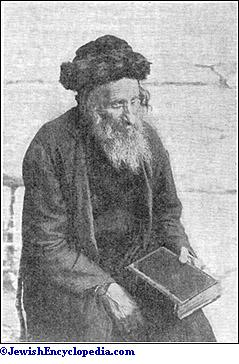
Trivial as all this question appears, it was important in the history of the Jewish Reform movement in Italy. Isaac Samuel Reggio published (Vienna, 1839) a pamphlet entitled "Ma'amar ha-Tiglaḥat, "in which he attempted to prove casuistically that the regulations of the Talmud concerning the cutting of the Beard on the "middle days" no longer had application, on account of the changed circumstances." This called forth the replies, "Tiglaḥat ha-Ma'amar" (Leghorn, 1839) by Abraham Ḥay Reggio and "Tisporet Lulyanit," by Jacob Ezekiel Levi (Berlin, 1839). In Italy the influence of the non-Jewish population was so strong that even so zealous a representative of rabbinical Judaism as Samuel David Luzzatto remarked in a private letter that he no longer concerned himself with the prohibition of shaving, because he thought the Bible intended it to apply only to priests. In Poland and in the Slavonic countries, attempts were made, toward the end of the eighteenth century, to evade the Biblical prohibition of shaving, much to the vexation of the leading Talmudists (Ezekiel Landau, "Nodi' bi-Yehuda," ii.; Yoreh De'ah, 80). Ḥasidism, which just then sprang up in those countries, restored the Beard to its former dignity; so that today, in all eastern Europe, the complete removal of the Beard is considered an evidence of a formal break with rabbinical Judaism (compare Smolenski, "Simḥat Ḥanef," ed. 1890, p. 46, and the Yiddish satire "Die Bord" in Michael Gordon, "Yüdische Lieder," p. 15). Special stress is laid upon the propriety of the ḥazan's wearing a Beard (Joel Sirkes, "Bet Ḥadash," on Ṭur Oraḥ Ḥayyim, 53; Shabbethai Beër, "Beër Sheba'," p. 107), with reference to an old Talmudical prescription dating from a period when the absence of a Beard was a sign of juvenility (Ḥul. 24b). The fourth council at Carthage (398) similarly decided "clericus nec comam nutriat, nec barbam radat" (the clergyman shall not let his hair grow, neither shall he remove his Beard); and even many centuries later, when the Church found it vain to oppose the removal of the Beard by the laity, it still insisted that the clerics should wear a Beard (Bingham, "Antiquities of the Christian Church," I. ii. 15, 16).
Popular imagination also has occupied itself with the Beard. The following saying, attributed to Ben Sirach, was current in Talmudical times: "A thinbearded man is cunning, a thick-bearded one is a fool; but nobody can do any harm to a man with a parted beard" (Sanh. 160b). The Talmud says of the Pharaoh of the Exodus, that his Beard was an ell in length (M. Ḳ. 18a).
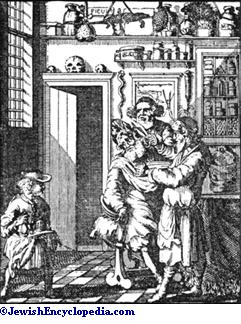
Beard-Trimming.(From Leusden, "Philologus Hebræo Mixtus," 1657.)
An oath upon the Beard and pe'ot is customaryamong the Polish Jews to-day, although generally employed in an ironical sense (compare Bernstein, in "Ha-Shaḥar," vi. 405).
BEARD.—See Hair.
The hair that grows on a man’s chin and cheek. Among the Jews and other Orientals the beard was cherished as a symbol of virility. It has been customary from early days for the clergy of the Latin Church to cut off or shave their beards. In the 16th and 17th centuries the contrary practise prevailed, and beards are now worn by the priests of the Eastern churches, both Uniat and Schismatic, by foreign missionaries, by certain religious like the Capuchins, and by individual priests for reasons of health.
(1) Western Semites in general, according to the monuments, wore full round beards, to which they evidently devoted great care. The nomads of the desert, in distinction from the settled Semites, wore a clipped and pointed beard (see Jer 9:26: “all that have the corners of their hair cut off, that dwell in the wilderness”; and compare Jer 25:23; Jer 49:32, etc.).
(2) Long beards are found on Assyrian and Babylonian monuments and sculptures as a mark of the highest aristocracy (compare Egyptian monuments, especially representations by W. Max Müller, Asien und Europa, 140). It is not clear that it was ever so with the Jews. Yet it is significant that the Hebrew “elder” (
(3) The view of some that it was customary among the Hebrews to shave the upper lip is considered by the best authorities as without foundation. The mustache (Hebrew
(4) In one case (1Sa 21:13, 1Sa 21:14) the neglect of the beard is set down as a sign of madness: “(He) let his spittle fall down upon his beard. Then said Achish,... Lo, ye see the man is mad.”
(5) It was common. Semitic custom to cut both hair and beard as a token of grief or distress. Isa 15:2, describing the heathen who have “gone up to the high places to weep,” says “Moab waileth over Nebo, and over Medeba; on all their heads is baldness, every beard is cut off.” Jeremiah (Jer 41:5), describing the grief of the men of Samaria for their slain governor, Gedaliah, says, “There came men from ... Samaria (his sorrowing subjects) even four score men, having their beards shaven and their clothes rent,” etc. And Amos, in his prophecy of the vision of the “basket of summer fruit” (Amo 8:1), makes Yahweh say to His people: “I will turn your feasts into mourning;... I will bring sackcloth upon all loins, and baldness upon every head” (Amo 8:10). On the other hand it was even more significant of great distress or fear to leave the beard untrimmed, as did Mephibosheth, the son of Saul, when he went to meet King David, in the crisis of his guilty failure to go up with the king according to his expectation: “He had neither dressed his feet, nor trimmed his beard, nor washed his clothes, from the day the king departed until the day he came home in peace.” (Compare 1Sa 21:13, 1Sa 21:14; 2Sa 19:24.)
(6) Absalom’s hair was cut only once a year, it would seem (2Sa 14:26; compare rules for priests, Levites, etc., Eze 44:20). But men then generally wore their hair longer than is customary or seemly with us (of Son 5:2, Son 5:11, “His locks are bushy, and black as a raven”). Later, in New Testament times, it was a disgrace for a man to wear long hair (1Co 11:6-15). To mutilate the beard of another was considered a great indignity (see 2Sa 10:4; compare Isa 50:6, “plucked off the hair”). The shaving of the head of a captive slave-girl who was to be married to her captor marked her change of condition and prospects (Deu 21:12; W. R. Smith, Kinship, 209).
Literature
Wilkinson, Ancient Egyptians, II, 324, 349; Herod. i.195; ii.36; iii.12; Josephus, Antiquities, VIII, viii, 3; XVI, viii, 1; W. R. Smith, Kinship, 209; RS, 324; Wellhausen, Skizzen, III, 167,