
See under BEAST.
That bears were common in Palestine appears from several passages of the Old Testament. Their strength, rapacity, and fierceness, furnish many expressive metaphors to the Hebrew poets. The Hebrew name of this animal is taken from his growling; so Varro deduces his Latin name ursus by an onomatopaeia from the noise which he makes; “ursi Lucana origo, vel unde illi, nostri ab ipsius voce:” [the origin of the term ursus (bear) is Lucanian, (whence also the bears themselves,) from the noise made by the animal.] David had to defend his flock against bears as well as lions, 1Sa 17:34. And Dr. Shaw gives us to understand that these rugged animals are not peculiar to the bleak regions of the north, being found in Barbary; and Thevenot informs us that they inhabit the wilderness adjoining the Holy Land, and that he saw one near the northern extremities of the Red Sea. The ferocity of the bear, especially when hungry or robbed of its whelps, has been mentioned by many authors. The Scripture alludes in three places to this furious disposition. The first is, 2Sa 17:8, “They be mighty men, and they be chafed in their minds as a bear robbed of her whelps in the field.” The second, Pro 17:12, “Let a bear robbed of her whelps meet a man rather than a fool in his folly.” And the third, Hos 13:8, “I will meet them as a bear that is bereaved of her whelps, and will rend the caul of their heart.”
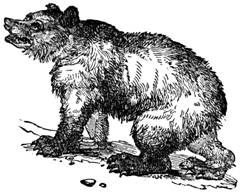
Fig. 86—Syrian Bear
Bear is noticed in 1Sa 17:34; 1Sa 17:36-37; 2Sa 17:8; 2Ki 2:24; Pro 17:12; Pro 28:15; Isa 11:7; Lam 3:10; Hos 13:8; Amo 5:19, etc. The genus Ursus is the largest of all the plantigrade carnassiers, and with the faculty of subsisting on fruit or honey unites a greater or less propensity, according to the species, to slaughter and animal food. To a sullen and ferocious disposition it joins immense strength, little vulnerability, considerable sagacity, and the power of climbing trees. The brown bear, Ursus arctos, is the most sanguinary of the species of the Old Continent, and Ursus Syriacus, or the bear of Palestine, is one very nearly allied to it, differing only in the stature being proportionally lower and longer, the head and tail more prolonged, and the color a dull buff or light bay, often clouded, like the Pyrenean variety, with darker brown. On the back there is a ridge of long semi-erect hairs running from the neck to the tail. It is still found in the elevated woody parts of Lebanon.
That bears were common in Palestine appears from several passages in the Old Testament, 1Sa 17:34,36,37 ; 2Sa 17:8 ; 2Ki 2:24 . The species known in Syria resembles the common brown bear; it is sill met in the recesses of Lebanon. To a sullen and ferocious disposition, the bear joins immense strength, considerable sagacity, and the power of climbing trees. Her ferocity, especially when her young are injured, is proverbial. See 2Sa 17:8 ; Pro 17:12 ; Isa 11:7 ; Hos 13:8 .\par
Bear. 1Sa 17:34; 2Sa 17:8. The Syrian bear, Ursus syriacus, which is, without doubt, the animal mentioned in the Bible, is still found on the higher mountains of Palestine. During the summer months, these bears keep to the snowy parts of Lebanon, but descend, in winter, to the villages and gardens. It is probable, also, that at this period, in former days, they extended their visits to other parts of Palestine.
The
It attacks flocks and cattle (1Sa 17:34-37; Isa 11:7). Its roaring, ranging widely for food, and lying in wait for its prey, are alluded to in Isa 59:11, where however translate, "We moan like (hungry) bears," growling for food (Pro 28:15; Lam 3:10). It was carnivorous. Dan 7:5; "it raised up itself on one side," lying on one of its fore feet and standing on the other; a figure still to be seen in Babylonian monuments, but see margin. Persia is meant. Media was the lower and passive side; Persia, the upper and active. It had three ribs in its mouth, namely, it seized on Babylon, Lydia, and Egypt. From a Hebrew root, "to move by creeping":
(
The genus Ursus is the largest of all the plantigrade carnassiers, and with the faculty of subsisting on fruit or honey unites a greater or less propensity, according to the species, to slaughter and animal food. To a sullen and ferocious disposition it joins immense strength, little vulnerability, considerable sagacity, and the power of climbing trees. The brown bear, Ursus arctos, is the most sanguinary of the species of the Old Continent, and Ursus Syriacus, or the bear of Palestine, is one very nearly allied to it, differing only in its stature being proportionably lower and longer, the head and tail more prolonged, and the color a dull buff or light bay, often clouded, like the Pyrenaean variety, with darker brown (Forskal, Descr. Anim. 4, 5, No. 21). On the back there is a ridge of long semi-erect hairs running from the neck to the tail. It is yet found in the elevated woody parts of Lebanon (Kitto, Phys. Hist. of Palest. p. 355). In the time of the first Crusades these beasts were still numerous and of considerable ferocity; for during the siege of Antioch, Godfrey of Bouillon, according to Math. Paris, slew one in defense of a poor woodcutter, and was himself dangerously wounded in the encounter. See Penny Cyclopedia, s.v.
The sacred writers frequently associate this formidable animal with the king of the forest, as being equally dangerous and destructive; and it is thus that the prophet Amos sets before his countrymen the succession of calamities which, under the just judgment of God, was to befall them, declaring that the removal of one would but leave another equally grievous (5:18, 19). Solomon, who had closely studied the character of the several individuals of the animal kingdom, compares an unprincipled and wicked ruler to these creatures (Pro 28:15). To the fury of the female bear when robbed of her young there are several striking allusions in Scripture (2Sa 17:8; Pro 17:12). The Divine threatening in consequence of the numerous and aggravated iniquities of the kingdom of Israel, as uttered by the prophet Hosea, is thus forcibly expressed: “I will meet them as a bear bereaved of her whelps” (Hos 13:8; see Jerome in loc.), which was fulfilled by the invasion of the Assyrians and the complete subversion of the kingdom of Israel. “The she-bear is said to be even more fierce and terrible than the male, especially after she has cubbed, and her furious passions are never more fiercely exhibited than when she is deprived of her young. When she returns to her den and misses the object of her love and care, she becomes almost frantic with rage. Disregarding every consideration of danger to herself, she attacks with great ferocity every animal that comes in her way, and in the bitterness of her heart will dare to attack even a band of armed men. The Russians of Kamtschatka never venture to fire on a young bear when the mother is near; for if the cub drop, she becomes enraged to a degree little short of madness, and if she get sight of the enemy will only quit her revenge with her life. A more desperate attempt can scarcely be performed than to carry off her young in her absence. Her scent enables her to track the plunderer; and unless he has reached some place of safety before the infuriated animal overtake him, his only safety is in dropping one of the cubs and continuing his flight; for the mother, attentive to its safety, carries it home to her den before she renews the pursuit” (Cook’s Voyages, 3, 307).
In the vision of Daniel, where the four great monarchies of antiquity are symbolized by different beasts, of prey, whose qualities resembled the character of these several states, the Medo-Persian empire is represented by a bear, which raised itself up on one side, and had between its teeth three ribs, and they said thus unto it, “Arise, devour much flesh” (7, 5). All the four monarchies agreed in their fierceness and rapacity; but there were several striking differences in the subordinate features of their character and their mode of operation, which is clearly intimated by the different character of their symbolical representatives. The Persian monarchy is represented by a bear to denote its cruelty and greediness after blood. Bochart has enumerated several points of resemblance between the character of the Medo-Persians and the disposition of the bear (Hieroz. 1, 806 sq.). The variety of the Asiatic bear which inhabits the Himalayas is especially ferocious, and it is probable that the same species among the mountains of Armenia is the animal here referred to. The beast with seven heads and ten horns (Rev 13:2) is described as having the feet of a bear. The bear’s feet are his best weapons, with which he fights, either striking or embracing his antagonist in order to squeeze him to death, or to trample him under foot.
For the constellation Ursa Major, or “the Great Bear,” SEE ASTRONOMY.
Bear. Pro 17:12. The Syrian bear seems but a variety of the brown bear of Europe and Asia, though it is much lighter in color. Its food is seeds, fruits, and roots, to which it occasionally adds a goat or sheep.
dob,
In Dan 7:5 the Medo-Persian kingdom was compared to a bear, with three ribs in its mouth; and to it was said, "Arise, devour much flesh." In Rev 13:2 the beast that represents the still future Roman empire is described as being like a leopard, with feet as the feet of a bear, showing its destructive character, for it is by the strength of its feet the bear destroys its prey by tearing it open.
By: Morris Jastrow, Jr., Immanuel Benzinger
 ("dob"): An animal often mentioned in the Old Testament, and evidently not rare in Palestine and Syria. Next to the lion, the Bear is regarded as the most formidable enemy of mankind (Amos v. 19), although he must be very hungry to attack man without provocation. The protection of his flock from the lions and bears constitutes the shepherd's most difficult task (I Sam. xvii. 34). The prophet can therefore appropriately use the metaphor of "the cow and the bear feeding together," as an emblem of the profound peace of Messianic times (Isa. xi. 7). The tender love of the female Bear for her cubs was well known to the Hebrews. A female Bear that has been robbed of her young is the picture of ungovernable wrath (II Sam. xvii. 8; Prov. xvii. 12; Hosea xiii. 8). In the apocalypse of Daniel (vii. 5) the Bear, on account of its greediness, is represented as a symbol of the Median empire, greedy for lands. At the present time the Bear is extinct in Palestine proper, and is only occasionally met with in the Lebanon district.
The Syrian Bear (Ursus Syriacus) is distinguished from the ordinary type of brown Bear by a somewhat lighter color and an appreciably smaller stature. The brown Bear is found almost every where in the north temperate zone.
Bibliography:
Tristram, Natural History of the Bible, p. 46;
Wood, Animals of the Bible, pp. 28-31.
BEAR (dôb).—The Syrian bear (Ursus syriacus, Arab.
E. W. G. Masterman.
Saint Aventinus
Saint Columbanus
Saint Corbinian
because of incidents connected with bears.
Pro 28:15 (b) This is a type of a wicked king, or an ungodly master who rules his people with cruel rigor and indicates no feeling in regard to the sufferings which he causes.
Dan 7:5 (b) This animal is used as a type of the Medo-Persian empire which was the second great world kingdom to appear following the fall of Babylon. The bear raising itself on one side indicated that one of this dual empire was to prevail - the Median. The three ribs probably refer to the three great kings who had gone before, but now had been destroyed; Nebuchadnezzar, his son, and his grandson, Belshazzar.
Rev 13:2 (b) This bear is a type of the anti-Christ who will work quickly, slyly, smoothly, quietly and apparently with no anger or hatred even as a bear which seems to be docile upon first observance.
Bear. In Old Testament times, bears were a threat to man and beast. They ate honey, fruit, and livestock; so they harmed both crops and herds. Bears are easily angered, and the Asian black bear is exceptionally fierce. This bear is prone to attack man, with or without provocation, as did the two female bears that mauled the boys who taunted the prophet Elisha (2Ki 2:24). It was a mark of David’s courage that he killed a bear that stole from his flock (1Sa 17:34-37).
A bear "robbed of her cubs" (2Sa 17:8) was legendary because of her fierceness. Since bears are rather clumsy, they sometimes lie in ambush, waiting for prey to come to them (Lam 3:10). The era of peace shall arrive when, as (Isa 11:7) predicts, "the cow and the bear shall graze" side by side.