
There are several words in the Hebrew Scriptures by which different kinds of baskets appear to be indicated:—
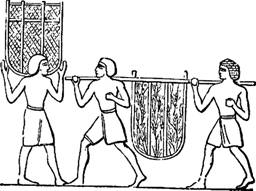
Fig. 83—Large Baskets
1. Dud which occurs in 2Ki 10:7, where the heads of Ahab’s sons are sent from Samaria to Jezreel in baskets; Jer 24:2, as containing figs; and Psa 81:6 (rendered pots), also as containing figs; where, therefore, deliverance from the baskets means deliverance from the bondage of carrying burdens in baskets. In fact, very heavy burdens were thus carried in Egypt, its corn in very large baskets from the field to the threshing-floor, and from the threshing-floor to the granaries. They were carried between two men by a pole resting on their shoulders; which agrees with the previous clause of the cited text, ’I removed his shoulder from the burden.’ This labor and form of the basket are often shown in the Egyptian sculptures.
2. Teba, which occurs in connection with agricultural objects, ’the basket and the store’ (Deu 26:2-4; Deu 28:5-17), and would therefore appear to have been somewhat similar to the above; and, in fact, the Egyptian sculptures show different baskets applied to this use.
3. Kelub. From the etymology, this appears to have been an interwoven basket, made of leaves or rushes. In Jer 5:27, however, it is used for a bird-cage, which must have been of open work, and probably not unlike our own wicker bird-cages. The name is also applied to fruit-baskets (Amo 8:1-2), Egyptian examples of which are presented in #2 and #4 (which contain pomegranates) of the annexed figure.
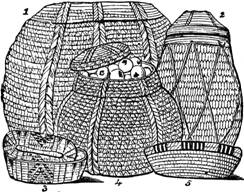
Fig. 84—Ancient Egyptian baskets
4. Salsilloth, occurs only in Jer 6:9, where it obviously denotes baskets in which grapes were deposited as they were gathered. The form of the baskets used for this purpose is often shown on the Egyptian monuments, and is similar to that represented in #4 of the above fig. 84.
5. In all the other places where the word basket occurs, we are doubtless to understand a basket made of rushes, similar both in form and material to those used by carpenters for carrying their tools. This is still the common kind of basket throughout Western Asia; and its use in ancient Egypt is shown by an actual specimen which was found in a tomb at Thebes, and which is now in the British Museum. It was, in fact, a carpenter’s basket, and contained his tools ( #1, see fig. 84).
The specimens of Egyptian baskets in the British Museum, represented in fig. 84, convey a favorable idea of the basket-work of ancient times. Some of these are worked ornamentally with colors (#3, #5, see fig. 84). And besides these the monuments exhibit a large variety of hand-baskets, of different shapes, and so extensively employed as to show the numerous applications of basket-work in the remote times to which these representations extend. They are mostly manufactured, the stronger and larger sorts of the fibers, and the finer of the leaves of the palm-tree, and not infrequently of rushes, but more seldom of reeds.
Basket. The Hebrew terms, used in the description of this article, are as follows:
(1) Sal, so called from the twigs of which it was originally made, specially used for holding bread. Gen 40:16 ff. Exo 29:3; Exo 29:23; Lev 8:2; Lev 8:26; Lev 8:31; Num 6:15; Num 6:17; Num 6:19.
(2) Salsilloth, a word of kindred origin, applied to the basket used in gathering grapes. Jer 6:9.
(3) Tene, in which the first-fruits of the harvest were presented. Deu 26:2; Deu 26:4.
(4) Celub, so called from its similarity to a bird-cage.
(5) Dud, used for carrying fruit, Jer 24:1-2, as well as, on a larger scale, for carrying clay to the brick-yard, Psa 81:6, (pots, Authorized Version), or for holding bulky articles. 2Ki 10:7. In the New Testament, baskets are described under three different terms.
Gen 40:16; "I had three white (margin ’full of holes,’ i.e. of open work, or rather ’baskets of white bread’) baskets on my head." The Bible accurately represents Egyptian custom (Herodotus, 2:35), whereby men carried burdens on the head, women on the shoulders. In the distinct miracles of feeding the 5,000 and the 4,000 the KJV uses the stone term "baskets" for distinct Greek words. In Mat 14:20; Mar 6:43; Luk 9:17; Joh 6:13, the disciples took up twelve
Thus also in referring back to the miracle (Mat 16:9-10) Jesus says: "Do ye not ... remember the five loaves of the 5,000, and how many
The coincidence is so undesigned that it escaped our translators altogether; it therefore can only be the result of genuineness and truth in the different evangelists’ accounts. In traveling through Samaria or Gentile regions the Jews used
the rendering in the Auth. Vers. of the following words:
1. SAL,
2. SALSILLOTH’.
In the N.T. baskets are described under the three following terms,
Various Hebrew words are translated ’basket,’ and doubtless the size, shape and strength varied according to the purpose for which they were intended. In the N.T. there are three Greek words used:
BASKET.—All four Evangelists, in narrating the miracle of the feeding of the five thousand, describe the baskets in which the fragments were placed as
‘Basket’ occurs in the Authorized and Revised Versions Gospels in the above passages only. The older English versions use the confusing rendering of ‘baskets’ for both words, except that Wyclif has ‘coffyns’ and ‘leepis.’ By ‘coffyn’ he evidently meant a small basket. Rheims renders
(2)
As
One might ask whether the
George Farmer.
BASKET.—The names of a round score of baskets in use in NT times are known from the Mishna (see Krengel, Das Hausgerät in der Mishnah, pp. 39–45). They were made of willow, rush, palm-leaf, and other materials, and used in an endless variety of ways, for purely domestic purposes, in agriculture, in gathering and serving fruit, and for collecting the alms in kind for the poor, etc. Some had handles, others lids, some had both, others had neither. In OT times the commonest basket was the sal, made, at least in later times, of peeled willows or palm-leaves. It was large and flat like the Roman canistrum, and, like it, was used for carrying bread (Gen 40:16 ff.) and other articles of food (Jdg 6:19), and for presenting the meal-offerings at the sanctuary (Exo 29:3). Another (dûd), also of wicker-work, probably resembled the calathus, which tapered towards the bottom, and was used in fruit-gathering (Jer 24:1). In what respect it differed from Amos’ ‘basket of summer fruit’ (Amo 8:1) is unknown. A fourth and larger variety was employed for carrying home the produce of the fields (Deu 28:5 ‘blessed shall be thy basket and thy kneading-trough,’ RV
In NT interest centres in the two varieties of basket distinguished consistently by the Evangelists in their accounts of the feeding of the 5000 and the 4000 respectively, the kophinos and the sphyris. The kophinos (Mat 14:20) is probably to be identified with the exceedingly popular kûphâ of the Mishna, which ‘was provided with a cord for a handle by means of which it was usually carried on the back’ (Krengel), with provisions, etc., and which, therefore, the disciples would naturally have with them. The Jews of Juvenal’s day carried such a provision basket (cophinus). The sphyris or spyris (Mat 15:37, Mar 8:8), from its use in St. Paul’s case (Act 9:25), must have been considerably larger than the other, and might for distinction be rendered ‘hamper.’
A. R. S. Kennedy.
1. Meaning of Old Testament Terms
(1)
(2) The commonest basket in use in Old Testament times was the
(3) The
(4) The term
2. Meaning of New Testament Terms
In the New Testament interest centers in two kinds of “basket,” distinguished by the evangelists in their accounts of the feeding of the 5,000 and of the 4,000, called in Greek
(1) The
(2) The
(3) The
Two different words for ‘basket’ are used in connexion with St. Paul’s escape from Damascus, one, óöõñßò or óðõñßò (Act_9:25), being the same as is found in the miracle of feeding the 4000 (Mat_15:37, Mar_8:8), the other, óáñãÜíç, being peculiar to the Apostle’s own version of the incident (2Co_11:33). The former kind of basket plays an important part in relation to the miracles of feeding, and the argument for its larger size as compared with êüöéíïò is supported by a reference to its use in facilitating St. Paul’s escape (but see Dict. of Christ and the Gospels , article ‘Basket’). The latter calls for detailed treatment here. It has been thought of: (1) as flexible, coming near the idea of reticule or net; (2) as rigid: either braid-work (used especially of fish-baskets [Encyclopaedia Biblica ]), or wicker-work. This last seems to be nearest the truth. In Jewish usage the root ñøð (ñøø) attaches to weaving in the rigid form (e.g. basket-making) as opposed to the flexible (e.g. spinning). One species of work-stool is called ñøðéï. The basket-making industry was located in the neighbourhood of the Sea of Galilee, with headquarters at Scythopolis, and a ready outlet for the manufactured article was found in Damascus (see S. Krauss, Talmud. Archäologie, ii. [Leipzig, 1911] 269f., where many kinds are specified).
In the absence of knowledge as to the nature and size of the window (èõñßò), and other details of St. Paul’s escape, we cannot hope to attain to a precise result regarding the structure of the óáñãÜíç. It need not be said that present-day tradition’s in Damascus are of little value. Only the lower half of the wall dates possibly from NT times (see Encyclopaedia Biblica , article ‘Damascus’). For the device of letting a person down through a window, see Jos_2:15 and 1Sa_19:12; cf. also Josephus, Bellum Judaicum (Josephus) i. xvi. 4.
W. Cruickshank.
Deu 28:5 (c) Moses is telling us that GOD will give abundant increase for us to take home to ourselves and enjoy for ourselves if we let the Lord GOD command us, and if we give obedient service.
Deu 28:17 (c) Here we find the opposite truth expressed, for if we refuse to listen to GOD, and to walk with Him, we shall find that GOD withholds the blessing, and leaves us with empty hands and desolate hearts.
Jer 6:9 (b) The figure here is that of the enemy who invades the land and gathers into his own possession the persons and the properties of disobedient Israel.