
(Gr.
Our only reason for mentioning all this is of course the presupposition that the Palestinian balsam is named in the Bible also, and, indeed, the bosem (
It contains a fat, oily kernel, from which the Arabs press an oil highly esteemed for its medicinal properties, especially for open wounds (Maundrell, in Paulus, Samml. 1, 110; Mariti, Trav. p. 415; Troilo, Trav. p. 107A. That this tree grows in Palestine, especially in the environs of Jericho, we are told not only by modern travelers (Hasselquist, Voyages, p. 150; Arvieux, 2:155; Pococke, East, 2:47 sq.; Volney, Voyages, 2:240; Robinson, 2:291), but even by Josephus (War, 4:8, 3). We must admit, however, that the Hebrew name tseri seems to imply rather a resin trickling from some plant than a pressed oil, and that the arguments of Rosenmüller in favor of his statement, that the Mecca balsam is a mere perfume and not a medicine, have not much weight (see Gesenius, Thes. 3, 1185). Our physicians make, indeed, no medicinal use of it; but we can never obtain the genuine Mecca balsam. The ancients certainly ascribed medicinal powers to the balsam (see Dioscor. ut sup.), and it is considered even at present as a medicine of well-attested quality, especially if applied externally (Prosp. Alpin. Rer. Eg. 3, 15, p. 192; Hasselquist, p. 565, “rescivi quod vulnerarium Turcis sit excellentissimum et palmarium, dum in vulnera recens inflicta guttas aliquot infundunt quo continuato brevissimo tempore vulnera maximi momenti persanant”). The tseri, therefore, might have been the balsam, and if so, the shrub, which originally grew in Gilead, may have been transplanted and cultivated as a garden-plant on the plains of Jericho, and preserved only there. We greatly doubt, however, whether the balsam shrub ever grew wild anywhere but in Arabia, and it seems to us more probable that it was brought from Arabia to Palestine, though, perhaps, not by the Queen of Sheba (Josephus, Ant. 8:6, 6). Besides the tseri (
By: Morris Jastrow, Jr., Ira Maurice Price, Marcus Jastrow, Kaufmann Kohler
Table of Contents
—In Hellenistic and Rabbinical Literature:
Word used as the translation (R. V., margin) of the Hebrew  (Cant. v. 1) and of
 (ib. v. 13, vi. 2), for which the A. V. has "spice." An aromatic gum or spice, probably the product of a Balsam tree or plant. The Balsam tree of Jericho is noted among ancient writers—Theophrastus, Strabo, Pliny—for its medicinal and highly agreeable aromatic qualities. The so-called Mecca Balsam is generally conceded to be the product of the Balsamodendron opobalsamum. It is reported that the Balsam has disappeared from Jericho. The product of the Balsam is known in Arabic as balasân from a balasân tree, from which balsamon (Greek), balsamum, balsam, and balm are probably derived. The so-called "balm of Gilead"—made by the monks of Jericho and sold to travelers to-day—is a product of the Balanites Ægyptiaca. See Balm.
—In Hellenistic and Rabbinical Literature:
Balm or Balsam (Aramean,  ,
,  , and for opobalsamum
  and
and  ), called by Pliny ("Naturalis Historia," xii. 53) "a plant which nature has bestowed only upon the land of Judea," was cultivated especially in what Pliny (l.c.) and Strabo (p. 763) call the royal gardens near Jericho (
 , Tosef., 'Ar. ii. 8), the juice obtained by incision being used for medicinal purposes, and the wood for its fragrant odor. According to Diodorus Siculus (ii. 48, xix. 98), a certain hollow in the neighborhood of the Dead Sea was the chief home of the Balsam, which was "found nowhere else in the world." Both statements are confirmed by Josephus, who relates that, according to popular belief, Queen Sheba brought the root from Arabia to King Solomon as a gift, and that the Balsam trees of Jericho yielded the most precious products of the land, the "only balsam in the world," thus making that part most valuable as a royal revenue; wherefore Antony took it away from the Jews and gave it to Cleopatra ("Ant." viii. 6, § 6; xv. 4, § 2; "B. J." i. 6, § 6; 18, § 5; iv. 8, § 3). In "Ant." ix. 1, § 2, he speaks of the opobalsamum that grows at Engedi.
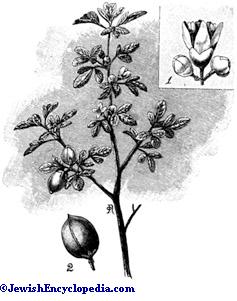
The Balsam Plant, Showing the Flower (1) and Fruit (2).
The words in Jer. lii. 16, "Nebuzar-adan, the captain of the guard, left the poor of the land to be vine-dressers and husbandmen," are referred, in Shab. 26a, to the gatherers of the opobalsamum in the neighborhood of Engedi and Ramata. Jerome also, in his commentary to Cant. i. 14, refers the "vineyards" there mentioned to the Balsam plantations of Engedi (compare Eusebius, "Onomasticon," s.v. "Engedi"). With what feeling the Romans looked upon the Balsam of Judea may be learned from the fact that Vespasian and Titus exhibited the Balsam shrub of Judea as one of the trophies at their triumphal procession (Pliny, l.c.); but no less characteristic are the rabbinical ordinances: "Blessed be the Lord who has created fragrant trees," recited only over either the opobalsam belonging to the house of Rabbi Judah of Tiberius or the one belonging to the imperial house of Rome; and the benediction recited over the oil of the opobalsam: "Blessed be the Lord who created the (fragrant) oil of our land," or, according to one authority, simply "fragrant oil" (Ber. 43a; see Rashi, l.c., and Musafia to 'Aruk, s.v.  , where the name "Jericho," as the home of the Balsam, is combined with the noun "reaḥ"=fragrant odor). Many passages in the Talmud and Midrash mention opobalsam (
 ) as used for the anointment of kings (Yer. Soṭah viii. 22c), or as an alluring ointment employed by the frivolous women of Jerusalem (Lam. R. to iv. 15), or as a merchandise (Yoma 39a), or by thieves as a means of scenting the strong boxes of rich people (Sanh. 109a), or as carried about in a flask (Gen. R. xxx., xxxix., and elsewhere); and there is also special mention of streams of opobalsam oil which flow for the enjoyment of the righteous in the world to come (Yer. 'Ab. Zarah iii. 42c; Ta'anit 25a; compare Apoc. Paul xxiii., xxviii.).
Bibliography:
Cheyne and Black, Encyc. Bibl. s. v. Balm;
Winer, B. R. s. v.
BALSAM.—See Spice.
An aromatic resin from the terebinth tree and other plants; it is mixed with the olive oil which is blessed as the Holy Chrism. It symbolizes the sweet odor of virtue.
Balsam is an oily, resinous, and odorous substance, which flows spontaneously or by incision from certain plants, and which the Church mixes with olive oil for use as chrism. Balsams are very widely distributed throughout the plant kingdom, being particularly abundant in the pine family, but the name is generally restricted in the present day to resins which in addition to a volatile oil contain benzoic and cinnamic acid. Among the true balsams are the Balm of Gilead, or Mecca, which is cultivated in Arabia, Egypt, Syria, etc., and is extremely costly; the copaiva balsam, and those of Peru and Tolu — all three found chiefly in South America. The term balsam, however, is also applied to many pharmaceutical preparations and resinous substances which possess a balsamic odour.The practice of the Church of using balsam, as mentioned above, is very ancient, going back possibly to Apostolic times. (See CHRISM.) The scarcity and high price of other perfumes has obliged the Latin Church to be content with balm alone in the mixture of holy chrism; but in the East, where the climate is more favourable than ours to the growth of these plants, the Church uses no less than thirty-six species of precious perfumes, according to the Euchologion, in the oil, which makes it an ointment of exquisite fragrance. The Latin Church does not insist on the quantity or the quality of the balsam to be used; any substance commonly known as a balsam may be utilized, and such a quantity as will give its odour to the oil is sufficient. This mingling of the balsam with the oil is intended to convey, by outward sign, the good odour of Christ, of whom it is written (Cantic., i, 3): "We will run after thee to the odour of thy ointments." It typifies also the odour of good works, the thought which ought to inspire those who worthily receive the sacraments; and it symbolizes an innocent life and the gifts of the Holy Spirit.The balsam is blessed by the bishop at the Mass which he solemnly celebrates on Holy Thursday and is poured into the oil after he has administered Holy Communion to the faithful. The cruet of balsam is brought by a subdeacon to the assistant priest, who in turn places it on a table in the sanctuary before the bishop. The latter blesses the balsam, reciting over it the three prayers found in the Roman Pontifical: he calls it the fragrant tear of dry bark — the oozing of a favoured branch that gives us the priestly unction. Later he mixes the balsam with a little oil on a paten and pours it into the chrism with a suitable invocation: "May this mixture of liquors be to those who shall be anointed with it, a propitiation and a salutary protection for ever and ever. Amen."In the early ages the pope, without using any form, as appears from the Roman Ordines, poured the balsam into the oil, while still in the sacristy before Mass (Ordo Romanus, X, n. 3; P. L. , LXXVIII, 1010.), but the blessing took place after the Communion of the pope, and before that of the clergy and the faithful (Duchesne, Christian Worship, 2d Eng. ed., 305, 306, 467). According to the Gregorian Sacramentary (Muratori, ed., P. L., LXXVIII, 330), however, the pope mixes the balsam and oil during the Mass. In the Church of Soissons in France, at one time, the "Veni Creator" was sung before the mingling of the balsam and oil.-----------------------------------MÖHLER in Kirchenlex.ANDREW B. MEEHAN. Transcribed by Douglas J. Potter Dedicated to the Immaculate Heart of the Blessed Virgin Mary The Catholic Encyclopedia, Volume IICopyright © 1907 by Robert Appleton CompanyOnline Edition Copyright © 2003 by K. KnightImprimatur. +John M. Farley, Archbishop of New York
Balsam. A thorny tree growing 3 to 5 meters (10-15 feet) tall with clusters of green flowers, also known as the Jericho balsam. Some think the lentisk or mastic tree, a shrubby evergreen growing one to three meters (3-10 feet) tall, is meant.
Balsam was highly valued during Bible times ( Gen 37:25; Gen 43:11; Jer 8:22; Jer 46:11; Jer 51:8; Eze 27:17). It produced a fragrant, resinous gum called balm. This was an article of export ( Gen 37:25) and was given as a gift by Jacob ( Gen 43:11). Balm was used as a symbol in ( Jer 8:22) to refer to spiritual healing.