
Babylo´nia (so called from the name of its chief city, termed also Chaldea, from those who at a later period inhabited it), a province of Middle Asia, bordered on the north by Mesopotamia, on the east by the Tigris, on the south by the Persian Gulf, and on the west by the Arabian Desert. On the north it begins at the point where the Euphrates and Tigris approach each other, and extends to their common outlet in the Persian Gulf, pretty nearly comprising the country now designated Iraq Arabi. The climate is temperate and salubrious. The country in ancient times was very prolific, especially in corn and palms. Timber-trees it did not produce. Many parts had springs of naphtha. As rain is infrequent, even in the winter months, the country owes its fruitfulness to the annual overflow of the Euphrates and the Tigris, whose waters are conveyed over the land by means of canals.
The alluvial plains of Babylonia, Chaldea, and Susiana, including all the river, lake, and newer marine deposits at the head of the Persian Gulf, occupy an extent of about 32,400 square geographic miles. The rivers are the Euphrates and its tributaries, the Tigris and its tributaries, the Kerah, the Karun and its tributaries, the Jerahi, and the Idiyan; constituting, altogether, a vast hydrographical basin of 189,200 geographic square miles; containing, within itself, a central deposit of 32,400 miles of alluvium, almost entirely brought down by the waters of the various rivers, and which have been accumulating from periods long antecedent to all historical records. The modern accumulation of soil in Babylonia from annual inundations is still very great. Several canals convey water at certain seasons of the year from one river and part of the country to another. In general, the alluvium that is brought down by canals and rivulets, and deposited at their mouths, is a fine clay. The great extent of the plain of Babylonia is everywhere altered by artificial works. There is still some cultivation and some irrigation. Flocks pasture in meadows of coarse grasses; the Arabs’ dusky encampments are met with here and there; but, except on the banks of the Euphrates, there are few remains of the date-groves, the vineyards, and the gardens which adorned the same land in the days of Artaxerxes; and still less of the population and labor which must have made a garden of such soil in the time of Nebuchadnezzar. The vegetation of these tracts is characterized by the usual saline plants, the river banks being fringed by shrubberies of tamarisk and acacia, and occasional groves of a poplar which has been mistaken for a willow.
The Euphrates is still a majestic stream, but wanders through a dreary solitude. Its banks are hoary with reeds, and the grey osier-willows are yet there on which the captives of Israel hung up their harps, and, while Jerusalem was not, refused to be comforted. According to Rennel its breadth at Babylon is about 491 English feet. Rich ascertained its depth to be 2½ fathoms, and that the current runs gently at the medium rate of about two knots an hour. The Euphrates is far less rapid than the Tigris, and rises at an earlier period. When at its height—from the latter end of April to the latter end of June—it overflows the surrounding country. The ruins of Babylon are then so inundated as to render many parts of them inaccessible. The course of the river through the site of Babylon is north and south. During the three great empires of the East, no tract of the whole appears to have been so reputed for fertility and riches as the district of Babylonia, which arose in the main from the proper management of the mighty river which flowed through it. But the abundance of the country has vanished as clean away as if ’the besom of desolation’ had swept it from north to south; the whole land, from the outskirts of Bagdad to the farthest reach of sight, lying a melancholy waste.
In order to defend the country against hostile attacks from its neighbors, northward from Babylon, between the two rivers, a wall was built, which is known under the name of the Median Wall. The Babylonians were famous for the manufacture of cloth and carpets: they also excelled in making perfumes, in carving in wood, and in working in precious stones. They were a commercial as well as a manufacturing people, and carried on a very extensive trade alike by land and by sea. Babylon was indeed a commercial depot between the Eastern and the Western worlds (Eze 17:4; Isa 43:14). Thus favored by nature and aided by art, Babylonia became the first abode of social order and the cradle of civilization.
The original inhabitants were without doubt of the Shemitic family; and their language belonged to the class of tongues spoken by that race, particularly to the Aramaic branch, and was indeed a dialect similar to that which is now called Chaldee.
From the account which is found in Gen 10:8, Nimrod, the son of Cush, appears to have founded the kingdom of Babylon, and to have been its first sovereign. In Gen 14:1, Amraphel is cursorily mentioned as king of Shinar. In the reign of Hezekiah (B.C. 713)—2Ki 20:12—’Berodach-baladan, the son of Baladan,’ was ’king of Babylon,’ and ’sent letters and a present unto Hezekiah, for he had heard that Hezekiah had been sick.’ About a hundred years later, Jeremiah and Habakkuk speak of the invasion of the Babylonians under the name of the Chaldeans; and now Nebuchadnezzar appears in the historical books (2Ki 24:1, sq.; Jer 36:9; Jer 36:27) as head of the all-subduing empire of Babylon. Evilmerodach (2Ki 25:27; Jer 52:31), son of the preceding, is also mentioned as ’king of Babylon;’ and with Belshazzar (Dan 5:1; Dan 5:30) the line of the Chaldean kings was closed: he perished in the conquest of Babylon by the Medo-Persians (Dan 5:31), ’and Darius, the Median, took the kingdom.’
The domination of the Chaldeans in Babylon has given historians some trouble to explain. The Chaldeans appear to have originally been a nomadic tribe in the mountains of Armenia, numbers of whom are thought to have settled in Babylon as subjects, where, having been civilized and grown powerful, they seized the supreme power and founded a Chaldeo-Babylonian empire.
There can be little doubt that the Chaldeans were a distinct nation. In connection with Babylonia they are to be regarded as a conquering nation as well as a learned people: they introduced a correct method of reckoning time, and began their reign with Nabonassar, B.C. 747. The brilliant period of the Chaldaeo-Babylonian empire extended to B.C. 538, when the great city, in accordance with the prophecy of Daniel, was sacked and destroyed. Babylonia, during this period, was ’the land of the Chaldeans,’ the same as that into which the children of Judah were carried away captive (Jer 24:5); which contained Babylon (Jer 1:1; Eze 12:13) was the seat of the king of Babylon (Jer 25:12), and contained the house of the god of Nebuchadnezzar (Dan 1:1-2).
The province of which Babylon was the capital; now the Babylonian or Arabian Irak, which constitutes the pashalic of Bagdad. This celebrated province included the track of country lying on the river Euphrates, bounded north by Mesopotamia and Assyria and south by the Persian Gulf. This gulf was indeed its only definite and natural boundary; for towards the north, towards the east or Persia, and towards the west or desert Arabia, its limits were quite indefinite. Bot in ancient and modern times, Important tracts on the eastern bank of the Tigris, and on the western ban of the Euphrates, and still more on both banks of their united streams, were reckoned to Babylonia, or Irak el-Arab.\par The most ancient name of the country is Shimar, Gen 10:10 Dan 1:2 . Afterwards Babel, Babylon, and Babylonia became its common appellation with which at a later period, Chaldea, or the land of the Chaldeans, was used as synonymous, after this people had got the whole into their possession.\par Babylonia is an extensive plain, interrupted by no hill or mountain, consisting of a fatty, brownish soil, and subject to the annual inundations of the Tigris and Euphrates, more especially of the latter, whose banks are lower than those of the Tigris. The Euphrates commonly rises about twelve feet above its ordinary level, and continues at this height from the end of April tell June. These inundations of course compelled the earliest tillers of the soil to provide means for drawing off the superabundant water, and so distributing it over the whole surface, that those tracts which were in themselves less watered might receive the requisite irrigation. From this cause, the whole of Babylonia came to be divided up by a multitude of larger and smaller canals; in part passing entirely through from one river to the other; in part also losing themselves in the interior, and serving only the purposes of irrigation. These canals seem to be the "rivers of Babylon" spoken of in Psa 137:1 . Besides this multitude of canals, which have long since vanished without trace, Babylonia contained several large lakes, partly the work of art and partly formed by the inundations of the two rivers. Babylonia, therefore, was a land abounding in water; and Jeremiah might therefore well say of it, that it "dwelt upon many waters," Jer 51:13 .\par The Babylonians belonged to the Shemitic branch of the descendants of Noah, and their language had an affinity with the Arabic and Hebrew, nearly resembling what is now called Chaldee. The Babylonian empire was founded by Nimrod twenty centuries before Christ, and then embraced the cities Babel, Erech, Accad, and Calneh, Gen 10:10 . After the building of Nineveh by Ninus, 1237 B.C., that city became the seat of power and continued so until about 606 B.C., when the Assyrian empire gave way to the Chaldean, and Babylon reached its highest point in fame and power. Upon the return of the Jews from captivity, many still remained in Babylonia, and to their posterity the gospel was early conveyed. Peter is supposed by many to have written his first epistle there, 1Pe 5:13 . The Jews had thriving synagogues in Babylonia, and one of their Talmuds was there composed. See CHALDEANS.\par
(
I. Geography and general Description. — This province of Middle Asia was bordered on the north by Mesopotamia, on the east by the Tigris, on the south by the Persian Gulf, and on the west by the Arabian Desert. On the north it began at the point where the Euphrates and Tigris approach each other, and extended to their common outlet in the Persian Gulf, pretty nearly comprising the country now designated Irak Arabi. The climate is temperate and salubrious. The country in ancient times was very prolific, especially in corn and palms. Timber-trees it did not produce. Many parts have springs of naphtha. As rain is infrequent, even in the winter months, the country owes its fruitfulness to the annual overflow of the Euphrates and the Tigris, whose waters are conveyed over the land by means of canals. Quintus Curtius (i. 5) declares that the country between the Euphrates and the Tigris was covered with so rich a soil that the cattle were driven from their pastures lest they should be destroyed by satiety and fatness. During the three great empires of the East, no tract of the whole appears to have been so reputed for fertility and riches as the district of Babylonia, which arose in the main from the proper management of the mighty river which flowed through it. Herodotus mentions that, when reduced to the rank of a province, it yielded a revenue to the kings of Persia which comprised half their income. The terms in which the Scriptures describe its natural as well as its acquired supremacy when it was the imperial city, evidence the same facts. They call it “Babylon, the glory of kingdoms; the beauty of the Chaldee excellency; the lady of kingdoms, given to pleasure; that dwelleth carelessly, and sayeth in her heart I am, and there is none else beside me.” But now, in the expressive and inimitable language of the same book, may it be said, “She sits as a widow on the ground. There is no more a throne for thee, O daughter of the Chaldaeans!” As for the abundance of the country, it has vanished as clean away as if “the besom of desolation” had swept it from north to south, the whole land, from the outskirts of Bagdad to the farthest reach of sight, lying a melancholy waste.
In order to defend the country against hostile attacks from its neighbors, northward from Babylonia, between the two rivers, a wall was built, which is known under the name of the Median Wall (Xen. Anab. 2:4,12). — The Babylonians were famous for the manufacture of cloth and carpets; they also excelled in making perfumes, in carving in wood, and in working in precious stones. They were a commercial as well as manufacturing people, and carried on a very extensive trade alike by land and by sea. Babylon was indeed a commercial depot between the Eastern and the Western worlds (Eze 17:4; Isa 43:14). SEE COMMERCE. Thus favored by nature and aided by art, Babylonia became the first abode of social order and the cradle of civilization. Here first arose a powerful empire-here astronomy was first cultivated here measures and weights were first employed. Herodotus has noticed the Chaldaeans as a tribe of priests (i. 28); Diodorus (i. 28) as a separate caste under Belus, an Egyptian priest; while the book of Daniel refers to them as astrologers, magicians, and soothsayers; but there can be little doubt, as laid down by Gesenius (Jesa. 23:13), that it was the name of a distinct nation, if not, as Heeren (Manual of Anc. Hist. p. 28) has maintained, the name of the northern nomades in general. In connection with Babylonia, the Chaldaeans are to be regarded as a conquering nation as well as a learned people; they introduced a correct method of reckoning time, and began their reign with Nabonassar, B.C. 747. There is a scriptural reference to the proud period in the history of the Chaldees when learned men filled the streets and the temples of Nineveh and Babel: “‘ Behold the land of the Chaldaeans; this people was not, till the Assyrian founded it for them that dwell in the wilderness: they set up the towers thereof, they raised up the palaces thereof; and he brought it to ruin” (Isa 23:13). Babylonia, during this period, was “the land of the Chaldaeans,” the same as that into which the children of Judah were carried away captive (Jer 24:5). SEE CAPTIVITY.
II. History of the Babylonian Empire. — The history of Babylon itself mounts up to a time not very much later than the Flood. SEE BABEL. The native historian seems to have possessed authentic records of his country for above 2000 years before the conquest by Alexander (Berosus, Fragm. 11); and Scripture represents the “beginning of the kingdom” as belonging to the time of Nimrod, the grandson of Ham, and the great-grandson of Noah (Gen 10:6-10). Of Nimrod no trace has been found in the Babylonian remains, unless he is identical with the god Bel of the Babylonian Pantheon, and so with the Greek Belus, the hero-founder of the city. This identity is possible, and at any rate the most ancient inscriptions appear to show that the primitive inhabitants of the country were really Cushite, i.e. identical in race with the early inhabitants of Southern Arabia and of Ethiopia. The seat of government at this early time was, as has been stated, in lower Babylonia, Erech (Warka) and Ur (Mugheir) being the capitals, and Babylon (if built) being a place of no consequence. The country was called Shinar (
It would appear, then, as if Babylon, after having a native Chaldaean dynasty which ruled for 224 years (Brandis, p. 17), and a second dynasty of Elamitic Chaldeans who ruled for a further period of 458 years, fell wholly under Semitic influence, becoming subject first to Arabia for two centuries and a half, and then to Assyria for above five centuries, and not regaining even a qualified independence till the time marked by the close of the Upper and the formation of the Lower Assyrian empire. This is the conclusion which seems naturally to follow from the abstract which is all that we possess of Berosus; and doubtless it is to a certain extent true. But the statement is too broad to be exact; and the monuments show that Babylon was at no time absorbed into Assyria, or even for very many years together a submissive vassal. Assyria, which she had colonized during the time of the second or great Chaldaean dynasty, to which she had given letters and the arts, and which she had held in subjection for many hundred years, became in her turn (about B.C. 1270) the predominant Mesopotamian power, and the glory of Babylon in consequence suffered eclipse. But she had her native kings during the whole of the Assyrian period, and she frequently contended with her great neighbor, being sometimes even the aggressor. Though much sunk from her former greatness, she continued to be the second power in Asia, and retained a vitality which at a later date enabled her to become once more the head of an empire.
The line of Babylonian kings becomes exactly known to us from the year B.C. 747. An astronomical work of the geographer Ptolemy has preserved to us a document, the importance of which for comparative chronology it is scarcely possible to exaggerate. The Canon of Ptolemy, as it is called, gives us the succession of Babylonian monarchs, with the exact length of the reign of each, from the year B.C. 747, when Nabonassar mounted the throne, to B.C. 331, when the last Persian king was dethroned by Alexander. This document, which, from its close accordance with the statements of Scripture, always vindicated to itself a high authority in the eyes of Christian chronologers, has recently been confirmed in so many points by the inscriptions that its authentic character is established beyond all possibility of cavil or dispute. As the basis of all accurate calculation for Oriental dates previous to Cyrus, it seems proper to transcribe the earlier portion of it in this place. [The accessions are given according to the aera of Nabonassar, and dates B.C. are added for convenience sake.]
Kings Nabonassar Nadius Chinzinus and Porus Elulaeus Mardocempalus Arceanus First interregnum Belibus Aparanadius Regibelus Mesesimordacus Second interregnum Asaridanus Saosduchinus Cinneladanus Nabopolassar Nebuchadnezzar Illoarudamus Nerigassolassarus Nabonadius Cyrus | Years. 14 2 5 5 12 5 2 3 6 1 4 8 13 20 22 21 43 2 4 17 9 | AE.N. 1 15 17 22 27 39 44 46 49 55 56 60 68 81 101 123 144 187 189 193 210 | B.C. 747 733 731 726 721 709 704 702 699 693 692 688 680 667 647 625 604 531 559 555 538 |
Of Nabonassar, the first king in Ptolemy’s list, nothing can be said to be known except the fact, reported by Berosus, that he destroyed all the annals of his predecessors for the purpose of compelling the Babylonians to date from himself (Fragm. 11 a). It has been conjectured that he was the husband or son of Semiramis, and owed to her his possession of the throne. But of this theory there is at present no proof. It rests mainly upon a synchronism obtained from Herodotus, who makes Semiramis a Babylonian queen, and places her five generations (167 years) before Nitocris, the mother of the last king. The Assyrian discoveries have shown that there was a Semiramis about this time, but they furnish no evidence of her connection with Babylon, which still continues uncertain. The immediate successors of Nabonassar are still more obscure than himself. Absolutely nothing beyond the brief notation of the canon has reached us concerning Nadius (or Nabius), Chinzinus (or Chinzirus), and Porus, or Elulaeus, who certainly cannot be the Tyrian king of that name mentioned by Menander (ap. Joseph. Ant. 9, 14, 2). Mardocempalus, on the contrary, is a monarch to whom great interest attaches. He is undoubtedly the Merodach-Baladan, or Berodach-Baladan (q.v.) of Scripture, and was a personage of great consequence, reigning himself twice, the first time for 12 years, contemporaneously with the Assyrian king Sargon, and the second time for six months only, during the first year of Sennacherib; and leaving a sort of hereditary claim to his sons and grandsons, who are found to have been engaged in hostilities with Essarhaddon and his successor. His dealings with Hezekiah sufficiently indicate the independent position of Babylon at this period, while the interest which he felt in an astronomical phenomenon (2Ch 32:31) harmonizes with the character of a native Chaldaean king which appears to belong to him. The Assyrian inscriptions show that after reigning 12 years Merodach-Baladan was deprived of his crown and driven into banishment by Sargon, who appears to have placed Arceanus (his son?) upon the throne as viceroy, a position which he maintained for five years. A time of trouble then ensued, estimated in the canon at two years, during which various pretenders assumed the crown, among them a certain Hagisa, or Acises, who reigned for about a month, and Merodach-Baladan, who held the throne for half a year (Polyhist. ap. Euseb.). Sennacherib, bent on re-establishing the influence of Assyria over Babylon, proceeded against Merodach-Bala-dan (as he informs us) in his first year, and having dethroned him, placed an Assyrian named Belib, or Belibus, upon the throne, who ruled as his viceroy for three years. At the end of this time, the party of Merodach- Baladan still giving trouble, Sennacherib descended again into Babylonia, once more overran it, removed Belib, and placed his eldest son — who appears in the canon as Aparanadius — upon the throne. Aparanadius rejoined for six years, when he was succeeded by a certain Regibelus, who reigned for one year; after which Mesesimordacus held the throne for four years. Nothing more is known of these kings, and it is uncertain whether they were viceroys or independent native monarchs. They were contemporary with Sennacherib, to whose reign belongs also the second interregnum, extending to eight years, which the canon interposes between the reigns of Mesesimordacus and Asaridanus. In Asaridanus critical eyes long ago detected Esarhaddon, Sennacherib’s son and successor; and it may be regarded as certain from the inscriptions that this king ruled in person over both Babylonia and Assyria, holding his court alternately at their respective capitals. Hence we may understand how Manasseh, his contemporary, came to be “carried by the captains of the king of Assyria to Babylon” instead of to Nineveh, as would have been done in any other reign. SEE ESARHADDON. Saosduchinus and Ciniladanus (or Cinneladanus), his brother (Polyhist.), the successors of Asaridanus, are kings of whose history we know nothing. Probably they were viceroys under the later Assyrian monarchs, who are represented by Abydenus (ap. Euseb.) as retaining their authority over Babylon up to the time of the last siege of Nineveh.
With Nabopolassar, the successor of Cinneladanus, and the father of Nebuchadnezzar, a new era in the history of Babylon commences. According to Abydenus, who probably drew his information from Berosus, he was appointed to the government of Babylon by the last Assyrian king, at the moment when the Medes were about to make their final attack; whereupon, betraying the trust reposed in him, he went over to the enemy, arranged a marriage between his son Nebuchadnezzar and the daughter of the Median leader, and joined in the last siege of the city. See NINEVEH. On the success of the confederates (B.C. 625) Babylon became not only an independent kingdom, but an empire; the southern and western portions of the Assyrian territory were assigned to Nabopolassar in the partition of the spoils which followed on the conquest, and thereby the Babylonian dominion became extended over the whole valley of the Euphrates as far as the Taurus range, over Syria, Phoenicia, Palestine, Idumaea, and (perhaps) a portion of Egypt. Thus, among others, the Jews passed quietly and almost without remark from one feudal head to another, exchanging dependency on Assyria for dependency on Babylon, and continuing to pay to Nabopolassar the same tribute and service which they had previously rendered to the Assyrians. Friendly relations seem to have been maintained with Media throughout the reign of Nabopolassar, who led or sent a contingent to help Cyaxares in his Lydian war, and acted as mediator in the negotiations by which that war was concluded (Herod. i, 74). At a later date hostilities broke out with Egypt. Necho, the son of Psamatik I, about the year B.C. 608 invaded the Babylonian dominions on the south-west, and made himself master of the entire tract between his own country and the Euphrates (2Ki 23:29; 2Ki 24:7). Nabopolassar was now advanced in life, and not able to take the field in person (Beros. Frag. 14). He therefore sent his son, Nebuchadnezzar, at the head of a large army, against the Egyptians, and the battle of Carchemish, which soon followed, restored to Babylon the former limits of her territory (comp. 2Ki 24:7 with Jer 46:2-12). Nebuchadnezzar pressed forward and had reached Egypt, when news of his father’s death recalled him, and hastily returning to Babylon, he was fortunate enough to find himself, without any struggle, acknowledged king (B.C. 604).
A complete account of the works and exploits of this great monarch — by far the most remarkable of all the Babylonian kings — will be given in the article SEE NEBUCHADNEZZAR. It is enough to note in this place that he was great both in peace and in war, but greater in the former. Besides recovering the possession of Syria and Palestine, and carrying off the Jews after repeated rebellions into captivity, he reduced Phoenicia, besieged and took Tyre, and ravaged, if he did not actually conquer, Egypt. But it was as the adorner and beautifier of his native land — as the builder and restorer of almost all her cities and temples — that this monarch obtained that great reputation which has handed down his name traditionally in the East on a par with those of Nimrod, Solomon, and Alexander, and made it still a familiar term in the mouths of the people. Probably no single man ever left behind him as his memorial upon the earth one half the amount of building that was erected by this king. The ancient ruins and the modern towns of Babylonia are alike built almost exclusively of his bricks. Babylon itself, the capital, was peculiarly the object of his attention. It was here that, besides repairing the walls and restoring the temples, he constructed that magnificent palace, which, with its triple enclosure, its hanging gardens, its plated pillars, and its rich ornamentation of enamelled brick, was regarded in ancient times as one of the seven wonders of the world (Strab. 16:1, § 5).
Nebuchadnezzar died B.C. 561, having reigned 43 years, and was succeeded by Evil-Merodach, his son, who is called in the Canon Illoarudamus. This prince, who, “in the year that he began to reign, did lift up the head of Jehoiachin, king of Judah, out of prison” (2Ki 25:27), was murdered, after having held the crown for two years only, by Neriglissar, his brother-in-law. SEE EVIL-MERODACH. Neriglissar — the Nerigassolassar of the Canon — is (apparently) identical with the “Nergal- shar-ezer, Rab-Mag” of Jeremiah (39:3, 13, 14). He bears this title, which has been translated “chief of the Magi” (Gesenius), or “chief priest” (Colossians Rawlinson), in the inscriptions, and calls himself the son of a “king of Babylon.” Some writers have considered him identical with
“Darius the Mede” (Larcher, Conringius, Bouhier); but this is improbable, SEE DARIUS THE MEDE, and he must rather be regarded as a Babylonian of high rank, who, having married a daughter of Nebuchadnezzar, raised his thoughts to the crown, and finding Evil- Merodach unpopular with his subjects, murdered him, and became his successor. Neriglissar built the palace at Babylon, which seems to have been placed originally on the west bank of the river. He was probably advanced in life at his accession, and thus reigned but four years, though he died a natural death, and left the crown to his son Laborosoarchod. This prince, though a mere lad at the time of his father’s decease, was allowed to ascend the throne without difficulty; but when he had reigned nine months he became the victim of a conspiracy among his friends and connections, who, professing to detect in him symptoms of a bad disposition, seized him, and tortured him to death. Nabonidus (or Labynetus), one of the conspirators, succeeded; he is called by Berosus “a certain Nabonidus, a Babylonian” (ap. Joseph. Ap. 1:21), by which it would appear that he was not a member of the royal family; and this is likewise evident from his inscriptions, in which he only claims for his father the rank of “Rab-Mag.” Herodotus seems to have been mistaken in supposing him (i. 188) the son of a great queen, Nitocris, and (apparently) of a former king, Labynetus (Nebuchadnezzar?). Indeed, it may be doubted whether the Babylonian Nitocris of Herodotus is really a historical personage. His authority is the sole argument for her existence, which it is difficult to credit against the silence of Scripture, Berosus, the Canon, and the Babylonian monuments. She may perhaps have been the wife of Nebuchadnezzar, but in that case she must have been wholly unconnected with Nabonidus, who certainly bore no relation to that monarch.
Nabonidus, or Labynetus (as he was called by the Greeks), mounted the throne in the year B.C. 555, very shortly before the war broke out between Cyrus and Croesus. He entered into alliance with the latter of these monarchs against the former, and, had the struggle been prolonged, would have sent a contingent into Asia Minor. Events proceeded too rapidly to allow of this; but Nabonidus had provoked the hostility of Cyrus by the mere fact of the alliance, and felt at once that sooner or later he would have to resist the attack of an avenging army. He probably employed his long and peaceful reign of 17 years in preparations against the dreaded foe, executing the defensive works which Herodotus ascribes to his mother (i. 185), and accumulating in the town abundant stores of provisions (ib. c. 190). In the year B.C. 539 the attack came. Cyrus advanced at the head of his irresistible hordes, but wintered upon the Diyaleh or Gyndes, making his final approaches in the ensuing spring. Nabonidus appears by the inscriptions to have shortly before this associated with him in the government of the kingdom his son, Bel-shar-ezer or Belshazzar; on the approach of Cyrus, therefore, he took the field himself at the head of his army, leaving his son to command in the city. In this way, by help of a recent discovery, the accounts of Berosus and the book of Daniel — hitherto regarded as hopelessly conflicting — may be reconciled. SEE BELSHAZZAR.
Nabonidus engaged the army of Cyrus, but was defeated and forced to shut himself up in the neighboring town of Borsippa (marked now by the Birs-Nimrud), where he continued till after the fall of Babylon (Beros. ap. Joseph. Ap. 1:21). Belshazzar guarded the city, but, over- confident in its strength, kept insufficient watch, and recklessly indulging in untimely and impious festivities (Daniel 5), allowed the enemy to enter the town by the channel of the river (Herod. 1:191; Xen. Cyrop. 7:7). Babylon was thus taken by a surprise, as Jeremiah had prophesied (Jer 51:31) — by an army of Medes and Persians, as intimated 170 years earlier by Isaiah (Isa 21:1-9), and, as Jeremiah had also foreshown (Jer 51:39), during a festival. In the carnage which ensued upon the taking of the town, Belshazzar was slain (Dan 5:30). Nabonidus, on receiving the intelligence, submitted, and was treated kindly by the conqueror, who not only spared his life, but gave him estates in Carmania (Beros. ut sup.; comp. Abyd. Fragm. 9).
Such is the general outline of the siege and capture of Babylon by Cyrus, as derivable from the fragments of Berosus, illustrated by the account in Daniel, and reduced to harmony by aid of the important fact, obtained recently from the monuments, of the relationship between Belshazzar and Nabonidus. It is scarcely necessary to remark that it differs in many points from the accounts of Herodotus and Xenophon; but the latter of these two writers is in his Cyropaedia a mere romancer, and the former is very imperfectly acquainted with the history of the Babylonians. The native writer, whose information was drawn from authentic and contemporary documents, is far better authority than either of the Greek authors, the earlier of whom visited Babylon nearly a century after its capture by Cyrus, when the tradition had doubtless become in many respects corrupted.
According to the book of Daniel, it would seem as if Babylon was taken on this occasion, not by Cyrus, king of Persia, but by a Median king named Darius (5:31). The question of the identity of this personage with any Median or Babylonian king known to us from profane sources will be discussed under DARIUS THE MEDE SEE DARIUS THE MEDE. It need only be remarked here that: Scripture does not really conflict on this point with profane authorities, since there is sufficient indication, from the terms used by the sacred writer, that “Darius the Mede,” whoever he may have been, was not the real conqueror, nor a king who ruled in his own right, but a monarch intrusted by another with a certain delegated authority (see Dan 5:31; Dan 9:1).
With the conquest by Cyrus commenced the decay and ruin of Babylon. The “broad walls” were then to some extent “broken down” (Beros. Fr. 14), and the “high gates” probably “burnt with fire” (Jer 51:58). The defences, that is to say, were ruined; though it is not to be supposed that the laborious and useless task of entirely demolishing the gigantic fortifications of the place was attempted or even contemplated by the conqueror. Babylon was weakened, but it continued a royal residence not only during the lifetime of Darius the Mede, but through the entire period of the Persian empire. The Persian kings held their court at Babylon during the larger portion of the year, and at the time of Alexander’s conquests it was still the second, if not the first city of the empire. It had, however, suffered considerably on more than one occasion subsequent to the time of Cyrus. Twice in the reign of Darius (Behist. Ins.), and once in that of Xerxes (Ctes. Pers. § 22), it had risen against the Persians, and made an effort to regain its independence. After each rebellion its defences were weakened, and during the long period of profound peace which the Persian empire enjoyed from the reign of Xerxes to that of Darius Codomannus they were allowed to go completely to decay. The public buildings also suffered grievously from neglect. Alexander found the great temple of Belus in so ruined a condition that it would have required the labor of 10,000 men for two months even to clear away the rubbish with which it was encumbered (Strabo, 16:1, 5). His designs for the restoration of the temple and the general embellishment of the city were frustrated by his untimely death, and the removal of the seat of empire to Antioch under the Seleucidae gave the finishing blow to the prosperity of the place. The great city of Seleucia, which soon after arose in its neighborhood, not only drew away its population, but was actually constructed of materials derived from its buildings (Pliny H. N. 6:30).
Since then Babylon has been a quarry from which all the tribes in the vicinity have perpetually derived the bricks with which they have built their cities, and (besides Seleucia) Ctesiphon, Al- Modain, Bagdad, Kufa, Kerbelah, Hillah, and numerous other towns, have risen from its ruins. The “great city,” “the beauty of the Chaldees’ excellency,” has thus emphatically “become heaps” (Jer 51:37) — she is truly “an astonishment and a hissing, without an inhabitant.” Her walls have altogether disappeared — they have “fallen” (Jer 51:44), been “thrown down” (Jer 50:15), been “broken utterly” (Jer 51:58). “A drought is upon her waters” (Jer 50:39); for the system of irrigation, on which, in Babylonia, fertility altogether depends, has long been laid aside; “her cities” are everywhere “a desolation” (Jer 51:43), her “land a wilderness;” “wild beasts of the desert” (jackals) “lie there,” and “owls dwell there” (comp. Layard, Nin. and Bab. p. 484, with Isa 13:21-22, and Jer 50:39): the natives regard the whole site as haunted, and neither will the “Arab pitch tent nor the shepherd fold sheep there.”
After the exile many of the Jews continued settled in Babylonia; the capital even contained an entire quarter of them (comp. Susann. 1:5 sq.; 1Pe 5:13; Josephus, Ant. 20:2, 2; 15:3, 1; 18:9, 1; Philo, Opp. 2:578, 587); and after the destruction of Jerusalem these Babylonian Jews established schools of considerable repute, although the natives were stigmatized as “Babylonians” by the bigoted Jewish population (Talm. Babyl. Joma, fol. 66). Traces of their learning exist not only in much rabbinical literature that emanated from these now extinct schools, but M. Layard has recently discovered several earthen bowls covered with their Hebrew inscriptions in an early character, copies and translations of which are given in his Bab. and Nin. p. 436 sq.
III. Literature. — On the history, see Niebuhr’s Geschichte Asshur’s und Babel’s; Brandis’s Rerum Assyriarum Tempora Emendata; Bosanquet’s Sacred and Profane Chronology; and Rawlinson’s Herodotus, vol. 1, Essays 6 and 8. Compare also the Am. Biblical Repository, April, 1836, p. 364-368; July, 1836, p. 158185; Jour. Sac. Literature, July, 1860, p. 492 sq.; Rollin, Anc. Hist. 2:54 etc.; Prideaux, Connection, 1:51 etc.; Heeren, Ideen, I, 2:172 sq.; Cellarii Notit. 2:746 sq.; Norberg, Opusc. acad. 3, 222 sq.; Kesler, Historia excidii Babyl. (Tubing. 1766); Bredow, Untersuchungen ub. alt. Gesch. (Altona, 1800); Jour. Roy. As. Soc. (Lond. 1855), xv, pt. 2, and Maps accompanying it. SEE BABYLON.
Babylonia
The recent explorations into the monuments of this country have led to many new conclusions respecting the early ethnic relations of the Babylonians. These we give in the resume of one of the most accepted exponents (Prof. Sayce, in the last edition of the Encyclopaedia Britannica), premising, however, that we do not fully acquiesce in some of them, especially the chronology, and that we do not regard the geographical identifications as fully determined.
"Geographically, as well as ethnologically and historically, the whole district enclosed between the two great rivers of Western Asia, the Tigris and Euphrates, forms but one country. The writers of antiquity clearly recognised this fact, speaking of the whole under the general name of Assyria, though Babylonia, as will be seen, would have been a more accurate designation. It naturally falls into two divisions, the northern being more or less mountainous, while the southern is flat and marshy; and the near approach of the two rivers to one another at a spot where the undulating plateau of the north sinks suddenly into the Babylonian alluvium tends still more completely to separate them. In the earliest times of which we have any record, the northern portion was comprehended under the vague title of Gutinm (the Goyim of Gen 14:1), which stretched from the Euphrates on the west to the mountains of Media on. the east; but it was definitely marked off as Assyria after the rise of that monarchy in the 16th century B.C. Aram-Naharaim, or Mesopotamia, however, though claimed by the Assyrian kings, taid from time to time overrun by them, did not form an integral part of the kingdom until the 9th century B.C.; while the region on the left bank of the Tigris, between that river and the Greater Zab, was not only included in Assyria, but contained the chief capitals of the empire. In this respect the monarchy of the Tigris resembled Chaldea, where some of the most important cities were situated on the Arabian side of the Euphrates. The reason of this preference for the eastern bank of the Tigris was due to its abundant supply of water, whereas the great Mesopotamian plain on the western side had to depend upon the streams which flowed into the Euphrates. This vast flat, the modern El-Jezireh, is about two hundred and fifty miles in length, interrupted only by a single limestone range rising abruptly: out of the plain and branching off from the Zagros mountains under the names of Sarazur, Haimrim, and Sinjar. The numerous remains of old habitations show how thickly this level tract must once have been peopled, though now for the most part a wilderness. North of the plateau rises a well-watered and undulating belt of country, into which run low ranges of limestone hills, sometimes arid, sometimes covered with dwarf-oak, and often shutting in between their northern and northeastern flank and the main mountain line from which they detach themselves rich plains and fertile valleys. Behind them tower the massive ridges of the Niphates and Zagros ranges, where the Tigris and Euphrates take their rise, and which cut off Assyria from Amneia and Kurdistan...
"In contrast with the and plain of Mesopotamia stretched the rich alluvial plain of Chaldea, formed by the deposits of the two great rivers by which it was enclosed. The soil was extremely fertile, and teemed with an industrious population. Eastward .rose the mountains of Elam, southward were the sea-marshes and the ancient kingdom of Nituk or Dilvum (the modern Bender-Dilvum), while on the west the civilization of Babylonia encroached beyond the banks of the Euphrates upon the territory of the Shemitic nomads (or Suti). Here stood Ur (now Mugheir), the earliest capital of the country; and Babylon, with its suburb Borsippa (Birs Nimrud), as well as the two Sipparas (the Sepharvaim of Scripture, now Mosaib), occupied both the Arabian and the Chaldaean side of the river. The Araxes, or River of Babylon, was conducted through a deep valley into the heart of Arabia, irrigating the laud through which it passed; and to the south of it lay the great inland fresh-water sea of Nejef, surrounded by red sandstone cliffs of considerable height, forty miles in length and thirty- five in breadth the widest part. Above and below this sea, from Borsippa to Kufa, extend the famous Chaldaean marshes where Alexander was nearly lost (Arrian, Exp. Al. 7:22; Strabo xvi, 1, 12); but these depend upon the state of the Hindiyah canal, disappearing altogether when it is closed. Between the sea of Nejef and Ur, but on the left side of the Euphrates, was Erech (now Warka), which with Niphur or Calneh (now Niffer), Surippac (Senkereh ?), and Babylon (now Hillah), formed the tetrapolis of Sumir or Shinar. This north-western part of Chaldeea was also called Gan-dumyas or Gun-duni after the accession of the Cassite dynasty. South-eastern Chaldea, on the other hand, was termed .Accad, though the name came also to be applied to the whole of Babylonia.
The Caldai, or Chaldaeans, are first met with in the 9th century B.C. as a small tribe on the Persian Gulf, whence they slowly moved northwards, until, under Merodach- Baladan, they made themselves masters of Babylon, and henceforth formed so important an element in the population of the country as in later days to give their name to the whole of it. In the inscriptions, however, Chaldaea represents the marshes on the sea-coast, and Feredon. was one of their ports. The whole territory was thickly studded with-towns, but among all this vast number of great cities, to use the words of Herodotus, Cuthah, or Tiggaba (nowIbrahim), Chilmad (Calwtadah), Is (Hit), and Duraba (Akkerkuf) alone need be mentioned." The cultivation of the country was regulated by canals, the three chief of which carried off the waters of the Euphrates towards the Tigris above Babylon-the ’Royal River,’ or Ar- Malch, entering the Tigris a little below Baghdad, the Nahr-Malcha running across to the site of Seleucia, and the Nahr-Kutha passing through Ibrahim. The Pallacopas, on the other side of the Euphrates, supplied an immense lake in the neighborhood of Borsippa. So great was the fertility of the soil that, according to Herodotus (i, 193), grain commonly returned two hundredfold to the sower, and occasionally three hundredfold. Pliny, too (H. N. 18:17), says that wheat was cut twice and afterwards was good keep for sheep; and Berosus remarked that wheat, barley, sesame, ochrys, palms, apples, and many kinds of shelled fruit grew wild, as wheat still does in the neighborhood of Anah. A Persian poem celebrated the three hundred and sixty uses of the palm (Strabo, 16:1, 14); and Ammianus Marcellinus (xxiv, 3) states that from the point reached by Julian’s army to the shores of the Persian Gulf was one continuous forest-of verdure. ...
"The primitive population of Babylonia, the builders of its cities, the originators of its culture, and the inventors of its hieroglyphics out of which it gradually developed, belonged to the Turanian or Ural-Altaic family. Their language was highly agglutinative, approaching the modern Mongolian idioms in the simplicity of its grammatical machinery, but otherwise more nearly related to the Ugro-Bulgaric division of the Finnic group; and its speakers were mentally in no way inferior to the Hungarians and Turks of the present day. The country was divided into two halves-the Sumir (Sungir, or Shinar) in the north- west and the Accadin the south-east corresponding most remarkably to the Suomi and Akkara, into which the Finnic race believed itself to have been separated in its first mountain home. Like .Suomi, Sumir signified (the people) of the rivers; and just as Finnic tradition makes Kemi a district of the Suomi, so Came was another name of the Babylonian Snmir; The Accadai, or Accad, were the ’highlanders’ who had descended from the mountainous region of Elaln on the east, and it was to them that the Assyrians ascribed the origin of Chaldaean civilization and writing. They were, at all events, the dominant people in Babylonia at the time to which our earliest contemporaneous records reach back, although the Sumir, or people of the home language,’ as they are sometimes termed, were named first in the royalties out of respect to their prior settlement in the country.
"The supremacy of Ur had been disputed by its more ancient rival Erech, but had finally given way before the rise of Nisin, or Karrak, a city whose site is uncertain, and Karrak in its turn was succeeded by Laisa. Elamitish conquest seems to have had something to do with these transferences of the seat, of power. In B.C. 2280 the date is fixed by an inscription of Assur-bani-pal’s-Cudnr-nankhunldi, the Elamite, conquered Chaldaea at a time when princes with Shemitic names appear to have been already reigning there; and Cudur-mabug not only overran the west, of Palestine, but established a line of monarchs in Babylonia. His son and successor took an Accadian name and extended his way over the whole country. Twice did the Elamitic tribe of Cassi, or Kosseseans, furnish Chaldaea with a succession of kings. At very early period we find one of these Kosseman dynasties claiming homage from Syria, Gutinm, and Northern Arabia, and rededicating the images of native Babylonian gods which had been carried away in war with great splendor and expense. The other Cassitic dynasty was founded by Khamurragas, who established his capital at Babylon, which henceforward continued to be the seat of empire in the south. ’he dynasty is probably to be identified with that called Arabian by Berosus, and it was during its domination that Shemitic came gradually to supersede Accadian as the language of the country. Khammuragas himself assumed a Shemitic name, and a Shemitic inscription of his is now at the Louvre.
A large number of canals were constructed during his reign, more especially the famous Nahr-Malcha, and the embankment built along the banks of the Tigris. The king’s attention seems to have been turned to the subject of irrigation by a flood which overwhelmed the important city of Mullias. His first conquests were in the north of Babylonia, and from this base of operations he succeeded in overthrowing Naram-Sin (or Rim-Acn ?) in the south and making himself master of the whole of Chaldsea. Naram-Sin and a queen had been the last representatives of a dynasty which had attained a high degree of glory both in arms and literature. Naram-Sin and his father, Sargon, had not only subdued the rival princes of Babylonia, but had successfully invaded Syria, Palestine, and even, as it would seem, Egypt. At Agarie, a suburb of Sippara, Sargon had founded a library especially famous for its works on astrology and astronomy, copies of which were made in later times for the libraries of Assyria. Indeed, so prominent a place did Sargon take in the early history of Babylonia that his person became surrounded with al atmosphere of myth. Not only was he regarded as a sort of eponymous hero of literature, a Babylonian Solomon, whose title was the deviser of law and prosperity; popular legends told of his mysterious birth-how, like Romulus and Arthur, he knew no father, but was born in secrecy and placed in an ark of reeds and bitumen, and left to the care of the river; how, moreover, this second Moses was carried by the stream to the dwelling of a ferryman, who reared him as his own sin until at last the time came that his rank should be discovered, and Sargon, the constituted king for such is the meaning of his name-took his seat upon the throne of his ancestors. It was while the Cassitic sovereigns were reigning, in the south, and probably in consequence of reverses that they had suffered at the hands of the Egyptians, who, under the monarchs of the 18th dynasty, were pushing eastward, that the kingdom of Assyria took its rise.
Its princes soon began to treat with their southern neighbors on equal terms; the boundaries of the two kingdoms were settled, and intermarriages between :the royal families took place, which led more than once to an interference on the part of the Assyrians in the affairs of Babylonia. Finally, in the 14th century B.C., Tiglath-Adar of Assyria captured Babylon and established a Shemitic line of sovereigns there, which contiued until the days of the later Assyrian empire. From this time down to the destruction of Nineveh, Assyria remained the leading power of Western Asia. Occasionally, it is true, a king of Babylon succeeded in defeating his aggressive rival and invading Assyria; but the contrary was more usually the case, and the Assyrians grew more and mole powerful at the expense of the weaker state, until at last Babylonia was reduced to a mere appanage of Assyria." The history of the next period-namely that of Assyrian domination-properly belongs under Asyria. (q.v.). On the downfall of Nineveh, Nabopolassar, the viceroy of Babylonia, who had achieved his independence, transferred the seat of government to the southern kingdom. We continue an account of this later Babylonian empire by an additional extract from the same source, embodying the views of the latest investigators, in whose results, however especially some of their dates, we do not fully concur.
"Nabopolassar was followed in 604 by his son Nebuchadnezzar, whose long reign of forty-three years made Babylon the mistress of the world. The whole East was overrun by the armies of Chaldaea, Egypt was invaded, and the city of the Euphrates left without a rival. Until systematic explorations are carried on in Babylonia, however, our knowledge of the history of Nebuchadnezzar’s empire must be confined to the notices of ancient writers, although we possess numerous inscriptions which record the restoration or construction of temples, palaces, and other public buildings during its continuance., One of these bears out the boast of Nebuchadnezzar, mentioned by Berosus, that he had built the wall of Babylonia fifteen days. Evil-Merodach succeeded his father in 561, but he was murdered two years after and the crown seized by his brother-in-law, Nergal-sharezer, who calls himself son of Bel-suma-iscun, king of Babylon. Nergal-sharezer reigned four years, and was succeeded by his son, a mere boy, who was put to death after nine months of sovereignty (B.C. 555). The power now passed from the house of Nabopolassar; Nabu-nahid, who was raised to the throne, being of another family. Nebuchadnezzar’s empire already began to show signs of decay, and a new enemy threatened it in the person of Cyrus the Persian. The Lydian monarchy, which had extended its sway over Asia Minor and the Greek islands, had some time before come into hostile collision with the Babyloniamns, but the famous eclipse foretold by Thales had parted the combatants and brought about peace. Croesus of Lydia and Nabu-nahid of Babylonia now formed an alliance against the-common foe, who had’subjected Media to his rule, and preparations were made for checking the Persian advance. ’The rashness of Crcesus, however, in meeting Cyrts before his allies had joined him brought on his overthrow: Sardis was taken, and the Persian leader occupied. the next fourteen years in consolidating his power in the north. This respite was employed by Nabu-nahid in fortifying Babylon, and. in constructing those wonderful walls anld hydraulic works which Herodotus ascribes to queen Nitocris. At last, however, the attack was made; and after spending a winter in draining the Guydes, Cyrus appeared in the neighborhood of Babylon. Belshazzar, Nabn-nahid’s eldest son, as we learn from an inscription, was left in charge of the city while his father took the field against the invader. But the Jews, who saw in the Persians monotheists and deliverers, formed a considerable element of the army; and Nabu-nahid found himself defeated and compelled to take refuge in Borsippa. By diverting the channel of the Euphrates, the Persians contrived to march along the dry river-bed and enter the city through an unguarded gate. Babylon was taken, and Nabu-nahid shortly afterwards submitted to the conqueror, receiving in return pardon and a residence in Carmania. ’He probably died before the end of Cyrus’s reign; at all events, when Babylon tried to recover its independence during the troubles that followed the death of Cambyses, it was under impostors who claimed to be Nebuchadnezzar, the son of Nabunahid.’
By: Morris Jastrow, Jr., Robert W. Rogers, Richard Gottheil, Samuel Krauss
—General Data:
A country in western Asia of varying limits at different periods. The natural boundaries were the Persian gulf on the south, the Tigris on the east, and the Arabian desert on the west. On the north the boundary changed with political changes; but it may be roughly placed at a line drawn along the beginning of the alluvial soil.
Climate and Products.
The climate is subtropical. Rain may fall at any time between November and February; but the rainiest months are November and December. The rest of the year is dry and extremely hot, though rain is not unknown, in the form of brief showers. Ancient writers ascribe extraordinary fertility to the soil; and, due allowance being made for exaggeration, there remains indubitable evidence of great productivity. The disuse of former elaborate arrangements for irrigation, and the lack of attention have, in modern times, turned much of the country into an arid waste interspersed with malarial marshes. The principal products of the country were wheat, dates, barley, millet, sesame, vetches, oranges, apples, pears, and grapes. The domestic animals in use were horses, camels, oxen, sheep, dogs, and goats. Of wild animals there were enough to furnish much sport for kings and princes. In the chase the lion held first place, if one is to judge by the native accounts; but the wild boar, the wild ox, the jackal, the gazelle, and the hare were likewise found. Birds were numerous; and fish, chiefly carp, were taken in the sluggish rivers.
People and Language.
The people that made the great civilization and history of Babylonia, as it is now known, were Semites, of the same general stock as the Hebrews and Arabs. The time at which they entered the country is matter of dispute, as is also the question whether or not they found another race already in possession. It is probably safe to say that the great majority of modern Assyriologists entertain the view that before the advent of the Semites Babylonia was peopled by a race known as Sumerians, to whom is due the origin of the method of writing, as also that of part of the religion and the general culture of the Babylonians. To this view, however, there is opposed a strong body of opinion, of which Joseph Halévy, the eminent French Orientalist, is the chief exponent. The language spoken by the Babylonians is usually called Assyrian. It belongs to the northern group of the Semitic family, and is more closely affiliated with Hebrew, Phenician, and the several Aramaic languages than with Arabic, Himyaritic, and Ethiopic. The method of writing is cumbrous; but it served its purpose from the earliest inscriptions antedating 4500 B.C. down to the period of Alexander the Great. It is called cuneiform, since the earlier picture-writing gradually developed into a character the chief constituent of which is a wedge (Latin, cuneus).
Its History.
The beginnings of history in Babylonia are lost in antiquity. More than 4,000 years before the common era the country was called Kengi—that is, "land of canals and reeds"—and in it were a number of cities, each with a sort of city king. One of the earliest of these kings bore the name En-shag-kush-anna, the political center of whose kingdom was probably Erech, while Nippur was its most important religious center. The names of many other kings that ruled in one city or another have been handed down; but no clear light upon the movements of men in the forming of kingdoms is obtained until the reign of Sargon I., about 3800 B.C., and of his son Naram-Sin. These kings were certainly Semites, whatever may be said of earlier monarchs. They made conquests over a large part of the country. Later astrological tablets ascribe to the former some successful campaigns into the far west to Phenicia and Elam. For a long period after the reigns of Sargon and Naram-Sin the supreme power in Babylonia passed from city to city; first one and then another held the supremacy.
Kings Ur-gur and Dungi.
The first one that held the chief place after this great conqueror was gone was the city of Ur, in which kings Ur-gur and Dungi held sway about 3200 B.C. Each of them was called not only "king of Ur," but also "king of Sumer and Akkad," under which title they claimed dominion over both northern and southern Babylonia.
After the power had slipped away from Ur, the city of Isin became supreme for a time, only to be succeeded again by Ur, and this in turn by Larsa. During all this long period the city of Babylon exerted no profound influence upon the general life of the country. But about 2450 B.C., according to the native chronologists, the first dynasty began to reign, with Sumuabi as the first king. The sixth king of this dynasty, Hammurabi (about 2342-2288 B.C.; see Amraphel), united all Babylonia under one scepter and made Babylon its capital. From that proud position the city was never deposed; for even when the Assyrians ruled the land from Nineveh.the city of Babylon was still the chief city of the southern kingdom. The development of the kingdom which Hammurabi had founded was continued during the second dynasty of Babylon, at the end of which (about 1780 B.C.) a foreign dynasty known as the Kassites came to the throne.
The Kassites.
The Kassites had come originally from the mountains of Elam; and they furnished to Babylonia some kings eminent as warriors and in the arts of peace. Among them were Kadashman-Bel and Burnaburiash (about 1400 B.C.), who were in correspondence with the kings of Egypt. During the 576 years that this dynasty ruled over Babylonia the kingdom of Assyria achieved complete independence, and the power of Babylonia waned greatly. The dynasties that followed (dynasty 4 of Isin, dynasty 5 of the Sea Lands, dynasty 6 of Bazi) produced few men of the highest rank either as warriors or as organizers; and modern knowledge of the latter part of the period is more or less fragmentary. The seventh dynasty had but one king, an Elamite of unknown name (about 1030 B.C.), and during the eighth dynasty the power gradually drifted into the hands of Assyria. In 729 B.C. Tiglathpileser III. of Assyria was also king of Babylonia, and thenceforward Babylonia had no life of its own (see Assyria).
Nabopolassar. Magic Bowl with Hebrew Inscriptions, Found Among the Ruins of Babylon.(From "Revue des Etudes Juives.")
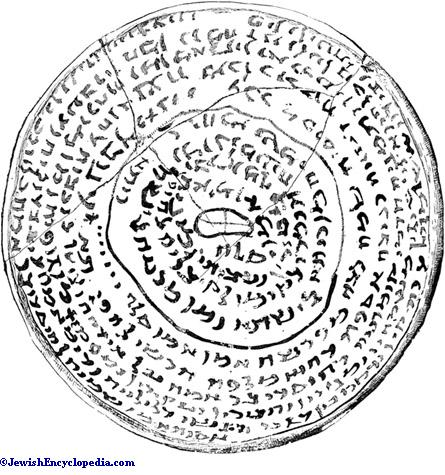
Not until 625 B.C. was a fresh lease of life given to Babylonia; and the king who began it was in all probability a Chaldean. Nabopolassar (625-605 B.C.) gave a rallying point to the independent life of the country, and threw off the Assyrian yoke with such energy and success as at once to establish a new world-empire and to destroy the once powerful Assyria. His son (see Nebuchadnezzar) carried on his plans with notable success, and was succeeded by Evil-Merodach (561-560 B.C.), and he by Nergalsharezer (559-556 B.C.); but the power that Nabopolassar had made dominant over the best of the world was now in decay. After Labashi-Marduk (556 B.C.), Nabonidus became king and reigned (555-539 B.C.) with singular devotion to religion and science, but without political wisdom. A new power had arisen in Elam; and Cyrus, who began to reign as king of Anshan, had become king of Media in 549 B.C., and shortly afterward king of Persia. In 545 B.C. he had conquered Lydia, and Babylonia was threatened. Revolts against Nabonidus in Babylonia opened the way for Cyrus; and in 538 B.C. Nabonidus fell into his hands and could no longer call himself "king of Babylonia." So ended the native rule of a mighty Semitic kingdom, which for 5,000 years had piled up wealth, furthered civilization, and ministered to peace. Babylonia, farmore than Assyria, represented the real genius of the Semitic people; and its conquest by the semi-barbaric races of the East seemed a sad ending to its brilliant roll of centuries.
Babylonia and Jeremiah. —Biblical Data:
In the Bible, Babylon and the country of Babylonia are not always clearly distinguished, in most cases the same word ( ) being used for both. In some passages the land of Babylonia is called Shinar; while in the post-exilic literature it is called the land of the Chaldeans (
 ). In the Book of Genesis Babylonia is described as the land in which are located Babel, Erech, Accad, and Calneh (Gen. x. 10), which are declared to have formed the beginning of Nimrod's kingdom. In this land was located the Tower of Babel (Gen. xi. 1-9); and here also was the seat of Amraphel's dominion (Gen. xiv. 1, 9). In the historical books Babylonia is frequently referred to (there are no fewer than thirty-one allusions in the Books of Kings), though the lack of a clear distinction between the city and the country is sometimes puzzling. Allusions to it are confined to the points of contact between the Israelites and the various Babylonian kings, especially Merodach-baladan (Berodach-baladan of II Kings xx. 12; compare Isa. xxxix. 1) and Nebuchadrezzar (see Nebuchadnezzar). In Chron., Ez., and Neh. the interest is transferred to Cyrus (see, for example, Ez. v. 13), though the retrospect still deals with the conquests of Nebuchadrezzar, and Artaxerxes is mentioned once (Neh. xiii. 6). In the poetical literature of Israel Babylonia plays an insignificant part (see Ps. lxxxvii. 4, and especially Ps. cxxxvii.), but it fills a very large place in the Prophets. The Book of Isaiah resounds with the "burden of Babylon" (xiii. 1), though at that time it still seemed a "far country" (xxxix. 3). In the number and importance of its references to Babylonian life and history, the Book of Jeremiah stands preeminent in the Hebrew literature. So numerous and so important are the allusions to events in the reign of Nebuchadnezzar that within recent times Jeremiah has become a valuable source in reconstructing Babylonian history. The inscriptions of Nebuchadrezzar are almost exclusively devoted to building operations; and but for the Book of Jeremiah, little would be known of his campaign against Jerusalem. See Assyria, Assyriology and the Old Testament, and Babylon.
Bibliography:
Histories—C. P. Tiele, Babylonisch-Assyrische Geschichte, Gotha, 1886;
Robert W. Rogers, History of Babylonia and Assyria, 2 vols., New York, 1900;
F. Hommel, Geschichte Babyloniens und Assyriens, Berlin, 1885;
Geschichte des Alten Morgenlandes, Stuttgart, 1895 (transl. into English as Civilization of the East, London, 1900);
Hugo Winckler, Geschichte Babyloniens und Assyriens, Leipsic, 1892. Works referring to the relationship between O. T. history and Babylonia—E. Schrader, Die Keilinschriften und das Alte Testament, Giessen, 1883 (English transl. by O. C. Whitehouse, The Cuneiform Inscriptions and the Old Testament, London, 1885-1889);
I. M. Price, The Monuments and the Old Testament, Chicago, 1900;
C. J. Ball, Light from the East, London, 1899;
D. G. Hogarth, Authority and Archœology, Part I, Hebrew Authority, by S. R. Driver, London, 1899.
[See Bibliography to Assyria.]
Extent.
—Post-Biblical Data
—Geography:
The Talmud gives the boundaries of as much of Babylonia as contained Jewish residents, but in doing so mentions geographical names which are not always clearly identifiable. The places mentioned in II Kings xvii. 6, as the localities where the Jewish exiles were settled, are not likely to have been the only ones inhabited by them after the lapse of a few centuries. Some of these places were identified as being inhabited by Jews in the post-Biblical period. Thus R. Abba bar Kahana, commenting on the above-mentioned passage in II Kings, states that: (a) "Ḥalaḥ" ( ) is Ḥalwan (according to the correct reading) or Holwan, as it is still called by the Arabs to-day; the Syrians also considered it identical with "Halah" (R. Payne Smith, "Thesaurus Syriacus," col. 1277); it is, according to Abulfeda, five days' journey north from Bagdad. Both Jews and Syrians apply the name to the whole province of Calachene. (b) "Habor" (II Kings l.c.) is the same as Ḥadyab (Adiabene). (c) "Nehar Gozan" (i.e. river of Gozan) is identical with Ginzak or, as Strabo and Ptolemy call it, Gaza, Gazaka, or Ganzaka, a large city on the bank of the lake Urmia (Ritter, "Erdkunde," ix. 774). (d) "The cities of the Medes" (II Kings l.c.) are intended to designate Hamadan, the ancient Ecbatana, and its sister cities. According to another opinion, Nehawend and its sister cities, south of Hamadan, are meant, (Ḳid. 72a; Yeb. 16b et seq.). Ganzaka is also mentioned elsewhere as one of the remotest points in which Jews of genuine stock, descended from the actual exiles, resided. Such Jews are said to have dwelt as far as the "river ["nhr" =water, as in Aramaic and Arabic] Ginzak," according to the correct reading of the 'Aruk based upon Ḳid. 71b; Yer. Ḳid. iv. 65d; Yer. Yeb. i. 3b. This statement was made by Rab; but Samuel names Nahrwan (see Ritter, l.c. ix. 418) as the farthest limit (see same passages, and also Gen. R. xvi. 3).
Toward the north ("above"), Rab gives as boundary a place on the Tigris which S. Cassel understands as the Bagravene mentioned by Ptolemy, a district eastward of the Tigris sources. Kohut and Berliner refer the name to Okbara and Awana, two cities on the east bank of the river; while Samuel here, too, assigns a smaller territory to Jewish residents by naming Moxœne as the farthest boundary. Southward ("below") along the Tigris, Jews are said to have been domiciled as far as Apamea in Mesene. Northward on the Euphrates, Rab mentions the fortress Thulbaḳni (called also Akra—Greek for "fort"—by the Jews) as the limit (Gen. R. l.c.), which place, according to most investigators, is the Thilbencane mentioned by Ptolemy. Samuel names a point farther north, a "bridge" over the Euphrates, identical with the well-known Zeugma on that river, as appears from R. Johanan's statement in the passage cited; this was a strategically important point on the boundary of Commagene, called "Bir" to-day. But the district Biram, mentioned in the Talmud (l.c.) as being upon "this side of the Euphrates," is not to be understood as identical with this Bir, as Neubauer and Berliner maintain; for then there would be nothing extraordinary in the accompanying statement that the leading (Jewish) families of Pumbedita contracted matrimonial alliances with the people of Biram. It is more probable that by the latter place the district of Bahrain was meant, apeninsula on the west side of the Persian gulf and a territory which in the times of Arabian domination, indeed, was frequently included in Irak. Nor, in speaking of Bahrain, are the words "above" and "below" employed to designate its position on the Euphrates, as with the other locations; instead, "on the other side" is used, which must mean southward, the previous side mentioned being north. Biram is identical with Beth Baltin, a spot between Syria and Babylonia, which was the extreme point to which the proclamation of the New Moon was forwarded: all beyond that was "Golah" (the Exile); i.e., Babylonia proper (R. H. 23b; compare 'Ab. Zarah 57a).
This wide extent of country contained numerous districts bearing the following names in rabbinical literature:
Provinces.
(a)  (Babylon), the most frequent designation, but meaning more strictly that section between the two rivers where they came most closely together. Thus it is said that Babylon covers the Euphrates on one side and the Tigris on the other ('Er. 22b). The term "Golah" (Exile) was also frequently applied to Babylon; and, inasmuch as Pumbedita, the city of such prime importance for Jews, was situated in it, Golah is at times used as equivalent to Pumbedita (R. H. 23b). In this district were situated those celebrated cities of Babylon, Borsippa, Seleucia, and Ctesiphon, repeatedly named by the Rabbis; in Arabian times, Bagdad, too, attained celebrity. Nehardea was also important. This region also received, poetically, as it were, the Biblical name of "Shin'ar," which was variously expounded (Gen. R. xxxvii. 4). Poetically, also, must be understood the appellation "Sheöl" (the nether world), Yeb. 17a. According to one passage (Gen. R. xxxvii. 1; compare Yalḳuṭ and Leḳaḥ Ṭob), the Biblical Tiras stands for Persia ("Monatsschrift," xxxix. 11). As distinguished from Palestine, Babylon, whether in its larger (Yer. Shek. ii. 47c) or smaller extent, was "abroad," "the foreign" (Yad. iv. 3).
(b)  ("between the rivers," Ḳid. 72a). The Greek name Mesopotamia, which arose after Alexander's time, means identically the same (Gen. R. xxx. 10, xliv. 3, lx. 1). In this district was situated the important city of Nisibis, called Naẓibin by the Jews, as it is to-day; this region is strictly differentiated from Golah, or Babylon proper (Sanh. 32b). Nineveh, however, had long before been destroyed, so that it is doubtful whether the Nineveh mentioned in the Talmud (Ta'anit 14b) as possessing Jewish inhabitants, can have been the celebrated city of that name. More probably the whole district of Nineveh is meant, as in Shab. 121b, where "Nineveh" is used with Adiabene. Assemani, "Bibliotheca Orientalis Clementino-Vaticana," iii. 2, p. lxv., mentions one baptized Jew from Nineveh in the fourth century.
(c) (Ḥabel Yamma, Ḳid. 72a; Yer. Ḳid. iv 65d; Gen. R. xxxvii. 8). The name means "the sea district," and probably applies to the region upon the Persian gulf, east of the Shaṭ-al-'Arab. This was considered the "crown" of Babylon. R. Papa applies the name, however, to the Phorat region (not Euphrates; compare Phorat, Mesene) of Borsippa, the word "sea" then referring to the lake Baḥr Nejef. An important commercial town east of the Tigris and near the sea was Charax, identified in rabbinical writings under the form "Haras," with the Biblical "Erech" ("Monatsschrift," xxxix. 58). The Biblical "Accad" is identified with Kashkar, a town called thus by the Syrians and Arabs (Smith, l.c., col. 1843), but also Karka, which is identical with Charax, and it thus must have been situated near the latter. In this actively commercial district, Cuthæans or Samaritans are said to have also resided (Ḳid. 72a).
(d)  (Meshan; in Greek and Latin authors, "Mesene," equivalent in meaning to "Mesopotamia"). A region, also celebrated for its commerce, west of the Shaṭ al-'Arab and north of the Persian gulf. In this district were both upper and lower Apamea; also Phorat Maishan, a large city identified by the rabbis with the Rehoboth-Ir of Gen. x. 11 (Yoma 10a). Mesene formed a portion of the old province of Chaldea, a name not in use among the Jews. As a collective name for all these districts, the designation "Babylonia" may be employed in its widest sense. Palestinian usage, supported by Biblical precedent, no doubt also employed the term "'Eber ha-Nahar" (beyond the river) to designate it (Ab. R. N., B, ii. 47; 'Aruk, s.v.
  III.). The somewhat boastful designation of Babylonia as "the land of Israel" (Gen. R. xvi. 3) was recognized by Zacuto ("Yuḥasin," p. 245b) and other moderns. So, too, many Babylonian cities were known among the Jews by nicknames (see Graetz, "Messene," p. 25, and Jastrow, "Dict." p. 167).
Political Divisions.
The provinces were subdivided officially and by common usage into smaller districts, as marked by the numerous canals and waterways; hence the functions of the "canalwardens" (see below). Such a district was styled a "parbar," a word occurring in I Chron. xxvi. 18; mention is made of Babylon and its district, Nehardea and its district (Ket. 54a); and there were doubtless other districts, named Nares, Sura, Pumbedita, Nehar-Peḳod, Maḥuza, etc., each with its peculiarities as to dialect, weights, and measures (Beẓa 29a, 'Er. 29b). One of the canals referred to above was called "the Jewish" (Nahr al-Yahudi; M. Streck, "Die Alte Landschaft Babylonien," i. 42, Leyden, 1900). From Sherira's "Letter," p. 40, it appears that Bassora was in a different district from Babylon (Bagdad). Many Babylonian cities are repeatedly mentioned in Jewish works, though the term "Sawâd" (for Babylon) is never used by Jews, who prefer the old name "Babel," just as the Arabs employ "Babil." Some scholars have endeavored to discern "Al-Irâk," one of the Arabic names for Babylonia, in Targ. Yer. upon Gen. x. 6, and I Chron. i. 8 ("Monatsschrift," xxxix. 55). This name is probably intended in "Toledot Alexander" (ed. J. Levi, "Ḳobeẓ," ii. 8), and is certainly meant in "Pe'er ha-Dor," No. 225 ("Irâk is Bagdad and its vicinity"), and in numerous other works.
Opposition to Palestine.
In view of the undoubted fact that the Jewish inhabitants of Babylonia were of purer racial extraction than the Jews of Palestine, the former considered themselves, especially after the fall of Jerusalem, as the genuine Israel, and their differing traditions and customs as of higher authority than those of thehome country. Indeed, these differences were intensified and cherished. The Babylonian Talmud repeatedly contains the remark, "This is our [Babylonian] custom; theirs [the Palestinians'] is different" (see Ḳid. 29b). Such expressions as "here" and "yonder," "in the east," and "in the west," are employed to specify differences of usage. The latter expressions are particularly rife as applied by the Masoretes to the verification of the Biblical text and comparisons of variant readings; but are likewise applied to minor differences of ritual and legal custom, especially in the time of the Geonim—differences which a modern scholar has enumerated to the number of seventy-three (J. Müller, "Ḥilluf Minhagim"). Of a different nature are the variations between the Babylonian and Jerusalem (or Palestinian) Talmuds, known already to the Geonim, who, of course, always preferred "our Talmud" (the Babylonian), and accordingly transplanted the study of the latter to Europe, where it became the dominant authority for modern Judaism in general.
But this independence of Palestine and Palestinian authority was not achieved by Babylonian Judaism all at once: it came about gradually. Thus, the exilarch R. Huna I., as many others, no doubt, before and after him, was buried in Palestine at his own request (Yer. Ket. xii. 35a); while, later on, it was maintained that in this respect Babylon must be considered as the equal of Palestine (Ket. 111a). "Just as one should not leave Palestine to live in Babylon, so one should not leave Babylon to dwell in other lands," ran a modest saying; but afterward the popular axiom was, "Who lives in Babylon, lives the same as in Palestine" (ib.); indeed, it soon became, "To leave Babylon is to transgress a precept" (ib. 110b). Huna, principal of the Pumbedita Academy, is credited with the utterance, "Since Rab came hither, we of Babylon have constituted ourselves in matters of divorce the peers of those in Palestine" (Giṭ. 6a). Learned intercourse between both countries was maintained by many amoraim traveling to and fro, as, for instance, Dimi and Zeïra. Babylonian scholars rightfully ranked themselves higher than their Palestinian colleagues, not, however, without incurring the ridicule of the latter for so doing (Zeb. 15a). R. Zeïra is said to have fasted a hundred days in order that he might forget the Babylonian Gemara (B. M. 85a), and R. Jeremiah always speaks of the "stupid Babylonians" (Yoma 57a). The Mishnah (Yoma vi. 4) mentions a particular instance of coarseness on the part of the Babylonians. They were accustomed to eat something raw which the Palestinians only ate cooked (Beẓah 16a). It was declared to be improper to entrust the oral tradition to men of Nehardea, or, according to another reading, to the Babylonians at all (Pes. 62b). Scholars in Palestine were called "Rabbi," whereas in Babylonia they were styled "Rab," possibly a difference of dialect only. In Babylonia, finally, people spoke more correctly and with sharper intonation than in Palestine.
Language.
At a period when Hebrew was still spoken in Palestine—at least in scholarly circles—the people in Babylonia had already adopted Aramaic, owing to the proximity of the Aramaic-Syriac districts. Hillel is expressly stated to have spoken a Babylonian Aramaic or Targum dialect (Ab. R. N. xii., p. 55, ed. Schechter). This dialect, of which the Babylonian Talmud is the chief literary monument, was closely related to the tongue of the natives, such as the Mandæans speak to-day. Persian never became the vernacular of the Babylonian Jews: a few words only were borrowed from it; more, perhaps, than from the Greek (Levias, "A Grammar of the Aramaic Idiom . . . in the Babylonian Talmud," pp. 3, 237, Cincinnati, 1900). Rabbi Joseph (fourth century) asks: "Why do we speak Aramaic in Babylon? It should be either the holy language [Hebrew] or Persian" (Soṭah 49b)—an utterance which shows that the Jews did not speak Persian. There are, of course, hundreds of Persian —or, more correctly, Pahlavi—words in Babylonian texts; and the amoraim of the first and second generations, like Rab and Judah, frequently intermingle Persian words in their utterances. Nevertheless, the proportion of Persian vocables in the Jewish Babylonian idiom is not so great as some (for instance, Kohut, in his "Aruch Completum," and Schorr, in "He-Ḥaluz," viii.) maintain. The Jewish incantations (see below) are Aramaic, and the Geonim render their responsa only in Aramaic, even during the Arabic period, as Sherira's and Hai's writings prove. But, of course, Arabic was then the ruling idiom, and Saadia—not a born Babylonian, it is true—calls the Aramaic "the language of the fathers" (comment. on the "Sefer Yeẓirah," text, p. 45); it was, therefore, no longer a living language. Hebrew, of course, was retained in a measure, as everywhere, by the Jews; and the Karaites especially wrote mainly in Hebrew. Pethahiah, the traveler, was rejoiced to find that Aramaic was closely related to Hebrew.
Non-Jewish Population.
Although Babylonia, or Irâk, was largely populated by Jews, the population was still a mixed one, and in the course of time the non-Jewish population grew to be in the majority. The uncultivated Parthians could, of course, exercise no religious influence upon the Jews; but it was otherwise with the Persians, and it is still a moot point to-day to what extent Judaism, both Biblical and post-Biblical, was influenced by Zoroastrianism. In Palestine it was acknowledged that the names of the angels (see Angelology) were of Babylonian origin (Gen. R. xlviii. 9), and were adopted in the Parthian period. In this direction in general the Jews were strongly influenced by Zoroastrianism (Kohut, "Ueber die Jüdische Angelologie und Dämonologie in Ihrer Abhängigkeit vom Parsismus," Leipsic, 1866; Stave, "Einfluss des Parsismus auf das Judenthum," Haarlem, 1898). Talmud and Midrash speak very often of the Persians. Naḥman, presiding judge at the court of the exilarch, was well versed in Persian law (Shebuot 34b); and a Persian document is mentioned (Giṭ. 19b; compare B. M. 108a). The Persians were acute enough to prize the Jewish Law: a Jewish soldier found a Hebrew copy of it in the Persian treasury (Sanh. 97b). Persian trousers, a characteristic garment, are, according to some, mentioned several times ('Ab. Zarah 2b; Meg. 11a; Ḳid. 72a). Interesting, too, is the mention of the Persian festivals (Yer. 'Ab. Zarah i. 39c),and of the fact that the Persians kiss each other upon the hand, and not upon the mouth (Tan., ed. Buber, iv. 110). It was only the Magi—wrongly called "Guebers"—who, as Nöldeke rightly explained, were contemptuously called "magicians" ("ḥaberim" or "ḥabrin") by the Jews, who hated and persecuted the latter. The Mandæans, however, chiefly residing in southern Babylonia, also felt deep hatred against the Jews (W. Brandt, "Die Mandäische Religion, "Leipsic, 1889; Lagarde, "Mittheilungen," iv. 143; Jewish sources contain nothing upon this point). Besides these, there were Arabs living in the land or on its borders (Niddah 47a, Ḳid. 72a), called also Ishmaelites or Nabatæans: intercourse with them, related as they were to the Jews, must have been amicable.
Their Influence.
But all this changed when the Arabs became masters of the country; by them all the inhabitants who were not Moslems were treated with contempt, if not with cruelty. The Christians experienced this more sharply than the Jews (in the predominantly Jewish district Nehardea, there were no Christians in olden times; Pes. 56a). The constitution of the Nestorian Church had for the Arabs great similarity to that of the Jews with their exilarchs and heads of academies. Hai Gaon had friendly intercourse with the Catholicus of the Nestorians. Strange to say, the only one of these nationalities to exert a detrimental influence upon Judaism was Mandæism, to which many of the superstitions and the belief in magic, found throughout the Talmud, must undoubtedly be ascribed. Evidences of this are the magic bowls used in common by both Jews and Mandæans. Layard first found them ("Discoveries," p. 509), since which they have repeatedly been encountered; and the American Nippur expedition unearthed a great number of them (Stubbe, "Jüdisch-Babylonische Zaubertexte," Halle, 1895, p. 8; Lidzbarski, "Ephemeris für Semitische Epigraphik," 1900, p. 89; "Amer. Journal of Archeology," 1900, iv. 482). The illustration of one of these bowls, given on page 402, is from the "Revue des Etudes Juives." Arabic influence was undoubtedly much more powerful; but this confined itself to the field of science, and did not intrude upon religion.
Commerce and Trade.
Babylonia was always a fertile country, yielding produce of every kind. Both Jewish and non-Jewish writers describe its wealth of date-palms (Pes. 87b et seq.); cedars are said to have been brought thither from Palestine (Lam. R. i. 4). The locust (insect) is also said to have been imported thence (Yer. Ta'an. iv. 69b). Olive-oil, however, was lacking; its place being supplied by sesame-oil (Shab. 26a). Linen was widely manufactured (Ta'an. 29b); and there was a special Babylonian purple material (Gen. R. lxxxv. 14; Tan., Mishpaṭim. 17), well known in commerce under the name of "Babylonicum." These fabrics (Pandects xxxiv. 2, 25) were brought by the Jews to Alexandria (Isaac Voss upon Catullus, p. 196). The Jews evidently contributed to Babylonia's foreign commerce, which in the earliest days was centered in Seleucia and Ctesiphon. In later days, when Bagdad rose to prominence, markets had already been held there (Streck, l.c. p. 52)—of course, with the assistance of Jews (Kohut, "Aruch." vi. 10) —and there was a special Jewish quarter there, with a "Jews' Bridge" (Yaḳut, iv. 1045, 11—see Bagdad). To-day trade is still mainly in the hands of the Jews in these localities, as, for instance, in Bassora (Ritter, "Erdkunde," x. 180). Their industry made the Jews rich, especially in Maḥuza (Gutschmid, "Kleine Schriften," v. 677). There were no laws in Babylonia in restraint of commerce (Giṭ. 58b); but, devoted as they were to trade, the Jews did not shrink from such lowly occupations as that of canal-dredging; indeed, the Babylonian Talmud mentions all kinds of handiwork as having been followed by Jews, and even by distinguished scholars among them. Their connection with agriculture is not quite so clear, although it is quite certain that there were farmers among them. The Talmud mentions the interesting fact that the Palestinian Jews gave one-third of their yearly offering ("terumah") "for Babylon, Media, the distant provinces, and all Israel" (Yer. Sheḳ. iii. 47c). There was no stone in Babylonia (Midr. Teh. xxiv. 10); bricks were, therefore, used for building, and Jews were employed in their manufacture.
The Jews are reported as having erected handsome synagogues and colleges; the pillars of the college at Pumbedita being particularly praised ('Er. 22b). The learned of Babylonia dressed more elegantly and were prouder in demeanor than those of Palestine (Shab. 145b). The climate was healthful, so that it was said that there was no leprosy in Babylonia (Ket. 77b).
—History:
The earliest accounts of the Jews exiled to Babylonia are furnished only by the scanty details of the Bible; certain not quite reliable sources seek to supply this deficiency from the realms of legend and tradition. Thus, the so-called "Small Chronicle" (Seder 'Olam Zuṭṭa) endeavors to preserve historic continuity by providing a genealogy of the Princes of the Exile ("Reshe Galuta") back to King Jeconiah; indeed, Jeconiah himself is made a Prince of the Exile (Neubauer, "Medieval Jew. Chronicles," i. 196). The "Small Chronicle's" statement, that Zerubbabel returned to Palestine in the Greek period, can not, of course, be regarded historical. Only this much can be considered as certain; viz., that the descendants of the Davidic house occupied an exalted position among their brethren in Babylonia, as, at that period, in Palestine likewise. At the period of the revolt of the Maccabees, these Palestinian descendants of the royal house had emigrated to Babylonia, to which an obscure notice by Makrizi (in De Sacy, "Chrestomathie Arabe," i. 100) probably refers (Herzfeld, "Gesch. des Volkes Yisrael," ii. 396).
Greek Period.
It was only with Alexander's campaign that accurate information concerning the Jews in the East reached the western world. Alexander's army contained numerous Jews who refused, from religious scruples, to take part in the reconstruction of the destroyed Belus temple in Babylon (Josephus, "Contra Ap." i. 22). The accession of Seleucus Nicator, 312 B.C., to whose extensive empire Babylonia belonged, was accepted by the Jews and Syrians for many centuries as the commencement of a new era for reckoning time, called "minyan sheṭarot,"æra contractuum, or era of contracts (see 'Ab. Zarah 10a, and Rapoport, "'Erek Millin," p. 73), which era was also officially adopted by the Parthians. This so-called "Greek" era survived in the Orient long after it had been abolished in the West (see Sherira's "Letter," ed. Neubauer, p. 28). Nicator's foundation of a city, Seleucia, on the Tigris is mentioned by the Rabbis (Midr. Teh. ix. 8); while both the "Large" and the "Small Chronicle" contain references to him. The important victory which the Jews are said to have gained over the Galatians in Babylonia (II Macc. viii. 20) must have happened under Seleucus Callinicus or under Antiochus III. The last-named settled a large number of Babylonian Jews as colonists in his western dominions, with the view of checking certain revolutionary tendencies disturbing those lands (Josephus, "Ant." xii. 3, § 4). Mithridates (174-136) subjugated, about the year 160, the province of Babylonia, and thus the Jews for four centuries came under Parthian domination.
Parthian Period.
Jewish sources contain no mention of Parthian influence; the very name "Parthian" does not occur, unless indeed "Parthian" is meant by "Persian," which occurs now and then. The Armenian prince Sanatroces, of the royal house of the Arsacides, is mentioned in the "Small Chronicle" as one of the successors (diadochoi) of Alexander. Among other Asiatic princes, the Roman rescript in favor of the Jews reached Arsaces as well (I Macc. xv. 22); it is not, however, specified which Arsaces. Not long after this, the Partho-Babylonian country was trodden by the army of a Jewish prince; the Syrian king, Antiochus Sidetes, marched, in company with Hyrcanus I., against the Parthians; and when the allied armies defeated the Parthians (129 B.C.) at the River Zab (Lycus), the king ordered a halt of two days on account of the Jewish Sabbath and Feast of Weeks (Josephus, "Ant." xiii. 8, § 4). In 40 B.C. the Jewish puppet-king, Hyrcanus II., fell into the hands of the Parthians, who, according to their custom, cut off his ears in order to render him unfit for rulership. The Jews of Babylonia, it seems, had the intention of founding a high-priesthood for the exiled Hyrcanus, which they would have made quite independent of Palestine (Josephus, "Ant." xiv. 13, § 9; ib. "B. J." i. 13, § 6). But the reverse was to come about: the Palestinians received a Babylonian, Ananel by name, as their high priest ("Ant." xv. 2, § 4), which indicates the importance enjoyed by the Jews of Babylonia.
In religious matters the Babylonians, as indeed the whole diaspora, were in many regards dependent upon Palestine. They went on pilgrimages to Jerusalem for the festivals, and one, whose full name is given in Mekilta on Deut. (xiv. 23, ed. Hoffmann), brought first-fruits of his land to Jerusalem (Ḥal. iv. 11); but this case was not permitted to constitute a precedent. Sherira himself, although strongly biased in favor of his own home, acknowledges that when the Sanhedrin and the colleges were flourishing in Palestine, neither existed in Babylonia; which fact would seem to warrant the inference that the Babylonian Jews must have sent to Palestine for religious instruction, as, for instance, in the case of Hillel. According to the "Small Chronicle," however, the exilarchs at this period already had their court-scholars. How free a hand the Parthians permitted the Jews is perhaps best illustrated by the rise of the little Jewish robber-state in Nehardea (see Anilai and Asinai). Still more remarkable is the conversion of the king of Adiabene to Judaism (see Adiabene). These instances show not only the tolerance, but the weakness of the Parthian kings. The Babylonian Jews wanted to fight in common cause with their Palestinian brethren against Vespasian; but it was not until the Romans waged war under Trajan against Parthia that they made their hatred felt (Eusebius, "Hist. Eccl." iv. 2); so that it was in a great measure owing to the revolt of the Babylonian Jews that the Romans did not become masters of Babylonia too. Philo ("Legatio ad Cajum," § 36) speaks of the large number of Jews resident in that country, a population which was no doubt considerably swelled by new immigrants after the destruction of Jerusalem. Accustomed in Jerusalem from early times to look to the east for help (Baruch iv. 36, 37; Pseudo-Solomon, Ps. 11), and aware, as the Roman procurator Petronius was, that the Jews of Babylon could render effectual assistance, Babylonia became with the fall of Jerusalem the very bulwark of Judaism. Rabbi Akiba's journeys to Nehardea (Yeb., end) and Gazaka (Gen. R. xxxiii. 5) were undoubtedly connected with preparations for revolt (Rapoport, in "Bikkure ha-'Ittim," 1823, p. 70), and it is a fact that Jews of the diaspora enrolled themselves under Bar Kokba ("Gola," in Saadia ibn Danan, in "Pe'er ha-Dor," No. 225); while it is undoubtedly erroneous when in the "Yuḥasin" (ed. London, 245b) it is maintained that Bar Kokba waged war with the Romans in Mesopotamia: this can be only a reminiscence of the struggles under Trajan. The Bar Kokba disaster no doubt added to the number of Jewish refugees in Babylon.
Resh Galuta.
In the continuous struggles between the Parthians and the Romans, the Jews had every reason to hate the Romans, the destroyers of their sanctuary, and to side with the Parthians, their protectors. Possibly it was recognition of services thus rendered by the Jews of Babylonia, and by the Davidic house especially, that induced the Parthian kings to elevate the princes of the Exile, who till then had been little more than mere collectors of revenue, to the dignity of real princes (F. Lazarus, in Brüll's "Jahrbücher," x. 62). Thus, then, the numerous Jewish subjects were provided with a central authority which assured an undisturbed development of their own internal affairs. It is in this period that the first certain traces of the dignity of the prince of the Exile are found; and the first-named resh galuta is Nahum or Naḥunya. About the year 140 of the common era, Hananiah, nephew of R. Joshua, migrated to Babylonia before the Bar Kokba war, and founded a college in Nehar-Peḳod (compare "Pekod" in Jer. l. 21; called in other places "Nehar-Peḳor," probably after the celebrated Parthian general Pakorus). Upon the overthrow of the insurrection and interruption of communication with Palestine, Hananiah set about arranging the calendar, which hitherto had been the exclusive prerogative of thePalestinian patriarch; possibly he even meditated the erection of a new temple. This spirit of independence must certainly have been gratifying to the resh galuta; but when the Palestinian Sanhedrin sent two messengers to Babylon with the sarcastic suggestion that Ahijah (the resh galuta) should build another altar and that Hananiah should play the harp thereto, the remonstrance sufficed to bring the people to their senses again, and to nip the dangerous schism in the bud. This episode made such a strong impression upon the public mind that there are several accounts of it (Ber. 63a; Yer. Ned. 40a; Yer. Sanh. 19a). Judah b. Bathyra, who had a college in Nisibis, also influenced Hananiah to give up his intention; nevertheless, the college of the latter was still recognized in Palestine as authorized (Sanh. 32b). Nathan, a son or brother of the exilarch, was vice-president of the Palestinian Sanhedrin at this time. From this period on, instances are numerous of talented Babylonians attaining high esteem in Palestine. The Babylonians were well aware of their preeminence; and a Babylonian amora thus expressed himself concerning it: "When the Torah was forgotten in Israel, Ezra came from Babylon and restored it; when forgotten again, Babylonian Hillel came and rehabilitated it; forgotten once more, R. Ḥiyya and his sons came and reestablished it" (Suk. 20a). This rather boastful utterance ignores the fact that both Hillel and Ḥiyya, although Babylonians by birth, gained their knowledge in the Palestinian colleges. The fact that Abba Arika (commonly called "Rab"), a nephew of Ḥiyya, studied in Palestine, led to remarkable results for the Babylonian Jews; for Rab was the intimate friend of the last Parthian king, Artaban IV. (209-226).
Sassanid Period.
The Persian people were now again to make their influence felt in the history of the world. Artaxerxes I. (Ardeshir I., son of Babek; the full name appears in Abraham ibn Daud, ed. Neubauer, p. 60) destroyed the rule of the Arsacids in the winter of 226, and founded the illustrious dynasty of the Sassanids. Different from the Parthian rulers, who in language and religion inclined toward Hellenism, the Sassanids intensified the Persian side of life, favored the Pahlavi language, and restored with zeal the old religion of the Magi, founded upon fireworship, which now, under the favoring influence of the government, attained the fury of fanaticism. Of course, both Christians and Jews suffered under this; but the latter, dwelling in more compact masses, were not exposed to such general persecutions as broke out against the more isolated Christians. The attitude of the first Sassanid, Ardeshir I., toward this movement is not clear. Gibbon ("Decline and Fall of the Roman Empire," ch. viii.) narrates that Ardeshir persecuted both Christians and Jews, and adduces Sozomen, book ii., ch. i., as authority; this passage, however, refers only to Christians.
Ardeshir I.
Against the statement, also, is the evidence of Ibn Daud that in Ardeshir's days the Jews and Persians loved each other, as also in the days of King Sapor. S. Cassel believes that the Jews were favored by the Persians; and Graetz knows of no persecution under Ardeshir. There is, however, in the "Small Chronicle"—although not in its proper place—a statement that "the Persians obtained dominion in the year 245 after the destruction of the Jerusalem Temple, and instituted a persecution of the Jews." The passage in "Yuḥasin" (ed. London, 93a) sets this event in the period of the exilarch Nehemiah, in the year 175 after the Destruction. Far from being declared erroneous (Lazarus, in Brüll's "Jahrbücher," x. 95), this statement deserves full confidence, but the year should read "165" instead of "175"; that is, the year 233 of the common era, seven years after the inauguration of Persian power. Certain Talmudical accounts, belonging to the period, corroborate this; thus, R. Kahana says: "Hitherto the Persians [Parthians] permitted Jews to exercise capital punishment; but now the Persians do not permit it" (B. Ḳ. 117a). The Jews were no longer appointed to the wardenship of the canals ("reshe nahare"), nor to offices of the court ("gezirpaṭi"; Persian, hazar paiti; Greek,  [Rome] for
  ).
).
All these things must have taken place under the vigorous Ardeshir. How powerful was the impression made by him upon the fancy of the Jews, may be gathered from the so-called Apocalypse of Elijah (ed. Jellinek, in "B. H." iii. 66; ed. Buttenwieser, Leipsic, 1897), which most probably refers to Ardeshir's war against the Romans ("Jew. Quart. Rev." xiv. 360). To his campaign in 230 the obscure statement of the Latin author Solinus must be referred, that Jericho was destroyed by "Artaxerxes"(Th. Reinach, in the Kohut Memorial Volume, pp. 457 et seq.). The schismatic Mani, founder of Manicheism, appeared at this time: his execution (doubtless because Manicheism exerted some influence upon Judaism) under Shabur is mentioned by Ibn Daud (p. 61).
Academies Founded.
It was, however, before the accession of the Sassanids that the powerful impetus toward the study of the Torah arose among the Jews of Babylonia which made that country the very focus of Judaism for more than a thousand years. An exact date may be determined: Sherira and those dependent upon him (compare "Seder Tannaim we-Amoraim," in the version of the Maḥzor Vitry, p. 482) set as the date of Rab's return from Palestine the year 530 of the Seleucid era; that is, 219 of the common era, or, according to Ibn Daud (l.c. p. 57), the year of the world 3979. It would seem that Palestinian scholarship had exhausted itself with the compilation of the Mishnah; and it was an easy matter to carry the finished work to Babylonia. When Rab returned thither, there was already an academy at Nehardea under the leadership of an obscure R. Shila, who bore the title "resh sidra." Upon the death of the latter it was but natural that the much more eminent Abba Arika—whose distinction is indicated by the title of "Rab"—should become head of the school. But, in his modesty, Rab resigned the academy at Nehardea to his younger countryman Samuel, while he himself founded a similar institution in Sura (known also by the name of an adjacent town, Mata Meḥasya). Nehardea, a long-established seat of Jewish life in Babylonia, first attained flourishing eminence through this prominent teacher, Mar Samuel; and when, with the death of Rab (247), the splendor of Sura vanished, Nehardea remained for seven years the only academy ("metibta") in Babylonia. From this period on, the history of the Jews in Babylonia, hitherto obscure, becomes quite clear (see Academies in Babylonia).
Sapor I.
The mass of tradition zealously preserved in the Babylonian academies furnishes a series of dates and facts which illuminate their life. The resh galuta about this time appears to have been Mar 'Uḳba, or Nathan 'Uḳban (c. 210-240); the chief judge was a certain Ḳarna; while Rab held the much more troublesome than brilliant official position of an "agoranomos" (Yer. B. B. v. 15b). Although even Rab himself had to endure harshness at the hands of the exilarch's officers, from this time on it would appear that the exilarchs, in accordance with the prevailing spirit of veneration for learning, began to devote themselves to the acquisition of knowledge as well as of power, approaching thus the example of the Palestinian patriarchs. King Sapor I. (240-271) favored Samuel with such a degree of intimacy that the latter was sometimes called "King Sapor" and "Arioch" (friend of the Arians; see Ḳid. 39a; Shab. 53a), and the people generally spoke of him with respect as "the Jewish sage" (Shab. 129a). But Samuel, too, liked the Persians. He was the author of the celebrated saying, "The law of the land is the law to go by" (B. B. 54b), referring, of course to civil matters; and even when his king, in the exigencies of war, felt himself compelled to slaughter twelve thousand Jews at Mazaga (Cæsarea), in Cappadocia, Samuel was ready to defend him (M. Ḳ. 26a). Under Sapor began the bitter contest with the Romans for possession of the rich lands of the Euphrates, so thickly populated by Jews. R. Johanan aptly remarked concerning these struggles that "Holwan, Adiabene, and Nisibis are the three ribs which the prophet Daniel describes as being held in the mouth of the beast, sometimes crunched and sometimes dropped" (ḳid. 72a; see Dan. vii. 5). The Persians penetrated to the very heart of the Roman territory, until Odenath, prince of Palmyra, moved against them and took their booty from them (261). Several Talmudic passages speak of a certain Papa bar Naẓor, who is identified by Cassel and Graetz with Odenath, while Nöldeke (l.c. p. 22, note 2) makes him a brother of Odenath. Zenobia, wife of menath, is quite distinctly referred to in the Talmud. According to non-Jewish writers, Odenath only penetrated as far as Ctesiphon; while Jewish sources (Sherira, the "Small Chronicle" and the "Seder Tannaim")refer to the calamity of the destruction of Nehardea by Papa bar Naẓor. Samuel was then no longer alive; his daughters were taken prisoners; and his disciples fled to Shekanẓib, Shelhi, and Maḥuza; Nehardea ceased to be the principal focus of Jewish life, although its academy still continued in existence. Many rabbis also escaped to Pumbedita, which city now became the seat for a thousand years of the most celebrated Babylonian Jewish college next to Sura.
Sapor II.
The Jews then enjoyed, it would appear, half a century of repose; not too long a respite for the enormous intellectual work going on. By Christian writers the Jews are accused without warrant of having instigated the slaughter of twenty-two bishops by Sapor II. (310-382) as part of his antagonism to the Christian predilection for Rome (Sozomen ii. 8; Burckhardt, "Die Zeit Constantins des Grossen," 2d ed., 1880, p. 90). The "Small Chronicle" narrates that when Huna was exilarch, and Rabbah chief of the academy, Sapor went against Nisibis and conquered it. A persecution of the Jews is mentioned as taking place in 313 (Theophanes, ed. De Boor, p. 25); but Sapor was at that time still a child. Rabbah b. Naḥmani, the head of the academy at Pumbedita (died 331), fell a victim to persecution. The charge was made against him that the 12,000 disciples who assembled twice a year for the usual public study ("kallah"; see Academies in Babylonia) did so merely to avoid paying the tax (see B. M. 86a). Rabbah fled and perished miserably, lost in a place called Agma (swamp?) (see Sherira, l.c. p. 31). His successors, R. Joseph the Blind and Raba (who followed Abaye), enjoyed the favor of the queen-mother Ifra Hormiz (B. B. 8a, 10b; Ta'anit 24b; Niddah 20b; Zeb. 116b); which did not, however, prevent Raba from being imprisoned upon a baseless charge (Ber. 56a). Rabbah and, still more, his pupils Abaye and Raba are considered as the founders of the acute Talmudic dialectics practised in Pumbedita. After the short presidencies of R. Joseph and Abaye, the renowned Raba became the head of Pumbedita; in his days it was the only remainingacademy in Babylonia; for Sura had ceased to exist. R. Papa, however, presently founded a new school in Naresh near Sura, which later on was removed to that city, where, under R. Ashi, it attained to high eminence.
In the vigorous war which the emperor Julian waged, and in which Mesopotamia and Babylonia proper were involved, it is probable that the Jews, in spite of the friendly attitude of the Roman ruler, sided with their own sovereign. A small town, Birta—called Bithra by Sozomen (iii. 20)—was deserted by its inhabitants, who were Jews, and in retaliation the Romans burned the place. The same fate befell the more important city Firuz Shabur (Pyrisabora), which also possessed a large Jewish population; Maḥuza, too, near Ctesiphon, Raba's birthplace and the seat of his academy, was also laid in ashes, together no doubt with many other towns in which Jews dwelt. There were probably no other enduring results of this Roman campaign, for Jewish records mention none. Julian honored the Jews in Haran (Charræ), when, on a visit there, he witnessed the mysteries (Bar-Hebræus, "Chronicum Syriacum," ed. Kirsch, i. 65).
Yezdegerd I.
Of Sapor's successors, Yezdegerd I. (397-417, Justi; 399-420, Nöldeke) was at least not hostile to the Jews. The fact that the heads of the academies, Amemar of Nehardea, Mar Zuṭra of Pumbedita, and Ashi of Sura, were rudely handled by the king's seneschal while waiting for audience in the palace (Ket. 61a, according to Rapoport's amended reading in "'Erek Millin," p. 35, and 'Aruk), does not certainly indicate a very great degree of friendliness. The Huna b. Nathan, whose girdle Yezdegerd adjusted with a few flattering words—a polite attention which was highly valued even by the eminent R. Ashi (Zeb. 19a)—was no doubt the exilarch of that date, Graetz to the contrary notwithstanding. This incident probably took place in this monarch's earlier years; later on he became a strong religious fanatic, and in 414 ordered a bloody persecution of the Christians. It may have been the king's intention that the exilarchate should gradually lose its political importance, for the Talmud (Giṭ. 59a) relates that Huna b. Nathan subordinated himself to R. Ashi; while Sherira adds thereto the information that the "rigle," the public festivities given by the exilarch, were transplanted to Mata Meḥasya (Sura), the home of R. Ashi. This would show that Nehardea had ceased to be the residence of the resh galuta, and that Sura had become the political center of Jewish Babylonia. With R. Ashi, who united in his person both rank and learning (Sanh. 36a), the position of the principal of the academy attained almost equal eminence with that of the exilarch.
Bahram V. Yezdegerd II.
Bahram (Varanes) V. (420-438) left the Jews in peace; it is probably to his time that Theodoret (ii. 264) refers when he says that Babylonia was populated with Jews (Lagarde, "Mittheilungen," iv. 145). His successor Yezdegerd II. (438-457) instituted a persecution of the Jews which transcended in cruelty all that they had hitherto experienced in Iran, and was a forerunner of still severer sufferings. In the year 456 (in which both the principals of the Sura Academy, R. Naḥman b. Huna and R. Reḥumai [or Neḥumai] of Pumbedita, died), the king issued a decree forbidding all observance of the Sabbath. His early death prevented further persecution. The Jewish chronicles relate that he was swallowed by a serpent, upon the prayer of the heads of the academies, Mar b. R. Ashi and R. Zoma. Rapoport did not question the authority of this Jewish source; but new discoveries show that, according to the local tradition, this sudden death in reality befell Yezdegerd I., and that only the Jews attributed it to their persecutor, Yezdegerd II. The persecution was probably instigated by the Magi; the Christians and Manicheans having been persecuted five years earlier ("Revue Etudes Juives," xxxvi. 296). To this period is to be referred Amemar's discussion with a Magus (Sanh. 39a).
Firuz.
Yezdegerd's second son and successor, Firuz, or Perozes (459-486), continued the persecution on a larger scale. The Jews of Ispahan were accused of having flayed two Magi alive (Hamza, ed. Gottwaldt, p. 56); and one-half of the Jewish population were slaughtered and their children delivered over to the fire-worshipers. But in Babylonia too the persecution gained foothold; Firuz "the wicked" (Ḥul. 62b) put the exilarch Huna Mari, son of Mar Zuṭra I., to death; and the Jews, coming under immediate Persian domination, underwent a year of suffering, 468, which in the Talmud is called "the year of the destruction of the world" (see Brüll, "Jahrb." x. 118). From this year to 474 a series of violent acts followed, such as the destruction of synagogues, prohibition of the study of the Law, the forcible delivery of children to the Fire Temples, the imprisonment and execution of Amemar b. Mar YanuḲa and Meshershiya. The destruction of Sura (Shab. 11a) possibly also took place at this time. Maḥzor Vitry (p. 483) states that Firuz suffered a violent death (result of an earthquake?) in 483, or, more correctly, 486. In 501 Rabina died, the last of the Amoraim; succeeding teachers were called Saboraim.
The Talmud.
The compilation and editing of the Babylonian Talmud, begun by R. Ashi, were completed by Rabina, though the Saboraim may also have worked upon it. The reduction of the traditional legal material to writing—previously forbidden—originated no doubt in the anxiety caused by the continually increasing persecution: it was no longer safe to confine this prized material to the oral traditions of the academies; it must be set down permanently in writing for posterity. Another remarkable result of these persecutions was the emigration of Babylonian and Persian Jews to India under Joseph Rabban.
Balash and Kobad.
The reign of Balash (Vologeses) was uneventful for the Jews; but the long sway of Kobad or Kawad (490-531; according to Nöldeke, 488-531) brought mournful developments. About 501 appeared Mazdak, the founder of Zendicism, whose socialist doctrine of community of property and wives must have aroused horror among both Christians and Jews. All indications show that Mazdak was of Irak origin, seeing that his doctrines made most headway there. Zendicism must have made existenceunbearable, especially for the Jews, who were jealous of the purity of their family life. King Kobad, to break the pride of the Persian nobles, embraced the new religion, and, although deposed by them, he remained a devotee of the new faith. Fortunately, the Jews had at that time an energetic exilarch, Huna VI., who succeeded to some extent in protecting his coreligionists against this evil. But when he died in 508, his nephew Paḥda was appointed to the exilarchate during the minority of his son; he was, however, eventually removed by the king through the exertions of Mar Ḥanina, the head of the academy (about 551). Judaism in the interval seems to have been close-pressed by Zendicism; and accordingly the new exilarch, Mar Zuṭra II., a grandson of Mar Ḥanina, gathered around him an armed band of four hundred men for the defense of Jewish family life. He succeeded in maintaining his independence for seven years, collecting revenue even from the non-Jewish population of Irak. Active measures by the king put an end, at length, to the little Jewish state: Mar Zuṭra, only twenty-two years of age, was crucified (520) on the bridge of Maḥuza, his capital; and his infant son, Mar Zuṭra III., was carried to Palestine, where he became Archipherecites. Kobad introduced an additional landtax, and all Jews and Christians between the ages of 20 and 50 were subjected to a poll-tax (Justi, l.c. p. 370), no doubt after Roman example. Kobad's army serving against the Byzantines contained a number of Jews, who were allowed to desist from active operations on the Passover (Bar-Hebræus, l.c. p. 85).
Chosroes Anushirwan.
The century between Kobad and the appearance of the Arabs is destitute of historical record. In the Babylonian Talmud, the latest date mentioned is the year 521 (Sanh. 97b); see "Me'or 'Enayim," 43; Zunz, "G. V." 2d ed., p. 56. From this time on, there are extant only accounts of individual sages, the Saboraim, and these only scantily. Mention is made of R. Rehumai, R. Jose, R. Aḥa of Be Ḥatim, near Nehardea, Rabai of Rob, and others; they all died early, as Sherira expressly remarks. Rabai was reckoned as one of the Geonim, the title of "Gaon" being henceforth borne by the head of the Academy of Sura, and later also by that of the Academy of Pumbedita. The Saboraim continued to teach undisturbedly under Kobad and Chosroes Anushirwan (531-578), a ruler beloved both by Persians and Arabs, and who showed a friendly attitude toward the Jews. It was in his time that the Christian sect of the Nestorians spread in Persia, as mentioned also by Jewish sources (Jellinek, "B. H." vi. 13). Under Hormiz IV. (578-590) "the end of the Persian rule," as Sherira says, persecutions occurred again; the academies were closed; and many rabbis of Pumbedita migrated to Firuz Shabur, near Nehardea, because this latter city was under Arab rule (c. 581). The Jews, accordingly, favored the insurrection led by Bahram Tshubin, as Theophylactus Simocatta relates (vol. vii., p. 218, ed. Bonn). The legitimate ruler, Chosroes Parwez (590-628), was able to maintain his right to the throne of the Sassanids, and the Jews were at liberty to resume their academic activities without being punished for having sided with the rebel. In the war which this king made upon the Byzantines, his general Shahr-Barz captured Jerusalem (615), and, it appears, handed over the Christians to the mercies of the Jews. Thus, for the last time, the Jews stood in intimate relations with the Persians; with the downfall of the latter ends likewise the brilliant era of the Jews in Babylonia.
Arab Period.
The first expression of Mohammedanism toward other faiths was one of intolerance and narrowness. It was an essential feature of Moslem state policy that Jews and Christians, no less than Zoroastrians, must be warred against until they paid tribute. In addition to a poll-tax ("jizyah"), the tax upon real estate ("kharaj") was instituted; indeed, first in Irak, and later on among the Jews (A. Müller, "Der Islam," i. 272). The first calif, Abu Baḳr, sent the famous warrior Ḥalid against Irak; and a Jew, by name Ka'abal-Aḥbar, is said to have fortified the general with prophecies of success (Weil, "Gesch. der Chalifen," i. 34). The Jews may have favored the advance of the Arabs, from whom they could expect mild treatment. Some such services it must have been that secured for the exilarch Bostanai the favor of Omar I., who awarded to him for a wife the daughter of the conquered Sassanid Chosroes II. as Theophanes and Abraham Zacuto narrate. Jewish records, as, for instance, "Seder ha-Dorot," contain a Bostanai legend which has many features in common with the account of the hero Mar Zuṭra II., already mentioned. The account, at all events, reveals that Bostanai, the founder of the succeeding exilarch dynasty, was a man of prominence, who received from the victorious Arab general certain high privileges, such as the right to wear a signet-ring, a privilege otherwise limited to Mohammedans. Omar and Othman were followed by Ali (656), with whom the Jews of Babylonia sided as against his rival Mo'awiyah. A Jewish preacher, Abdallah ibn Saba, of southern Arabia, who had embraced Islam, held forth in support of his new religion, expounded Mohammed's appearance in a Jewish sense, and, to a certain extent, laid the foundation for the later sect of the Shiïtes. Ali made Kufa, in Irak, his capital, and thither went Jews who had been expelled from Arabia (about 641). It is perhaps owing to these immigrants that the Arabic language so rapidly gained ground among the Jews of Babylonia, although a greater portion of the population of Irak were of Arab descent. The capture by Ali of Firuz Shabur, where 90,000 Jews are said to have dwelt, is mentioned by the Jewish chroniclers. Mar Isaac, chief of the Academy of Sura, paid homage to the calif, and received privileges from him.
The proximity of the court lent to the Jews of Babylonia a species of central position, as compared with the whole califate; so that Babylonia still continued to be the focus of Jewish life. The time-honored institutions of the exilarchate and the gaonate—the heads of the academies attained great influence—constituted a kind of higher authority, voluntarily recognized by the whole Jewish diaspora. But unfortunately exilarchs and geonim only too soon began to rival each other. A certainMar Yanḳa, closely allied to the exilarch, persecuted the rabbis of Pumbedita so bitterly that several of them were compelled to flee to Sura (Sherira, l.c. p. 35), not to return until after their persecutor's death (about 730). "The exilarchate was for sale in the Arab period" (Ibn Daud); and centuries later, Sherira boasts that he was not descended from Bostanai. In Arabic legend, the resh galuta (ras al-galut) remained a highly important personage; one of them could see spirits (Goldziher, in "Revue Etudes Juives," viii. 127); another is said to have been put to death under the last Ommiad, Merwan ibn Mohammed (745-750).
Omar II.
Messianic hopes were nurtured by external oppression. The Ommiad calif, Omar II. (717-720), persecuted the Jews. He issued orders to his governors: "Tear down no church, synagogue, or fire-temple; but permit no new ones to be built" (Weil, l.c. i. 583). A pseudo-Messiah, called Serenus by Graetz, but probably named Severus (see Bar-Hebræus, "Chronicon Syriacum," p. 123; Payne Smith, "Thesaurus Syriacus," col. 2549), appeared in Syria (about 720); his adherents were received back into Judaism on the decision of the gaon Natronai b. Nehemiah of Pumbedita (Responsa, "Sha'are Ẓedek," Nos. 7-10). Another Messiah, Obadiah Allah abu-Isa, took up arms in Ispahan; but the strong house of the Abbassids, which attained sovereignty about this time (750), soon put an end to the Messiah "across the river." The sect of the Isawites, as also that of the Yudghanites—called after their founder, Yudghan (Judah)—and other small sects which appeared at this time, all amalgamated in Karaism.
Karaism.
Karaism owes its origin to a struggle for the succession to the exilarchate. Anan b. David, residing probably in the recently founded (758) city of Bagdad, and therefore inclined to the free views of life current at the court of the calif Almanṣur, was passed over in an election for exilarch: he thereupon publicly renounced (762) Rabbinism altogether and founded the sect of the Karaites (see Anan b. David). Ten years later, again owing to dissensions, the exilarch Natronai b. Habibai was compelled to emigrate to Africa (773). Isaac Iskawi II. (about 800) received from Harun al-Rashid (786-809) confirmation of the right to carry a seal of office (see Lazarus, in "Brüll's Jahrbuch," x. 177). At the court of the mighty Harun appeared an embassy from the emperor Charlemagne, in which a Jew, Isaac, took part (Pertz, "Monumenta Germaniæ Historica," i. 190, 353). Charles (possibly Charles the Bald) is said to have asked the "king of Babel" to send him a man of royal lineage; and in response the calif despatched R. Makir to him ("Yuḥasin," 84b); this was the first step toward establishing communication between the Jews of Babylonia and European communities. Although it is said that the law requiring Jews to wear a yellow badge upon their clothing originated with Harun (Weil, l.c. ii. 162, note 1), and although the intolerant laws of Islam were stringently enforced by him, the magnificent development which Arabian culture underwent in his time must have benefited the Jews also; so that a scientific tendency began to make itself noticeable among the Babylonian Jews under Harun and his successors, especially under Al-Ma'mun (813-833).
Like the Arabs, the Jews were zealous promoters of knowledge, and by means of translations of the Greek and Latin authors contributed essentially to their preservation. They took up religio-philosophical studies (the "kalam"), siding generally with the Motazilites and maintaining the freedom of the human will ("ḳadr"). The sects mentioned above also accepted this doctrine. In opposition to the enlightenment of the Motazilites, however, there arose at this period a system of mysticism: Joseph b. Abba, who taught at the Academy of Pumbedita, was a mystic, claiming intercourse with Elijah. In addition to the religious differences among the Rabbinites, there was continuous strife with the Karaites, who wished to have a certain Daniel, a Karaite, appointed exilarch, while the Rabbinites insisted upon David b. Juda (825). As the calif Al-Ma'mun, who had to regulate similar quarrels among the Syrian Christians, gave his decision in such a manner as to show that he washed his hands of the whole matter, the candidate of the Rabbinites had no difficulty in asserting himself. Such episodes could not but ultimately contribute to the complete downfall of the influence of the exilarchate. Some mysterious event compelled the Babylonian Abu Aaron, son of the prince Samuel, to emigrate to Europe (about 876, under Charles the Bald), where he imparted a mystic prayer-formula of the Babylonians ("Revue Etudes Juives," xxiii. 230; see Aaron ben Samuel ha-Nasi).
Decline of the Exilarchate.
The government meanwhile accomplished all it could toward the complete humiliation of the Jews. All non-believers—Magi, Jews, and Christians—were compelled by Al-Mutawakkil to wear a badge; their places of worship were confiscated and turned into mosques; they were excluded from public offices, and compelled to pay to the calif a tax of one-tenth of the value of their houses (about 850; Weil, l.c. ii. 354). An utterance of the calif Al-Mu'tadhel (892-902) ranks the Jews, as state servants, after Christians (Assemani, l.c. iii. 1, 215). How insignificant the exilarchate had become is shown by the fact that Uḳba, one of the best of the exilarchs, was deposed after a long rule by a gaon, Cohen Ẓedek of Pumbedita (917); this is reported by a contemporary, Nathan the Babylonian, who has transmitted many valuable facts relating to this period (preserved by Zacuto, in "Yuḥasin"). On the other hand, the geonim of Pumbedita, because their district embraced the capital, Bagdad, soon attained equal rank with their colleagues of Sura. The gaon of Sura, Mar Amram, had distinguished himself by the form of prayers ("siddur") which he sent to Spain; but the brilliant period of the literary activity of the Geonim was inaugurated by Ẓemaḥ b. Paltoi I. (872-890), of Pumbedita, fragments of whose Talmudic dictionary are still extant. Naḥshon of Sura left a key to the calendar system, thus marking a departure from the strict field of Talmudism, hitherto the only department studied by the Geonim. In addition, an entire series of geonim left responsa to various religious questions that came to them from the whole diaspora.
Saadia.
After an interval of a few years, a nephew of the deposed Uḳba, David b. Zakkai (920-940), was made exilarch, and Cohen ẓedek II. was forced to recognize him. Foiled as this ambitious Pumbeditan thus was in regard to the exilarchate, he was in addition compelled to witness the rise and development of the Academy of Sura, also strongly opposed by him, but which under Saadia reached a point of unprecedented splendor. Saadia, who had been called to Sura from Egypt because there was no scholar of sufficient Talmudic authority there, had already made himself famous by his translation of the Bible into Arabic, and by his commentary upon it. His activity as gaon of Sura (928-942) was even more meritorious than this accomplishment. His battles with the Karaites form but one side of the general polemic activity which ruled at this time in Irak among the professors of the various religious. There was a Parsee controversy ("shikand gumanik Vijar") against Jews and Christians in the ninth century (Darmesteter, "Rev. Et. Juives," xviii. 4). Sabaryeshu, a Jacobite presbyter of Mosul in the tenth century, waged a discussion with a Jewish sage (Assemani, l.c. iii. 1, 541; compare Steinschneider, "Polemische Literatur," p. 85); and Mohammedan writers like Al-Kindi were continuous in their attacks, from the ninth century on, against Jews and Christians alike (Steinschneider, l.c. p. 112). Two califs, Al-Muḳtadir and Kahir, interfered in the disputes between the exilarchate and the gaonate, with the result that both institutions suffered in influence. David had successfully maintained himself against his brother Joshua, whom Saadia had declared exilarch, and had thereafter made friends with the gaon, who had in the interval been banished to Bagdad. He left a son, Judah, to succeed him; but be ruled only seven months. Saadia then took affectionate charge of Judah's infant son, until the latter was slain in a Moslem riot. The exilarchate had to be suspended (about 940) until quieter times permitted its artificial revival. There are some faint traces that a certain Hezekiah, a grandson of David's son Judah, was exilarch for a time; but, according to other authorities, he was only gaon of Pumbedita—a post which, with his violent death in 1040, also passed away after an existence of 800 years.
The Academy of Pumbedita flourished for a century longer. Aaron ibn Sargado, a wealthy merchant of Bagdad and an opponent of Saadia, acted as gaon of Pumbedita (943-960) and very effectively.
Sherira and Hai.
Of less importance was Nehemiah, son of Cohen Ẓedek; but in Sherira (968-1000) and his son Hai or Haia, the Jews of Babylonia possessed two incumbents of the gaonate who shed unrivaled brilliancy upon their office. Yet both these respected dignitaries found themselves the victims of calumnious representations made to the calif Al-Ḳadir, probably through the instrumentality of scholars who felt themselves slighted. The two geonim were for a time imprisoned, but ultimately were set at liberty, and the now aged Sherira resigned his office in favor of Hai, who discharged the duties of the gaonate until 1038. Upon his death the above-mentioned Hezekiah ruled for two years longer, and with his murder the gaonate of Pumbedita came to an end.
The gaonate of Sura was extinguished less suddenly. About 970 a certain R. Jacob b. Mordecai is said to have written to the Jewish communities on the Rhine on the matter of a false Messiah (Mannheimer, "Die Juden in Worms," p. 27); this is, however, considered to be a fabrication. The last gaon of Sura was Samuel b. Hophni, the father-in-law of Hai; he was distinguished for his literary activities. When he died in 1034, the gaonate of Sura retrograded more and more, until at last it expired quietly and unnoticed.
A special intervention of Providence, according to Ibn Daud, was arranged in order that Babylonian learning should be transplanted to Europe. Four scholars, sent to the West to gather funds for the academies, were captured on the Mediterranean by an admiral of the calif of Cordova; and after many experiences these four became the founders of rabbinical academies in Alexandria, Kairwan, Cordova, and perhaps Narbonne. Babylonia thus lost its central importance for Judaism: it was, however, replaced by the rising communities of Spain, whither the two sons of the unfortunate Hezekiah above mentioned had also migrated.
Babylonian Influence on Judaism.
This forms an appropriate point at which to consider the general influence of Babylonia upon European Judaism. Luzzatto ("Hebräische Briefe," p. 865) thus, in substance, describes it: The West received both the written and the oral Law from Babylonia. Punctuation and accentuation were begun in Babylonia; so also the piyyuṭ, rime, and meter. Even philosophy had its origin here; for the frequently mentioned but little-known David ha-Babli or Al-Mukammez, who lived before Saadia, is the oldest known Jewish philosopher. The greatest if not also the earliest payyeṭan, Eleazar Kalir, of the eighth century, was apparently a Babylonian. It is true indeed, adds Luzzatto, that heresy is also a Babylonian product; for, in addition to the Karaites, Ḥiwi al-Balkhi, Saadia's opponent, was a Persian—in a broader sense a Babylonian. [The Talmudic usage survived for a long time of calling all Western Jews ("ma'arbaye") "Palestinians" and all Eastern Jews ("madinḥaye") "Babylonians."] One peculiarity of the Babylonians, however, made no headway among the Jews of other lands: this was the system of supralineal punctuation (see Pinsker, "Einleitung in das Babylonisch-Hebräische Punctuationssystem"), called the Babylonian or Assyrian, and said to have been invented by the Karaite, R. Aḥa of Irak (see Margoliouth, in "Proc. Soc. Bibl. Archæology," 1893, p. 190). To Babylonian literary activity, in addition to the Babylonian Talmud, must be ascribed possibly the Targum Onkelos, together with some Midrashic works ("Rabbot"), "Halakot Gedolot," and the well-known works bearing the names of the geonim Aḥa of Shabḥa, Amram, Saadia, Sherira, Hai, Hophni, and others. Babylonian learning, always great from Rab's time, expressed itself in independent works only toward the close of the period, and then disappeared altogether.
Middle Ages.
Babylonia, however, still continued to be regardedwith reverence by the Jews in all parts. Eldad, who in the ninth century traveled extensively from Africa, notes that the Jews of Abyssinia placed "the sages of Babylon" first in their prayers for their brethren of the diaspora (Ẓemaḥ Gaon, in Epstein, "Eldad ha-Dani," p. 8); and a similar prayer,  , although it has quite lost its application, is extant today in many congregations. R. Paltiel of Cairo contributed one thousand gold pieces to the schools of Babylonia ("Medieval Jewish Chron." ii. 128), in accordance, no doubt, with a custom prevalent in all places where Jews dwelt. In 1139 Abraham ibn Ezra was in Bagdad, and the exilarchate had possibly been restored at that time (see his commentary on Zech. xii. 7). Toward the end of the twelfth century, both Benjamin of Tudela and Pethahiah of Regensburg gave a description of Babylon; Judah al-Ḥarizi's journey was somewhat later. Benjamin found seven thousand Jews in Mosul on the Tigris opposite ancient Nineveh, and at their head was R. Zakkai, of Davidic descent; he found also R. Joseph Burj al-Fulk, court astronomer of the Seljuk sultan Saifeddin. Pethahiah ("Travels," London, 1856) found there two "nesi'im" (princes) of the house of David. Other inhabitants paid a gold dinar to the government, but the Jews paid one-half to the government and the other to the two princes. In another passage (l.c. p. 20) Pethahiah says that every Jew in Babylonia paid a poll-tax of one gold piece to the head of the academy (of Bagdad?); for the king (calif) demanded no taxes. The Jews in Babylonia lived in peace. Passing through many places which counted two thousand, ten thousand, and even fifteen thousand Jewish inhabitants, Benjamin reached Bagdad, the residence of the calif. At this time the calif (Emir al-Mumemin) was considered only as the spiritual head of the state; the functions of government proper were exercised by the Seljuk princes.
Benjamin of Tudela.
"The calif," says Benjamin, "is kindly disposed toward Israel, and reads and speaks our holy tongue." In Bagdad there resided about a thousand Jews, and there were ten colleges, which he enumerates, all under a president of their own. At the head of all stood the exilarch Daniel b. Ḥisdai. This shows that the exilarchate must have been restored, and, to judge from Benjamin's further description, it had lost but little of its former splendor. Pethahiah mentions only one academy in Bagdad and but a single presiding officer; he knows nothing of an exilarch. The inroad of the Mongolians seems to have wrought havoc in Bagdad; and the only large congregation known to Al-Ḥarizi (Makamas 12, 18, 24, 46) was that of Mosul. Passing through the city of Babylon, Benjamin reached a place inhabited by twenty thousand Jews, where the house of the prophet Daniel was shown.
Both travelers recount many legends and popular traditions concerning Daniel's grave in Susa (see Cambridge Bible, Daniel, p. xxi.), Ezekiel's synagogue, and the graves of individual Talmudists—traditions which survive to-day in great measure there, but which evidence considerable superstition on the part of the Babylonian Jews, a failing they share, however, with their Mohammedan neighbors. Al-Ḥarizi sings of Ezekiel's grave in his 53d makama; Niebuhr saw the grave in 1765, and was assured that even then many hundred Jews annually visited it (Ritter, l.c. x. 264). Benjamin went to Kufa, where seven thousand Jews dwelt, and visited also the academic cities, Sura and Pumbedita; in ruined Nehardea, Pethahiah found a congregation, and in the celebrated Nisibis there were then eight hundred Jews. He relates that the "nasi" of Damascus received his ordination from the academic head of Babylonia, so that this country was still predominant in the minds of the Jews of the Moslem world. The gaon of Bagdad, Samuel b. Ali ha-Levi, did not hesitate to oppose Maimonides publicly. Two hundred years later, about 1380, there lived in Babylonia a prince, David b. Hodayah, who took up the cause of a German rabbi, Samuel Schlettstadt; this prince traced his descent, not from Bostanai, but from the Palestinian patriarchs (Coronel, "Commentarii Quinque," p. 110, Vienna, 1864). There was likewise an exilarchate in Syria under the Egyptian sultan in the thirteenth and fourteenth centuries, with its seat at Damascus; the exilarch Yisha of Damascus (1288) joined hands with the exilarch David of Mosul and the rabbinical authorities of Babylonia—that is, Bagdad—in opposing the anti-Maimonists ("Ḥemdah Genuzah," p. 21b; "Kerem Ḥemed," iii. 170).
Temporary commotion was caused in the life of the Jews of the califate by the appearance of David Alroy, who called himself in his Messianic capacity by the name of Menahem b. Solomon.
Mongolian Period.
The califate hastened to its end before the rising power of the Mongolians. These heathen tribes knew no distinction, as Bar Hebræus remarks, between heathens, Jews, and Christians; and their grand mogul Cubalai showed himself just toward the Jews who served in his army (Marco Polo, book ii., ch. vi.). Hulagu, the destroyer of the califate (1258) and the conqueror of Palestine (1260), was tolerant toward both Jews and Christians; but there can be no doubt that in those days of terrible warfare the Jews must have suffered much with others. Under the Mongolian rulers, the priests of all religions were exempt from the poll-tax; and it is not true when Mohammedan writers deny that the Jews possessed the same privilege (Vambéry, "Gesch. Buchara's," i. 156, Stuttgart, 1872). Hulagu's second son, Aḥmed, embraced Islam, but his successor, Argun (1284-91), hated the Moslems and was friendly to Jews and Christians; his chief counselor was a Jew, Sa'ad al-Daulah, a physician of Bagdad (D'Ohsson, "Histoire des Mongoles," book iii., ch. ii., p. 31; Weil, "Gesch. der Islamitischen Völker," p. 381). After the death of the great khan and the murder of his Jewish favorite, the Mohammedans fell upon the Jews, and Bagdad witnessed a regular battle between them. Ghaikatu also had a Jewish minister of finance, Reshid al-Daulah (Bar Hebræus, i. 632). The khan Gazan also became a Mohammedan, and restored the so-called Omar Law (see above) to full sway. The Egyptian sultan Naṣr, who also ruled over Irak, reestablished the same law in 1330, and saddled it with new limitations (Weil, l.c. pp. 19, 398). Mongolian fury once again devastated the localities inhabited by Jews, when, in 1393, Timurcaptured Bagdad, Wasit, Hilleh, Bassora, and Tekrit, after obstinate resistance (Weil, l.c. p. 427). After various changes of fortune, Mesopotamia and Irak came into the hands of the Osmans, when Sultan Sulaiman II. in 1534 took Tebriz and Bagdad from the Persians; and, with slight interruptions, Babylonia has remained to this day under Turkish domination.
Modern Period.
There is but scanty historical information available concerning these latter centuries. The president of a synagogue in "Babylon" (Bagdad?) brought home a scroll of the Law from Palestine to Bagdad in 1333 (Isaac Chelo, in Carmoly, "Itinéraires"). The scroll belonging to the celebrated Moses b. Asher is said to have been brought to Cairo by the "Babylonian" Jabez b. Solomon, a Karaite, probably in Turkish times ("Ibn Saphir," p. 14b). Babylonia thenceforth disappears from the history of Judaism.
Bibliography:
J. Fürst, Kulturund Literaturgeschichte der Juden in Asien, Leipsic, 1849;
A. Berliner, Beiträge zur Geographie und Ethnographie Babylonien's im Talmud und Midrasch, Berlin, 1883;
W. Bacher, Agada der Babylonischen Amoräer, Budapest, 1878;
F. Lazarus, Die Häupter der Vertriebenen, in Brüll's Jahrbücher, x., Frankfort-on-the-Main, 1890;
A. Kaminka, Die Literatur der Geonischen Zeit, in Winter and Wünsche, Jüdische Literatur;
S. Cassel, Juden, in Ersch and Gruber, Encyklopädie, series ii., vol. xxvii.;
Th. Nöldeke, Gesch. der Perser und Araber zur Zeit der Sassaniden, Leyden, 1879;
F. Justi, Gesch. des Alten Persiens, Berlin, 1879;
G. Weil, Gesch. der Chalifen, i.-iii., Mannheim, 1846, 1848, 1859;
Ritter, Die Erdkunde, vol. x., Berlin, 1843;
I. H. Weiss, Gesch. der Jüdischen Tradition, i.-iii., Vienna, 1871-1883.
Ancient empire in Asia in the region of the Tigris and Euphrates rivers. Semitic in language and civilization, and founded c.2800 B.C. by Sargon I, its greatest ruler was Hammurabi (c.2100 B.C.) who united Babylonia and became famous for the exhaustive code of civil and criminal law compiled during his reign. In 710 B.C. Babylonia was subjugated by Sargon II of Assyria, but regained independence c.626 B.C. under Nabopolas-Bar whose son Nabuchodonosor conquered Syria, destroyed Jerusalem (586 B.C.), and subjugated Tyre. After him the empire declined, becoming a province of Persia upon the victory of Cyrus the Great in 538 B.C. Babylon, ancient capital of Babylonia, is regarded as the site of the Tower of Babel
In treating of the history, character, and influence of this ancient empire, it is difficult not to speak at the same time of its sister, or rather daughter, country, Assyria. This northern neighbour and colony of Babylon remained to the last of the same race and language and of almost the same religion and civilization as that of the country from which it emigrated. The political fortunes of both countries for more than a thousand years were closely interwoven with one another; in fact, for many centuries they formed one political unit. The reader is therefore referred to the article ASSYRIA for the sources of Assyro-Babylonian history; for the story of exploration, language, and writing; for its value in Old Testament exegesis, and for much of Babylonian history during the period of Assyrian supremacy. GEOGRAPHYThe country lies diagonally from northwest to southeast, between 30° and 33° N. lat., and 44° and 48° E. long., or from the present city of Bagdad to the Persian Gulf, from the slopes of Khuzistan on the east to the Arabian Desert on the west, and is substantially contained between the Rivers Euphrates and Tigris, though, to the west a narrow strip of cultivation on the right bank of the Euphrates must be added. Its total length is some 300 miles, its greatest width about 125 miles; about 23,000 square miles in all, or the size of Holland and Belgium together.Like those two countries, its soil is largely formed by the alluvial deposits of two great rivers. A most remarkable feature of Babylonian geography is that the land to the south encroaches on the sea and that the Persian Gulf recedes at present at the rate of a mile in seventy years, while in the past, though still in historic times, it receded as much as a mile in thirty years. In the early period of Babylonian history the gulf must have extended some hundred and twenty miles further inland. According to historical records both the towns Ur and Eridu were once close to the gulf, from which they are now about a hundred miles distant; and from the reports of Sennacherib’s campaign against Bît Yakin we gather that as late as 695 B.C., the four rivers Kerkha, Karun, Euphrates, and Tigris entered the gulf by separate mouths, which proves that the sea even then extended a considerable distance north of where the Euphrates and Tigris now join to form the Shat-el-arab. Geological observations show that a secondary formation of limestone abruptly begins at a line drawn from Hit on the Euphrates to Samarra on the Tigris, i.e. some four hundred miles from their present mouth; this must once have formed the coast line, and all the country south was only gradually gained from the sea by river deposit. In how far man was witness of this gradual formation of the Babylonian soil we cannot determine at present; as far south as Larsa and Lagash man had built cities 4,000 years before Christ. It has been suggested that the story of the Flood may be connected with man’s recollection of the waters extending far north of Babylon, or of some great natural event relating to the formation of the soil; but with our present imperfect knowledge it can only be the merest suggestion. It may, however, well be observed that the astounding system of canals which existed in ancient Babylonia even from the remotest historical times, though largely due to man’s careful industry and patient toil, was not entirely the work of the spade, but of nature once leading the waters of Euphrates and Tigris in a hundred rivulets to the sea, forming a delta like that of the Nile.The fertility of this rich alluvial plain was in ancient times proverbial; it produced a wealth of wheat, barley, sesame, dates, and other fruits and cereals. The cornfields of Babylonia were mostly in the south, where Larsa, Lagash, Erech, and Calneh were the centres of an opulent agricultural population. The palm tree was cultivated with assiduous care and besides furnishing all sorts of food and beverage, was used for a thousand domestic needs. Birds and waterfowls, herds and flocks, and rivers teeming with fish supplied the inhabitants with a rural plenty which surprises the modern reader of the cadastral surveys and tithe-accounts of the ancient temples. The country is completely destitute of mineral wealth, and possesses no stone or metal, although stone was already being imported from the Lebanon and the Ammanus as early as 3000 B.C.; and much earlier, about 4500 B.C., Ur-Nina, King of Shirpurla sent to Magan, i.e. the Sinaitic Peninsula, for hard stone and hard wood; while the copper mines of Sinai were probably being worked by Babylonians shortly after 3750, when Snefru, first king of the Fourth Egyptian dynasty, drove them away. It is remarkable that Babylonia possesses no bronze period, but passed from copper to iron; though in later ages it learnt the use of bronze from Assyria.The towns of ancient Babylonia were the following: southernmost, Eridu, Semitic corruption of the old name of Eri-dugga, "good city", at present the mounds of Abu-Sharain; and Ur, Abraham’s birthplace, about twenty-five miles northeast of Eridu, at present Mughair. Both of the above towns lay west of the Euphrates. East of the Euphrates, the southernmost town was Larsa, the Biblical Ellasar (Genesis 14; in Vulg. and D.V. unfortunately rendered Pontus), at present Senkere; Erech, the Biblical Arach (Genesis 10:10), fifteen miles northwest of Larsa, is at present Warka; eight miles northeast from the modern Shatra was Shirpurla, or Lagash, now Tello. Shirpurla was one of Babylon’s most ancient cities, though not mentioned in the Bible; probably "Raventown" (shirpur-raven), from the sacred emblem of its goddess and sanctuary, Nin-Girsu, or Nin-Sungir, which for a score of centuries was an important political centre, and probably gave its name to Southern Babylonia -- Sungir, Shumer, or, in Gen., x, 10, Sennaar. Gishban (read also Gish-ukh), a small city a little north of Shirpurla, at present the mounds of Iskha, is of importance only in the very earliest history of Babylonia. The site of the important city of Isin (read also Nisin) has not yet been determined, but it was probably situated a little north of Erech. Calneh, or Nippur (in D.V., Genesis 10:10, Calanne), at present Nuffar, was a great religious centre, with its Bel Temple, unrivaled in antiquity and sanctity, a sort of Mecca for the Semitic Babylonians. Recent American excavations have made its name as famous as French excavations made that of Tello or Shirpurla. In North Babylonia we have again, southernmost, the city of Kish, probably the Biblical Cush (Genesis 10:8); its ruins are under the present mound El-Ohemir, eight miles east of Hilla. A little distance to the northwest lay Kutha, the present Telli Ibrahim, the city whence the Babylonian colonists of Samaria were taken (2 Kings 17:30), and which played a great role in Northern Babylonia before the Amorite dynasty. The site of Agade, i.e. Akkad (Genesis 10:10), the name of whose kings was dreaded in Cyprus and in Sinai in 3800 B.C., is unfortunately unknown, but it must have been not far from Sippara; it has even been suggested that this was one of the quarters of that city, which was scarcely thirty miles north of Babylon and which, as early as 1881, was identified, through British excavations, with the present Abu-Habba. Lastly, Babylon, with its twin-city Borsippa, though probably founded as early as 3800 B.C., played an insignificant role in the country’s history until, under Hammurabi, about 2300 B.C., it entered on that career of empire which it maintained for almost 2000 years, so that its name now stands for a country and a civilization which was of hoary antiquity before Babylon rose to power and even before a brick of Babylon was laid. EARLY HISTORYAt the dawn of history in the middle of the fifth millennium before Christ we find in the Euphrates Valley a number of city-states, or rather city-monarchies, in rivalry with one another and in such a condition of culture and progress, that this valley has been called the cradle of civilization, not only of the Semitic world, but most likely also of Egypt. The people dwelling in this valley were certainly not all of one race; they differed in type and language. The primitive inhabitants were probably of Mongolian ancestry, they are styled Sumerians, or inhabitants of Sumer, Sungir, Sennaar. They invented the cuneiform script, built the oldest cities, and brought the country to a great height of peaceful prosperity.They were gradually overcome, dispossessed, and absorbed by a new race that entered the plain between the two rivers, the Semites, who pressed on them from the north from the kingdom of Akkad. The Semitic invaders, however, eagerly adopted, improved, and widely spread the civilization of the race they had conquered. Although a number of arguments converge into an irrefragable proof that the Sumerians were the aboriginal inhabitants of Babylonia, we have no historical records of the time when they were the sole occupants of the Euphrates Valley; at the dawn of history we find both races in possession of the land and to a certain extent mixed, though the Semite was predominant in the North while the Sumerian maintained himself for centuries in the South. Whence these Sumerians came, cannot be decided, and probably all that will ever be known is that, after a nomadic existence in mountainous districts in the East, they found a plain in the lands of Sennaar and dwelt in it (Genesis 11:2). Their first settlement was Eridu, then a seaport on the Persian Gulf, where their earliest myths represent the first man, Adapu, or Adamu (Adam?), spending his time in fishing, and where the sea-god taught them the elements of civilization. It is certain, however, that they possessed a considerable amount of culture even before entering the Babylonian plain; for, coeval with the first foundations of their oldest temples, they possessed the cuneiform script, which can be described as a cursive hand developed out of picture-signs by centuries of primeval culture. From whence the Semitic race invaded Babylonia, and what was its origin, we know not, but it must be noted that the language they spoke, though clearly and thoroughly Semitic, is yet so strikingly different from all other Semitic languages that it stands in a category apart, and the time when it formed one speech with the other Semitic tongues lies immeasurably far back beyond our calculations.The earliest records, then, show us a state of things not unlike that of our Saxon heptarchy: petty princes, or city-monarchies successfully endeavouring to obtain lordship over a neighbouring town or a group of towns, and in turn being overcome by others. And, considering that most of these towns were but a score of miles distant from one another and changed rulers frequently, the history is somewhat confusing.The most ancient ruler at present known to us is Enshagkushanna, who is styled King of Kengi. Owing to the broken state of the sherd on which the inscription occurs, and which possibly dates soon after 5000 B.C., the name of his capital is unknown. It probably was Shirpurla, and he ruled over Southern Babylonia. He claims to have won a great victory over the City of Kish, and he dedicated the spoil, including a statue of bright silver, to Mullil, the god of Calanne (Nippur). It seems like that Kish was the most southern city captured by Semites; of one of its kings, Manishtusu, we possess a mace-head, as a sign of his royalty, and a stele, or obelisk, in archaic cuneiforms and Semitic Babylonian. Somewhat later Mesilim, the King of Kish, retrieved the defeat of his predecessor and acted as suzerain of Shirpurla. Another probable name of a King of Kish is Urumush, or Alusharshid, though some make him King of Akkad. Whereas our information concerning the dynasty of Kish is exceedingly fragmentary, we are somewhat better informed about the rulers of Shirpurla. About 4500 B.C. we find Urkagina reigning there and, somewhat later, Lugal (lugal, "great man", i.e. " prince", or "king") Shuggur. Then, after an interval, we are acquainted with a succession of no fewer than seven Kings of Shirpurla: Gursar, Gunidu, Ur-Ninâ, Akur-Gal, Eannatum I, Entemena and Eannatum II -- which last king must have reigned about 4000 B.C. De Sarszec found at Tello a temple-wall some of the bricks of which bore the clear legend of Ur-Nina, thus leaving on record this king’s building activity. Thanks to the famous stele of the vultures, now in the Louvre, to some clay steles in the British Museum, and a cone found at Shirpurla, we have an idea of the warlike propensities of Eannatum I, who subdued the people of Gishban by a crushing defeat, made them pay an almost incredible war-indemnity of corn, and appointed over that city his own viceroy, "who placed his yoke on the land of Elam", "and of Gisgal", and who is represented as braining with his club foes whose heads are protruding out of the opening of a bag in which they are bound.That, notwithstanding these scenes of bloodshed, it was an age of art and culture can be evidently shown by such finds as that of a superb silver vase of Entemena, Eannatum’s son and successor, and, as crown-prince, general of his army. After Eannatum II the history of Shirpurla is a blank, until we find the name of Lugal Ushumgal, when, however, the city has for a time lost its independence, for this ruler was the vassal of Shargon I of Akkad, about 3800 B.C. Yet, some six centuries afterwards, when the dynasty of Akkad had ceased to be, the patesis, or high-priests, of Shirpurla were still men of renown. A long inscription on the back of a statue tells us of the vast building achievements of Ur-Bau about the year 3200; and the name of his son and successor, Nammaghani. About two centuries later we find Gudea, one of the most famous rulers the city every possessed. Excavations at Tello have laid bare the colossal walls of his great palace and have shown us how, both by land and sea, he brought his materials from vast distances, while his architecture and sculpture show perfect art and refinement, and we incidentally learn that he conquered the district of Anshan in Elam. After Gudea, we are acquainted with the names of four more rulers of Shirpurla, but in these subsequent reigns the city seems to have quickly sunk into political insignificance. Another Sumerian dynasty was that of Erech, or Gishban. About 4000 B.C. a certain Lugal Zaggisi, son of the Patesi of Gishban, who became King of Erech, proudly styled himself King of the World, as Enshagkushanna and Alusharshid had done, claimed to rule from the Persian Gulf to the Mediterranean, and praises the supreme god Enlil, or Bel, of Nippur, who "granted him the dominion of all from the rising of the sun to the setting thereof and caused the countries to dwell in peace". Yet to us it seems but a rushlight of glory; for after his son Lugal-Kisalsi the Kingdom of Erech disappears in the night of the past. The same may be said of the dynasty of Agade. Ittibel’s son, Sargon I, suddenly stands before us as a giant figure in history about 3800 B.C. He was a monarch proud of his race and language, for his inscriptions were in his Semitic mother-tongue, not in the Sumerian, like those of previous kings. He is rightly called the first founder of a Semitic empire. Under him flourished Semitic language, literature, and art, especially architecture. He established his dominion in Susa, the capital of Elam, subdued Syria and Palestine in three campaigns, set up an image of himself on the Syrian coast, as a monument of his triumphs, and welded his conquests into one empire. Naram-Sin, his son, even extended his gather’s conquests, invading the Sinai Peninsula and, apparently, Cyprus, where a seal cylinder was found on which he receives homage as a god. On inscriptions of that date first occurs mention of the city of God’s Gate, or Babylon (Bâb-ilu sometimes Bâb-ilani, whence the Greek Babulon, then written ideographically Kâ-Dungir.After Bingani, Naram-Sin’s son, Semitic successes were temporarily eclipsed; Egypt occupied Sinai, Elam became again independent, and in Babylonia itself the Sumerian element reasserted itself. We find a dynasty of Ur already in prominence. This city seems at two different periods to have exercised the hegemony over the Euphrates Valley or part of it. First under Urgur and Dungi I, about 3400 B.C. This Urgur assumed the title of King of Sumer and Akkad, thus making the first attempt to unite North and South Babylonia into a political unit, and inaugurating a royal style which was borne perhaps longer than the title of any other dignity since the world was made. Ur predominates, for the second time, about 2800 B.C., under Dungi II, Gungunu, Bur-Sin, Gimil-Sin and Ine Sin, whose buildings and fortifications are found in many cities of Babylonia. The history of Ur is as yet so obscure that some scholars (Thureau-Dangin, Hilprecht, Bezold) accept but two dynasties, other (Rogers) three, others (Hugo, Radau) four. The supremacy of Ur is followed, about 2500 B.C., by that of (N) Isin, apparently an unimportant city, as its rulers style themselves Shepherds, or Gracious Lords, of Isin, and place this title after that of King of Ur, Eridu, Erech, and Nippur. Six rulers of Isin are known: Ishbigarra, Libit-Ishtar, Bur-Sin II, Ur-Ninib, Ishme-Dagan, and Enannatum. The last of the city-kingdoms was that of Larsa, about 2300 B.C., with its sovereigns Siniddinam Nur-Adad, Chedornanchundi, Chedorlaomer, Chedormabug, and Eri-Aku. The composition of these royal names with Chedor, the Elamite Kudor, sufficiently shows that they did not belong to a native dynasty, whether Sumerian or Semitic. One of the earliest Elamite invaders of Babylonia was Rim-Amun, who obtained such a foothold on Babylonian soil that the year of his reign was used to date contract tablets, a sure sign that he was at least king de facto. Chedornanchundi invaded Babylonia about the year 2285, reached Erech, plundered its temples, and captured the city-goddess; but whether he established a permanent rule, remains doubtful. Somewhat later Chedorlaomer (Kudur-Laghamar, "Servant of Laghamar", an Elamite deity), known to us from the Bible, seems to have been more successful. Not only does he appear as overlord of Babylonia, but he carried his conquest as far west as Palestine. Chedormabug was originally Prince of Emutbal, or western Elam, but obtained dominion over Babylonia and rebuilt the temple at Ur. His son, Rim-Sin, or Eri-Aku, considered himself so well established on Babylonian territory that he affected the ancient titles, Exalter of Ur, King of Larsa, King of Sumer and Akkad. Yet he was the least of the city-kings, and a new order of things began with the rise of Babylon. THE FIRST EMPIREThe dynasty which laid the foundation of Babylon’s greatness is sometimes called the Arabian. It certainly was West-Semitic and almost certainly Amorite. The Babylonians called it the dynasty of Babylon, for, though foreign in origin, it may have had its actual home in that city, which it gratefully and proudly remembered. It lasted for 296 years and saw the greatest glory of the old empire and perhaps the Golden Age of the Semitic race in the ancient world. The names of its monarchs are: Sumu-abi (15 years), Sumu-la-ilu (35), Zabin (14), Apil-Sin (18), Sin-muballit (30); Hammurabi (35), Samsu-iluna (35), Abishua (25), Ammi-titana (25), Ammizaduga (22), Samsu-titana (31). Under the first five kings Babylon was still only the mightiest amongst several rival cities, but the sixth king, Hammurabi, who succeeded in beating down all opposition, obtained absolute rule of Northern and Southern Babylonia and drove out the Elamite invaders. Babylonia henceforward formed but one state and was welded into one empire.They were apparently stormy days before the final triumph of Hammurabi. The second ruler strengthened his capital with large fortifications; the third ruler was apparently in danger of a native pretender or foreign rival called Immeru; only the fourth ruler was definitely styled King; while Hammurabi himself in the beginning of his reign acknowledged the suzerainty of Elam. This Hammurabi is one of the most gigantic figures of the world’s history, to be named with Alexander, Caesar, or Napoleon, but best compared to a Charlemagne, a conqueror and a lawgiver, whose powerful genius formed a lasting empire out of chaos, and whose beneficent influence continued for ages throughout an area almost as large as Europe. Doubtless a dozen centuries later Assyrian kings were to make greater conquests than he, but whereas they were giant destroyers he was a giant builder. His large public and private correspondence gives us an insight into his multitudinous cares, his minute attention to details, his constitutional methods. (See "The Letters and Inscriptions of Hammurabi", by L. W. King; London, 1898, 3 vols.) His famous code of civil and criminal law throws light on his genius as legislator and judge. The stele on which these laws are inscribed was found at Susa by M. de Morgan and the Dominican friar Scheil, and first published and translated by the latter in 1902. This astounding find, giving us, in 3638 short lines, 282 laws and regulations affecting the whole range of public and private life, is unequalled even in the marvelous history of Babylonian research. From no other document can a more swift and accurate estimate of Babylonian civilization be formed than from this code. (For a complete English translation see T.G. Pinches, op. cit. infra, pp. 487-519.)Whereas the Assyrian kings loved to fill the boastful records of their reigns with ghastly descriptions of battle and war, so that we possess the minutest details of their military campaigns, the genius of Babylon, on the contrary, was one of peace, and culture, and progress. The building of temples, the adorning of cities, the digging of canals, the making of roads, the framing of laws was their pride; their records breathe, or affect to breathe, all serene tranquility; warlike exploits are but mentioned by the way, hence we have, even in the case of the two greatest Babylonian conquerors, Hammurabi and Nabuchodonosor II, but scanty information of their deeds of arms. "I dug the canal Hammurabi, the blessing of men, which bringeth the water of the overflow unto the land of Sumer and Akkad. Its banks on both sides I made arable land; much seed I scattered upon it. Lasting water I provided for the land of Sumer and Akkad. The land of Sumer and Akkad, its separated peoples I united, with blessings and abundance I endowed them, in peaceful dwellings I made them to live" -- such is the style of Hammurabi. In what seems an ode on the king, engraved on his statue we find the words: "Hammurabi, the strong warrior, the destroyer of his foes, he is the hurricane of battle, sweeping the land of his foes, he brings opposition to naught, he puts an end to insurrection, he breaks the warrior as an image of clay." But chronological details are still in confusion. In a very fragmentary list of dates the 31st year of his reign is given as that of the land Emutbalu, which is usually taken as that of his victory over western Elam, and considered by many as that of his conquest of Larsa and its king, Rim-Sin, or Eri-Aku. If the Biblical Amraphel be Hammurabi we have in Gen., xiv, the record of an expedition of his to the Westland previous to the 31st year of his reign. Of Hammurabi’s immediate successors we know nothing except that they reigned in peaceful prosperity. That trade prospered, and temples were built, is all we can say.The Amorite dynasty was succeeded by a series of eleven kings which may well be designated as the Unknown Dynasty, which has received a number of names: Ura-Azag, Uru-ku, Shish-ku. Whether it was Semite or not is not certain; the years of reign are given in the "King-List", but they are surprisingly long (60-50-55-50-28, etc), so that not only great doubt is cast on the correctness of these dates, but the very existence of this dynasty is doubted or rejected by some scholars (as Hommel). It is indeed remarkable that the kings should be eleven in number, like those of the Amorite dynasty, and that we should nowhere find a distinct evidence of their existence; yet these premises hardly suffice to prove that so early a document as the "King-List" made the unpardonable mistake of ascribing nearly four centuries of rule to a dynasty which in reality was contemporaneous, nay identical, with the Amorite monarchs. Their names are certainly very puzzling, but it has been suggested that these were not personal names, but names of the city-quarters from which they originated. Should this dynasty have a separate existence, it is safe to say that they were native rulers, and succeeded the Amorites without any break of national and political life. Owing to the questionable reality of this dynasty, the chronology of the previous one varies greatly; hence it arises, for instance, that Hammurabi’s date is given as 1772-17 in Hasting’s "Dictionary of the Bible", while the majority of scholars would place him about 2100 B.C., or a little earlier; nor are indications wanting to show that, whether the "Unknown Dynasty" be fictitious or not, the latter date is approximately right.In the third place comes the Kassite dynasty, thirty-six kings, for 576 years. The tablet with this list is unfortunately mutilated, but almost all the nineteen missing names can with some exactness be supplied from other sources, such as the Assyrian-synchronistic history and the correspondence with Egypt. This dynasty was a foreign one, but its place of origin is not easy to ascertain. In their own official designation they style themselves kings of Kardunyash and the King of Egypt addresses Kadashman Bel as King of Kardunyash. This Kardunyash has been tentatively identified with South Elam. Information about the Kassite period is obtained but sparsely. We possess an Assyrian copy of an inscription of Agum-Kakrime, perhaps the seventh King of this dynasty: he styles himself: "King of Kasshu and Akkad, King of the broad land of Babylon, who caused much people to settle in the land of Ashmumak, King of Padan and Alvan, King of the land of Guti, wide extended peoples, a king who rules the four quarters of the world." The extent of territory thus under dominion of the Babylonian monarch is wider than even that under the Amorite dynasty; but in the royal title, which is altogether unusual in its form, Babylon takes but the third place; only a few generations later, however, the old style and title is resumed, and Babylon again stands first; the foreign conquerors were evidently conquered by the peaceful conquest of superior Babylonian civilization. This Agum-Kakrime with all his wide dominions had yet to send an embassy to the land of Khani to obtain the gods Marduk and Zarpanit, the most sacred national idols, which had evidently been captured by the enemy. The next king of whom we have any knowledge is Karaindash (1450 B.C.) who settled the boundary lines of his kingdom with his contemporary Asshur-bel-nisheshu of Assyria. From the Tell-el-et-marna tablets we conclude that in 1400 B.C., Babylon was no longer the one great power of Western Asia; the kingdom of Assyria and the Kingdom of Mitanni were its rivals and wellnigh equals. Yet, in the letters which passed between Kadashman-Bel and Amenophis III, King of Egypt, it is evident that the King of Babylon could assume a more independent tone of fair equality with the great Pharao than the kings of Assyria or Mitanni. When Amenophis asks for Kadashman-Bel’s sister in marriage, Kadashman-Bel promptly asks for Amenophis’ sister in return; and when Amenophis demurs, Kadashman-Bel promptly answers that, unless some fair Egyptian of princely rank be sent, Amenophis shall not have his sister. When Assyria has sought Egyptian help against Babylon, Kadashman-Bel diplomatically reminds Pharao that Babylon has in times past given no assistance to Syrian vassal princes against their Egyptian suzerain, and expects Egypt now to act in the same way in not granting help to Assyria. And when a Babylonian caravan has been robbed by the people of Akko in Canaan, the Egyptian Government receives a preemptory letter from Babylon for amende honorable and restitution. Amenophis is held responsible, "for Canaan is thy country, and thou art its King". Kadashman-Bel was succeeded by Burnaburiash I, Kurigalzu I, Burnaburiash II. Six letters of the last-named to Amenhotep IV of Egypt suggest a period of perfect tranquillity and prosperity. For the cause and result of the first great conflict between Assyria and Babylon see ASSYRIA.How the long Kassite dynasty came to an end we know not, but it was succeeded by the dynasty of Pashi (some read Isin), eleven kings in 132 years (about 1200-1064 B.C.). The greatest monarch of this house was Nabuchodonosor I (about 1135-25 B.C.); though twice defeated by Assyria, he was successful against the Lulubi, punished Elam, and invaded Syria, and by his brilliant achievements stayed the inevitable decline of Babylon. The next two dynasties are known as those of the Sealand, and of Bazi, of three kings each and these were followed by one Elamite king (c. 1064-900 B.C.). Upon these obscure dynasties follows the long series of Babylonian kings, who reigned mostly as vassals, sometimes quasi-independent, sometimes as rebel-kings in the period of Assyrian supremacy (for which see ASSYRIA). THE SECOND, OR CHALDEAN, EMPIREWith the death, in 626 B.C., of Kandalanu (the Babylonian name of Assurbanipal), King of Assyria, Assyrian power in Babylon practically ceased. Nabopolassar, a Chaldean who had risen from the position of general in the Assyrian army, ruled Babylon as Shakkanak for some years in nominal dependence on Ninive. Then, as King of Babylon, he invaded and annexed the Mesopotamian provinces of Assyria, and when Sinsharishkun, the last King of Assyria, tried to cut off his return and threatened Babylon, Nabopolassar called in the aid of the Manda, nomadic tribes of Kurdistan, somewhat incorrectly identified with the Medes. Though Nabopolassar no doubt contributed his share to the events which led to the complete destruction of Ninive (606 B.C.) by these Manda barbarians, he apparently did not in person co-operate in the taking of the city, nor share the booty, but used the opportunity to firmly establish his throne in Babylon. Though Semites, the Chaldeans belonged to a race perfectly distinct from the Babylonians proper, and were foreigners in the Euphrates Valley. They were settlers from Arabia, who had invaded Babylonia from the South. Their stronghold was the district known as the Sealands. During the Assyrian supremacy the combined forces of Babylon and Assyria had kept them in check, but, owing probably to the fearful Assyrian atrocities in Babylon, the citizens had begun to look towards their former enemies for help, and the Chaldean power grew apace in Babylon till, in Nabopolassar, it assumed the reins of government, and thus imperceptibly a foreign race superseded the ancient inhabitants. The city remained the same, but its nationality changed. Nabopolassar must have been a strong, beneficient ruler, engaged in rebuilding temples and digging canals, like his predecessors, and yet maintaining his hold over the conquered provinces. The Egyptians, who had learnt of the weakness of Assyria, had already, three years before the fall of Ninive, crossed the frontiers with a mighty army under Necho II, in the hope of sharing in the dismemberment of the Assyrian Empire. How Josias of Juda, trying to bar his way, was slain at Megiddo is known from IV Kings, xxiii, 29.Meanwhile Ninive was taken, and Necho, resting satisfied with the conquest of the Syrian provinces, proceeded no further. A few years later, however, he marched a colossal army from Egypt to the Euphrates in hopes of annexing part of Mesopotamia. He was met by the Babylonian army at Carchemish, the ancient Hittite capital, where he wished to cross the Euphrates. Nabopolassar, being prevented by ill health and advancing age, had sent his son Nabuchodonosor, and put him in command. The Egyptians were utterly routed in this great encounter, one of the most important in history (604 B.C.). Nabuchodonosor pursued the enemy to the borders of Egypt, where he received the news of his father’s death. He hastened back to Babylon, was received without opposition, and began, in 604 B.C., the forty-two years of his most glorious reign. His first difficulties arose in Juda. Against the solemn warning of Jeremias the Prophet, Jehoiakim refused tribute, i.e. rebelled against Babylon. At first Nabuchodonosor II began a small guerilla warfare against Jerusalem; then, in 607 B.C., he dispatched a considerable army, and after a while began the siege in person. Jechonias, however, son of Jehoiakim, who as a lad of eighteen had succeeded his father, surrendered; 7000 men capable of bearing arms and 1000 workers in iron were carried away and made to form a colony on a canal near Nippur (the River Chobar mentioned in Ezekiel 1:1), and Zedekias was substituted for Jechonias as vassal King of Juda.Some ten years later Nabuchodonosor once more found himself in Palestine. Hophra, King of Egypt, who had succeeded Necho II in 589 B.C., had by secret agents tried to combine all the Syrian States in a conspiracy against Babylon. Edom, Moab, Ammon, Tyre, and Sidon had entered into the coalition, and at last even Juda had joined, and Zedekias against the advice of Jeremias, broke his oath of allegiance to the Chaldeans. A Babylonian army began to surround Jerusalem in 587 B.C.. They were unable to take the city by storm and intended to subdue it by starvation. But Pharao Hophra entered Palestine to help the besieged. The Babylonians raised the siege to drive the Egyptians back; they then returned to Jerusalem and continued the siege in grim earnest. On July the 9th, 586 B.C., they poured in through a breach in the wall of Ezekias and took the city by storm. They captured the flying Zedekias and brought him before Nabuchodonosor at Riblah, where his children were slain before him and his eyes blinded. The city was destroyed, and the temple treasures carried to Babylon. A vast number of the population was deported to some districts in Babylonia, a miserable remnant only was allowed to remain under a Jewish governor Godolias. When this governor was slain by a Jewish faction under Ishmael, a fraction of this remnant, fearing Nabuchodonosor’s wrath, emigrated to Egypt, forcibly taking Jeremias the Prophet with them.Babylon’s expedition to Juda thus ended in leaving it a devastated, depopulated, ruined district. Nabuchodonosor now turned his arms against Tyre. After Egypt this city had probably been the mainspring of the coalition against Babylon. The punishment intended for Tyre was the same as that of Jerusalem, but Nabuchodonosor did not succeed as he did with the capital of Juda. The position of Tyre was immeasurably superior to that of Jerusalem. The Babylonians had no fleet; therefore, as long as the sea remained open, Tyre was impregnable. The Chaldeans lay before Tyre thirteen years (585-572), but did not succeed in taking it. Ethobaal II, its king, seems to have come to terms with the King of Babylon, fearing, no doubt, the slow but sure destruction of Tyrian inland trade; at least we have evidence, from a contract-tablet dated in Tyre, that Nabuchodonosor at the end of his reign was recognized as suzerain of the city. Notwithstanding the little success against Tyre, Nabuchodonosor attacked Egypt in 567. He entered the very heart of the country, ravaged and pillaged as he chose, apparently without opposition, and returned laden with booty through the Syrian Provinces. But no permanent Egyptian occupation by Babylon was the result.Thus Nabuchodonosor the Chaldean showed himself a capable military ruler, yet as a Babylonian monarch, following the custom of his predecessors, he gloried not in the arts of war, but of peace. His boast was the vast building operations which made Babylon a city (for those days) impregnable, which adorned the capital with palaces, and the famous "procession road", and Gate of Ishtar, and which restored and beautifies a great number of temples in different towns of Babylonia. Of Nabuchodonosor’s madness (Daniel, iv, 26-34) no Babylonian record has as yet been found. A number of ingenious suggestions have been made on this subject, one of the best of which Professor Hommel’s substitution of Nabu-na’id for Nabu-chodonosor, but the matter had better stand over till we possess more information on the period. Of the prophet Daniel we find no certain mention in contemporary documents; the prophet’s Babylonian name, Baltassar (Balatsu-usur), is unfortunately a very common one. We know of at least fourteen persons of that time called Balatu and seven called Balatsu, both of which names may be abbreviations of Baltassar, or "Protect His life". The etymology of Sidrach and Misach is unknown, but Abednego and Arioch (Abdnebo and Eriaku) are well known. Professor J. Oppert found the base of a great statue near a mound called Duair, east of Babylon, and this may have belonged to the golden image erected "in the plain of Dura of the province of Babylon" (Dan. iii, 1). In 561 B.C., Nabuchodonosor was succeeded by Evil-Merodach (2 Kings 25:27), who released Joachim of Juda and raised him above the other vassal kings at Babylon, but his mild rule evidently displeased the priestly caste, and they accused him of reigning lawlessly and extravagantly. After less than three years he was assassinated by Neriglissar (Nergal-sar-usur), his brother-in-law, who is possibly the Nergalsharezer present at the taking of Jerusalem (Jer. xxxix, 3-13). Neriglissar was after four years succeeded by his son Labasi-Marduk, no more than a child, who reigned nine months and was assassinated.The conspirators elected Nabonidus (Nabu-na’id) to the throne. He was the last King of Babylon (555-539 B.C.). He was a royal antiquarian rather than a ruling king. From their foundations he rebuilt the great Shamash temple in Sippar and the Sin temple in Harran, and in his reign the city walls of Babylon "were curiously built with burnt brick and bitumen". But he resided in Tema, shunned the capital, offended the provincial towns by transporting their gods to Shu-anna, and alienated the priesthood of Babylon by what they would call misdirected piety. To us his antiquarian research after first foundation-stones of the temples he rebuilt is of the greatest importance. He tells us that the foundation-stone of the Shamash temple laid by Naram Sin had not been seen for 3200 years, which, roughly speaking, gives us 3800 B.C., for Sargon of Akkad, Naram Sin’s father; upon this date most of our early Babylonian chronology is based. The actual duties of government seem to have been largely in the hands of the Crown Prince Baltassar (Bel-shar-usur), who resided in Babylon as regent.Meanwhile Cyrus, the petty King of Anshan, had begun his career of conquest. He overthrew Astyages, King of the Medes, for which victory Nabonaid praised him as the young servant of Merodach; he overthrew Croesus of Lydia and his coalition; he assumed the title of King of the Parsu, and ha begun a new Indo-Germanic world power which replaced the decrepit Semitic civilization. At last Nabonaid, realizing the situation, met the Persians at Opis. Owing to internal strife amongst the Babylonians, many of whom were dissatisfied with Nabonaid, the Persians had an easy victory, taking the city of Sippar without fighting. Nabonaid fled to Babylon. Cyrus’s soldiers, under the generalship of Ugbaru (Gobryas), Governor of Gutium, entered the capital without striking a blow and captured Nabonaid. This happened in June; in October Cyrus in person entered the city, paid homage at E-sagila to Marduk. A week later the Persians entered, at night, that quarter of the city where Baltassar occupied a fortified position in apparent security, where the sacred vessels of Jehovah’s temple were profaned, where the hand appeared on the wall writing Mane, Tekel Phares, and where Daniel was offered the third place in the kingdom (i.e. after Nabonaid and Baltassar). That same night Baltassar was slain and the Semitic Empire of Babylon came to an end, for the ex-King Nabonaid spent the rest of his life in Carmania.In one sense Babylonian history ends here, and Persian history begins, yet a few words are needed on the return of the Jewish captives after their seventy years of exile. It has long been supposed that Cyrus, professing the Mazdean religion, was a strict monotheist and released the Jews out of sympathy for their faith. But this king was, apparently, only unconsciously an instrument in God’s hands, and the permission for the Jews to return was merely given out of political sagacity and a wish for popularity in his new domains. At least we possess inscriptions of him in which he is most profuse in his homage to the Babylonian Pantheon. As Nabonaid had outraged the religious sentiments of his subjects by collecting all their gods in Shu-anna, Cyrus pursued an opposite policy and returned all these gods to their own worshippers; and, the Jews having no idols, he returned their sacred vessels, which Baltassar had profaned, and gave a grant for the rebuilding of their Temple. The very phraseology of the decree given in I Esdras, i,2 sqq., referring to "the Lord God of Heaven" shows his respectful attitude, if not inclination, towards monotheism, which was professed by so many of his Indo-Germanic subjects. Darius Hystaspes, who in 521 B.C., after defeating Pseudo-Smerdis, succeeded Cambyses (King of Babylon since 530 B.C.) was a convinced monotheist and adorer of Ahuramazda; and if it was he who ordered and aided the completion of the temple at Jerusalem, after the interruption caused by Samaritan intervention, it was no doubt out of sympathy with the Jewish religion (Ezra 6:1 sqq.). It is not quite certain, however, that the Darius referred to is this king; it has been suggested that Darius Nothus is meant, who mounted the throne almost a hundred years later. Zerubabel is a thoroughly Babylonian name and occurs frequently on documents of that time; but we cannot as yet trace any connection between the Zerubabel of Scripture and any name mentioned in these documents. SOME SPECIAL BIBLE REFERENCES(1) The first passage referring to Babylonia is Gen., x, 8-10: "Chus begat Nemrod, and the beginning of his kingdom was Babylon and Arach and Achad and Chalanne in the land of Sennaar." The great historical value of these genealogies in Genesis has been acknowledged by scholars of all schools; these genealogies are, however, not of persons, but of tribes, which is obvious from such a bold metaphor as: "Chanaan begat Sidon, his first born" (v, 15). But in many instances the names are those of actual persons whose personal names became designations of the tribes, just as in known instances of Scottish and Irish clans or Arab tribes. Chus begat Nemrod. Chus was not a Semite, according to the Biblical account, and it is remarkable that recent discoveries all seem to point to the fact that the original civilization of Babylonia was non-Semitic and the Semitic element only gradually displaced the aborigines and adopted their culture. It must be noted, also, that in v. 22 Assur is described as a son of Sem, though in v. 11 Assur comes out of the land of Sennaar. This exactly represents the fact that Assyria was purely Semitic where Babylonia was not. Some see in Chus a designation of the city of Kish, mentioned above amongst the cities of early Babylonia, and certainly one of its most ancient towns. Nemrod, on this supposition, would be none else than Nin-marad, or Lord of Marad, which was a daughter-city of Kish. Gilgamesh, whom mythology transformed into a Babylonian Hercules, whose fortunes are described in the Gilgamesh-epos, would then be the person designated by the Biblical Nemrod. Others again see in Nemrod an intentional corruption of Amarudu, the Akkadian for Marduk, whom the Babylonians worshiped as the great God, and who, perhaps, was the deified ancestor of their city. This corruption would be parallel to Nisroch (2 Kings 19:37) for Assuraku, and Nibhaz (2 Kings 17:31) for Abahazu, or Abed Nego for Abdnebo. The description of "stout hunter" or hero-entrapper would fit in well with the role ascribed to the god Marduk, who entrapped the monster Tiamtu in his net. Both Biblical instances, IV Kings, xvii, 31, and xix, 37, however, are very doubtful, and Nisroch has recently found a more probable explanation.(2) "The beginning of his kingdom was Babylon and Arach and Achad and Calanne". These cities of Northern Babylonia are probably enumerated inversely to the order of their antiquity; so that Nippur (Calanne) is the most ancient, and Babylon the most modern. Recent excavations have shown that Nippur dates far back beyond the Sargonid age (3800 B.C.) and Nippur is mentioned on the fifth tablet of the Babylonian Creation-story.(3) The next Biblical passage which requires mention is that dealing with the Tower of Babel (Genesis 11:1-9). This narrative, though couched in the terms of Oriental folklore, yet expresses not merely a moral lesson, but refers to some historical fact in the dim past. There was perhaps in the ancient world no spot on all the earth where such a variety of tongues and dialects was heard as in Babylonia, where Akkadians, Sumerians, and Amorites, Elamites, Kassites, Sutites, Qutites, and perhaps Hittites met and left their mark on the language; where Assyrian or Semitic Babylonian itself only very gradually displaced the older non-Semitic tongue, and where for many centuries the people were at least bilingual. It was the spot where Turanian, Semitic, and Indo-Germanic met. Yet there remained in the national consciousness the memory that the first settlers in the Babylonian plain spoke one language. "They removed from the East", as the Bible says and all recent research suggests. When we read, "The earth was of one tongue", we need not take this word in its widest sense, for the same word is often translated "the land". Philology may or may not prove the unity of all human speech, and man’s descent from a single set of parents seems to postulate original unity of language; but in any case the Bible does not here seem to refer to this, and the Bible account itself suggests that a vast variety of tongues existed previous to the foundations of Babylon. We need but refer to Gen., x, 5, 21, 31: "In their kindreds and tongues and countries and nations"; and Gen., x, 10, where Babylon is represented as almost coeval with Arach, Achad, and Calanne, and posterior to Gomer, Magog, Elam, Arphaxad, so that the original division of languages cannot first have taken place at Babel. What historical fact lies behind the account of the building of the Tower of Babel is difficult to ascertain. Of course any real attempt to reach heaven by a tower is out of the question. The mountains of Elam were too close by, to tell them that a few yards more or less were of no importance to get in touch with the sky. But the wish to have a rallying-point in the plain is only too natural. It is a striking fact that most Babylonian cities possessed a ziggurrat (a stage, or temple-tower), and these bore very significant Sumerian names, as, for instance, at Nippur, Dur-anki, "Link of heaven and earth" -- "the summit of which reaches unto heaven, and the foundation of which is laid in the bright deep"; or, at Babylon, Esagila, "House of the High Head", the more ancient designation of which was Etemenanki, "House of the Foundation of Heaven and Earth"; or Ezida, at Borsippa, by its more ancient designation Euriminianki, or "House of the Seven Spheres of Heaven and Earth". The remains of Ezida, at present Birs Nimrud, are traditionally pointed out as the Tower of Babel; whether rightly, is impossible to say; Esagila, in Babylon itself, has as good, if not a better, claim. We have no record of the building of the city and tower being interrupted by any such catastrophe as a confusion of languages; but that such an interruption because of diversity of speech of the townspeople took place, is not impossible. In any case it can only have been an interruption, though perhaps of many centuries, for Babylon increased and prospered for many centuries after the period referred to in Genesis. The history of the city of Babylon before the Amorite dynasty is an absolute blank, and we have no facts to fill up the fifteen centuries of its existence previous to that date. The etymology given for the name Babel in Gen., xi, 9, is not the historic meaning of the word, which, as given above is Kadungir, Bab-Ilu, or "God’s Gate". The derivation in Genesis rests upon the similarity of sound with a word formed from the root balal, "to stammer", or "be confused".(4) Next to be mentioned is the account of the battle of the four kings against five near the Dead Sea (Genesis 14). Sennaar mentioned in v. 1 is the Sumer of the Babylonian inscriptions, and Amraphel is identified by most scholars with the great Hammurabi, the sixth King of Babylon. The initial gutteral of the king’s name being a soft one, and the Babylonians being given to dropping their H’s, the name actually occurs in cuneiform inscriptions as Ammurapi. The absence of the final l arises from the fact that the sign pi was misread bil or perhaps ilu, the sign of deification, or complement of the name, being omitted. There is no philological difficulty in this identification, but the chronological difficulty (viz., of Hammurabi being vassal of Chedorlaomer) has led others to identify Amraphel with Hammurabi’s father Sin-muballit, whose name is ideographically written Amar-Pal. Arioch, King of Pontus (Pontus is St. Jerome’s unfortunate guess to identify Ellazar) is none else but Rim-Sin, King of Larsa (Ellazar of A. V.), whose name was Eri-Aku, and who was defeated and dethroned by the King of Babylon, whether Hammurabi or Sin-muballit; and if the former, then this occurred in the thirty-first year of his reign, the year of the land of Emutbalu, Eri-Aku bearing the title of King of Larsa and Father of Emutbalu. The name Chedorlahomer has apparently, though not quite certainly, been found on two tablets together with the names Eriaku and Tudhula, which latter king is evidently "Thadal, king of the Nations". The Hebrew word goyim, "nations", is a clerical error for Gutium or Guti, a neighbouring state which plays an important role throughout Babylonian history. Of Kudur-lahgumal, King of the Land of Elam, it is said that he "descended on", and "exercised sovereignty in Babylon the city of Kar-Duniash". We have documentary evidence that Eriaku’s father Kudurmabug, King of Elam, and after him Hammurabi of Babylon, claimed authority over Palestine the land of Martu. This Biblical passage, therefore, which was once described as bristling with impossibilities, has so far only received confirmation from Babylonian documents.(5) According to Gen., xi, 28 and 31, Abraham was a Babylonian from the city of Ur. It is remarkable that the name Abu ramu (Honored Father) occurs in the eponym lists for 677 B.C., and Abe ramu, a similar name, on a contract-tablet in the reign of Apil-Sin, thus showing that Abram was a Babylonian name in use long before and after the date of the Patriarch. His father removed from Ur to Harran, from the old centre of the Moon-cult to the new. Talmudic tradition makes Terah an idolater, and his religion may have had to do with his emigration. No excavations have as yet taken place at Harran, and Abraham’s ancestry remains obscure. Aberamu of Apil-Sin’s reign had a son Sha-Amurri, which fact shows the early intercourse between Babylonia and the Amorite land, or Palestine. In Chanaan Abraham remained within the sphere of Babylonian language and influence, or perhaps even authority. Several centuries later, when Palestine was no longer part of the Babylonian Empire, Abd-Hiba, the King of Jerusalem, in his intercourse with his over-lord of Egypt, wrote neither his own language nor that of Pharao, but Babylonian, the universal language of the day. Even when passing into Egypt, Abraham remained under Semitic rule, for the Hyksos reigned there.(6) Considering that the progenitor of the Hebrew race was a Babylonian, and that Babylonian culture remained paramount in Western Asia for more than 1000 years, the most astounding feature of the Hebrew Scriptures is the almost complete absence of Babylonian religious ideas, the more so as Babylonian religion, though Oriental polytheism, possessed a refinement, a nobility of thought, and a piety, which are often admirable. The Babylonian account of creation, though often compared with the Biblical one, differs from it on main and essential points for it contains no direct statement of the Creation of the world: Tiamtu and Apsu, the watery waste and the abyss wedded together, beget the universe; Marduk, the conqueror of chaos, shapes and orders all things; but this is the mythological garb of evolution as opposed to creation. It does not make the Deity the first and only cause of the existence of all things; the gods themselves are but the outcome of pre-existent, apparently eternal, forces; they are not cause, but effect. It makes the present world the outcome of a great war; it is the story of Resistance and Struggle, which is the exact opposite of the Biblical account. It does not arrange the things created into groups or classes, which is one of the main features of the story in Genesis. The work of creation is not divided into a number of days -- the principal literary characteristic of the Biblical account. The Babylonian mythology possesses something analogous to the biblical Garden of Eden. But though they apparently possessed the word Edina, not only as meaning "the Plain", but as a geographical name, their garden of delight is placed in Eridu, where "a dark vine grew; it was made a glorious place, planted beside the abyss. In the glorious house, which is like a forest, its shadow extends; no man enters its midst. In its interior is the Sun-god Tammuz. Between the mouths of the rivers, which are on both sides." This passage bears a striking analogy to Gen., ii, 8-17. The Babylonians, however, seem to have possessed no account of the Fall. It seems likely that the name of Ea, or Ya, or Aa, the oldest god of the Babylonian Pantheon, is connected with the name Jahve, Jahu, or Ja, of the Old Testament. Professor Delitzsch recently claimed to have found the name Jahve-ilu on a Babylonian tablet, but the reading has been strongly disputed by other scholars. The greatest similarity between Hebrew and Babylonian records is in their accounts of the Flood. Pir-napistum, the Babylonian Noe, commanded by Ea, builds a ship and transfers hither his family, the beasts of the field, and the sons of the artificers, and he shuts the door. Six days and nights the wind blew, the flood overwhelmed the land. The seventh day the storm ceased; quieted, the sea shrank back; all mankind had turned to corruption. The ship stopped at the land of Nisir. Pir-napistum sends out first a dove, which returns; then a swallow, and it returns, then a raven, and it does not return. He leaves the ship, pours out a libation, makes an offering on the peak of the mountain. "The gods smelled a savour, the gods smelled a sweet savour, the gods gathered like flies over the sacrificer." No one reading the Babylonian account of the Flood can deny its intimate connection with the narrative in Genesis, yet the former is so intimately bound up with Babylonian mythology, that the inspired character of the Hebrew account is the better appreciated by the contrast. RELIGIONThe Babylonian Pantheon arose out of a gradual amalgamation of the local deities of the early city states of Sumer and Akkad. And Babylonian mythology is mainly the projection into the heavenly sphere of the earthly fortunes of the early centres of civilization in the Euphrates valley. Babylonian religion, therefore, is largely a Sumerian, i.e. Mongolian product, no doubt modified by Semitic influence, yet to the last bearing the mark of its Mongolian origin in the very names of its gods and in the sacred dead languages in which they were addressed. The tutelary spirit of a locality extended his power with the political power of his adherents; when the citizens of one city entered into political relations with the citizens of another, popular imagination soon created the relation of father and son, brother and sister, or man and wife, between their respective gods. The Babylonian Trinity of Anu, Bel, and Ea is the result of later speculation, dividing the divine power into that which rules in heaven, that which rules the earth, and that which rules under the earth. Ea was originally the god of Eridu on the Persian Gulf and therefore the god of the ocean and the waters below. Bel was originally the chief spirit (in Sumerian En-lil, the older designation of Bel, which is Semitic for "chief" or "lord") of Nippur, one of the oldest, possibly the oldest, centre of civilization after Eridu. Anu’s local cult is as yet uncertain; Erech has been suggested; we know that Gudea erected a temple to him; he always remained a shadowy personality. Although nominal head of the Pantheon, he had in later days no temple dedicated to him except one, and that he shared with Hadad. Sin, the moon, was the god of Ur; Shamash, the sun, was the god of Larsa and Sippar; when the two towns of Girsu and Uruazaga were united into the one city of Lagash, the two respective local deities, Nin-Girsu and Bau, became man and wife, to whom Gudea brought wedding presents. With the rise of Babylon and the political unification of the whole country under this metropolis, the city-god Marduk, whose name does not occur on any inscription previous to Hammurabi, leaps to the foreground. The Babylonian theologians not only gave him a place in the Pantheon, but in the Epos "Enuma Elish" it is related how as reward for overcoming the Dragon of Chaos, the great gods, his fathers, bestowed upon Marduk their own names and titles. Marduk gradually so outshone the other deities that these were looked upon as mere manifestations of Marduk, whose name became almost a synonym for God. And though Babylonians never quite reached monotheism, their ideas sometimes seem to come near it. Unlike the Assyrians, the Babylonians never possessed a female deity of such standing in the Pantheon as Ishtar of Ninive or Arbela. In the Second Empire, Nebo, the city-god of Borsippa, over against Babylon, rises into prominence and wins honours almost equal to those of Marduk, and the twin cities have two almost inseparable gods. Judging from the continual invocation of the gods in every conceivable detail of life, and the continual acknowledgment of dependence on them, and the anxious humble prayers that are still extant, the Babylonians were as a nation pre-eminent in piety. CIVILIZATIONIt is impossible in this article to give an idea of the astounding culture which had developed in the Euphrates Valley, the cradle of civilization, even as early as 2300 B.C. A perusal of the article Hammurabi, and a careful reading of his code of laws will give us a clear insight in the Babylonian world of four thousand years ago. The ethical litany of the Shurpu tablets contains an examination of conscience more detailed than the so-called "Negative" confessions in the Egyptian Book of the Dead and fills us with admiration for the moral level of the Babylonian world. Though polygamists, the Babylonians raised but one woman to the legal status of wife, and women possessed considerable rights and freedom of action. Marriage settlements protected the married, and the unmarried managed their own estates. On the other hand, they possessed an institution analogous to vestal virgins at Rome. These female votaries had a privileged position in Babylonian society; we know, however, of no such dire penalty for their unfaithfulness as the Roman law inflicted. A votary could even enter into nominal marriage, if she gave her husband a maid as Sarah gave Abraham. According to Law 110 of Hammurabi, however, "if a votary who dwells not in a cloister open a wine-house or enter a wine-house for drink, that female they shall burn". On the other hand (Law 127), "if a man has caused the finger to be pointed against a votary and has not justified it, they shall set that man before the judges and mark his forehead." The dark side of Babylonian society is seen in the strange enactment: "If the child of a courtesan or of a public woman come to know his father’s house and despise his foster-parents and go to his father’s house, they shall tear out his eyes." The repeated coupling of the words "votary or public woman" and the minute and indulgent legislation of which they are the objects make us fear that the virtue of chastity was not prized in Babylon. Although originally only a provident, prosperous agricultural people, the Babylonians seem to have developed a great commercial talent; and well might some Assyrian Napoleon have referred to his Southern neighbours as "that nation of shopkeepers." In 1893 Dr. Hilprecht found 730 tablets twenty feet underground in a ruined building at Nippur, which proved to be the banking archives of the firm Nurashu and Sons, signed, sealed, and dated about 400 B.C. We also possess a deed of purchase by Manishtusu, King of Kish, some 4000 B.C., in archaic Babylonian, which in accuracy and minuteness of detail in moneys and values would compare well with a modern balance sheet that has passed the chartered accountants. Proofs are not lacking of the commercial talents of the Babylonians during the thirty-five centuries between these dates. LITERATUREVast as is the material of Babylonian inscriptions, equally varied are their contents. The great majority no doubt of the 300,000 tablets hitherto unearthed deal with business matters rather than with matters literary; contracts, marriage settlements, cadastral surveys, commercial letters, orders for goods or acknowledgments of their receipt, official communications between magistrates and civil or military governors, names, titles, and dates on foundation stones, private correspondence, and so on. Still a fair percentage has a right to be strictly classed as "literature" or "belles-lettres". We must moreover constantly keep in mind that only about one-fifth of the total number of these tablets have been published and that any description of their literature must as yet be fragmentary and tentative. It is convenient to classify as follows: (1) the Epos; (2) the Psalm; (3) the Historical Narrative.(1) The Epos(a) The so called "Seven Tablets of Creation", because written on a series of seven very mutilated tablets in the Kouyunshik Library. Happily the lacunae can here and there be filled up by fragments of duplicates found elsewhere. Borrowing an expression from the early Teuton literature, this might be called the "saga of the primeval chaos". Assyrian scribes called it by its first words "Enuma Elish" (When on high) as the Jews called Genesis "Bereshith" (in the beginning). Although it contains an account of the world’s origin, as above contrasted with the account given in the Bible, it is not so much a cosmogony as the story of the heroic deeds of the god Marduk, in his struggle with the Dragon of Chaos. Though the youngest of the gods, Marduk is charged by them to fight Tiamtu and the gods on her side. He wins a glorious victory; he ta
kes the tablets of fate from Kimgu, her husband; he splits open her skull, hews asunder the channels of her blood and makes the north wind carry it away to hidden places. He divides the corpse of the great Dragon and with one half makes a covering for the heavens and thus fixes the waters above the firmament. He then sets about fashioning the universe, and the stars, and the moon; he forms man. "Let me gather my blood and let me set up a man, let me make then men dwelling on the earth." When Marduk has finished his work, he is acclaimed by all the gods with joy and given fifty names. The gods are apparently eager to bestow their own titles upon him. The aim of the poem clearly is to explain how Marduk, the local god of as modern a city as Babylon, had displaced the deities of the older Babylonian cities, "the gods his fathers".(b) The great national epos of Gilgamesh, which probably had in Babylonian literature some such place as the Odyssey or the Aeneid amongst the Greeks and Romans. It consists of twelve chapters or cantos. It opens with the words Sha nagbo imuru (He who saw everything). The number of extant tablets is considerable, but unfortunately they are all very fragmentary and with exception of the eleventh chapter the text is very imperfect and shows as yet huge lacunae. Gilgamesh was King of Erech the Walled. When the story begins, the city and the temples are in a ruinous state. Some great calamity has fallen upon them. Erech has been besieged for three years, till Bel and Ishtar interest themselves in its behalf. Gilgamesh has yearned for a companion, and the goddess Arurn makes Ea-bani, the warrior; "covered with hair was all his body and he had tresses like a woman, his hair grew thick as corn; though a man, he lives amongst the beasts of the field". They entice him into the city of Erech by the charms of a woman called Samuhat; he lives there and becomes a fast friend of Gilgamesh. Gilgamesh and Ea-bani set out in quest of adventure, travel through forests, and arrive at the palace of a great queen. Gilgamesh cuts off the head of Humbabe, the Elamite king. Ishtar the goddess falls in love with him and asks him in marriage. But Gilgamesh scornfully reminds her of her treatment of former lovers. Ishtar in anger returns to heaven and revenges herself by sending a divine bull against Gilgamesh and Ea-bani. This animal is overcome and slain to the great joy of the city of Erech. Warning dreams are sent to Gilgamesh and his friend Ea-bani dies, and Gilgamesh sets out on a far journey, to bring his friend back from the underworld. After endless adventures our hero reaches in a ship the waters of death and converses with Pir-napistum, the Babylonian Noe, who tells him the story of the flood, which fills up the eleventh chapter of some 330 lines, referred to above. Pir-napistum gives to Gilgamesh the plant of rejuvenescence but he loses it again on his way back to Erech. In the last chapter Gilgamesh succeeds in calling up the spirit of Ea-bani, who gives a vivid portrayal of life after death "where the worm devoureth those who had sinned in their heart, but where the blessed lying upon a couch, drink pure water". Though weird in the extreme and to our eyes a mixture of the grotesque with the sublime, this epos contains descriptive passages of unmistakable power. A few lines as example: "At the break of dawn in the morning there arose from the foundation of heaven a dark cloud. The Storm god thundered within it and Nebo and Marduk went before it. Then went the heralds over mountain and plain. Uragala dragged the anchors loose, the Annunak raised their torches, with their flashing they lighted the earth. The roar of the Storm god reached to the heavens and everything bright turned into darkness."(c) The Adapa-Legend, a sort of "Paradise Lost", probably a standard work of Babylonian literature, as it is found not only in the Ninive library, but even among the Amarna tablets in Egypt. It relates how Adapa, the wise man or Atrachasis, the purveyor to the sanctuary of Ea, is deceived, through the envy of Ea. Anu, the Supreme God, invites him to Paradise, offers him the food and drink of immortality, but Adapa, mistakenly thinking it poison, refuses, and loses life everlasting. Anu scornfully says: "Take him and bring him back to his earth."(d) Ishtar’s descent into Hades, here and there bearing a surprising resemblance to well-known lines of Dante’s Inferno. The goddess of Erech goes: To the land whence no one ever returneth, To the house of gloom where dwelleth Irkalla, To the house which one enters but nevermore leaveth, On the way where there is no retracing of footsteps, To the house which one enters, and daylight all ceases. On an Amarna tablet we find a description ghostly and graphic of a feast, a fight, and a wedding in hell.(e) Likewise fragments of legendary stories about the earliest Babylonian kings have come down to us. One of the most remarkable is that in which Sargon of Akkad, born of a vestal maiden of high degree, is exposed by his mother in a basket of bulrushes and pitch floating on the waters of the Euphrates; he is found by a water carrier and brought up as a gardener. This story cannot but remind us of Moses’ birth.(2) The PsalmThis species of literature, which formerly seemed almost limited to the Hebrew race, had a luxurious growth on Babylonian soil. These songs to the gods or to some one god are indeed often either weird incantations or dreary litanies; and when after perusal of a good number of them one turns to the Hebrew Psalter, no fair-minded person will deny the almost immeasurable superiority of the latter. On the other hand, naught but unreasoning prejudice would trouble to deny the often touching beauty and nobility of thought in some of these productions of the instinctive piety of a noble race. It is natural moreover that the tone of some Babylonian psalms should strongly remind us of some songs of Israel, where every psalmist boasted that he had as forefather a Babylonian: Abraham from Ur of the Chaldees. Some of these psalms are written in Sumerian with Semitic Babylonian interlinear translations; others in Semitic Babylonian only. They show all sorts of technicalities in versification, parallelism, alliteration, and rhythm. There are acrostics and even double acrostics, the initial and final syllable of each line being the same. These psalms contain praise and supplication of the great gods, but, what is most remarkable, some of them are penitential psalms, the sinner mourning his sin and begging restoration to favour. Moreover, there are a great number of "lamentations" not over personal but over national calamities; and a Babylonian "prophet" wept over the fall of Nippur many centuries before Jeremias wrote his inspired songs of sorrow over the destruction of Jerusalem. Besides these there are numberless omen tablets, magical recipes for all sorts of ills, and rituals of temple service, but they belong to the history of religion and astrology rather than to that of literature.(3) The Historical NarrativeThe Babylonians seemed to have possessed no ex professo historians, who, like a Herodotus, endeavoured to give a connected narrative of the past. We have to gather their history from the royal inscriptions on monuments and palace walls and state-cylinders, in which each sovereign records his great deeds in perpetuam rei memoriam. Whereas we fortunately possess an abundance of historical texts of the Assyrian kings, thanks to the discovery of Assurbanipal’s library, we are as yet not so fortunate in the case of Babylonian kings; of the early Babylonian city-kings we have a number of shorter inscriptions on steles and boundary stones in true lapidary style and longer historical records in the great cylinder inscriptions of Gudea of Lagash. Whereas we possess considerable historical texts of Hammurabi, we possess but very little of his many successors on the Babylonian throne until the Second Babylonian Empire, when long historical texts tell us the doings of Nabopolassar, Nabuchodonosor, and Nabonidus. They are all of a pompous grandeur that palls a little on a Western mind, and their self-adulation comes strange to us. They are in the style which popular imagination is wont to attribute to the utterances of His Celestial Majesty, the Emperor of China. They invariably begin with a long homage to the gods, giving lengthy lists of deities, protectors of the sovereign and state, and end with imprecations on those who destroy, mutilate, or disregard the inscription. The Babylonian royal inscriptions, as far as at present known, are almost without exception peaceful in tone and matter. Their ever recurring themes are the erection, restoration, or adornment of temples and palaces, and the digging of canals. Even when at war, the Babylonian king thought it bad taste to refer to it in his monumental proclamations. No doubt the Babylonians must have despised Assyrian inscriptions as bloodthirsty screeds. Because the genius of Babylon was one of culture and peace; therefore, though a world-centre a thousand years before Ninive, it lasted more than a thousand years after Ninive was destroyed.-----------------------------------In addition to literature given after article Assyria: Boscawen, The First of Empires (2d ed., London, 1905); Bezold, Ninive und Babylon (Leipzig, 1903); Pinches, The Old Testament in the Light of the Historical Records and Legends of Assyria and Babylonia (London, 1903); Sayce, The Archaeology of the Cuneiform Inscriptions (London, 1907); Jastrow, Die Religion Babyloniens und Assyriens (Giessen, I, 1905; II, 1907); Radau, Early Babylonian History (New York, 1900); Lagrange, Historical Criticism and O.T. (London, 1906); Jeremias, Das Alte Testament in Lichte des alten Orients (Leipzig, 1906); Delitzsch, Babel und Bibel (Leipzig and Stuttgart, 1905) for a collection of texts with immediate bearing on O.T.; Winckler, Keilinschriftliches Textbuch zum Alten Testament (Leipzig, 1903).J.P. ARENDZEN Transcribed by Rev. Richard Giroux The Catholic Encyclopedia, Volume IICopyright © 1907 by Robert Appleton CompanyOnline Edition Copyright © 2003 by K. KnightImprimatur. +John M. Farley, Archbishop of New York
1. Mounds
2. Explorations
3. Names
4. Semites
5. Sumerians
6. Home of the Semites
7. Immigration
8. Language
9. Script
10. Architecture
11. Art
12. Literature
13. Libraries
14. Personal Names
15. History of Kingdoms
16. Kish
17. Lagash
18. Adab
19. Nippur
20. Erech
21. Larsa
22. Shuruppak
23. Kisurra
24. Umma
25. Accad
26. Opis
27. Basime
28. Drehem
29. Urumma
30. First Dynasty of Babylon
31. Sealand Dynasty
32. Cassite Dynasty
33. Cassite Rule
34. Isin Dynasty
35. Nebuchadrezzar I
36. Sealand Dynasty
37. Bit-Bazi Dynasty
38. Other Rulers
39. Babylonian Dynasty
40. Neo-Babylonian Rulers
41. Persian Rulers of Babylon
Literature
Babylonia is a plain which is made up of the alluvial deposits of the mountainous regions in the North, where the Tigris and Euphrates have their source. The land is bounded on the North by Assyria and Mesopotamia; on the East by Elam, separated by the mountains of Elam; on the South by the sea marshes, and the country Kaldu (Chaldaea); and on the West by the Syrian desert. Some of the cities of the lower country were seaport towns in the early period, but now are far inland. This land-making process continues even at the present time at the rate of about 70 ft. a year.
This plain, in the days when Babylonia flourished, sustained a dense population. It was covered with a network of canals, skillfully planned and regulated, which brought prosperity to the land, because of the wonderful fertility of the soil. The neglect of these canals and doubtless, also, the change of climate, have resulted in altered conditions in the country. It has become a cheerless waste. During some months of the year, when the inundations take place, large portions of the land are partially covered with swamps and marshes. At other times it looks like a desolate plain.
1. Mounds
Throughout the land there are seen, at the present time, ruin-hills or mounds of accumulation of débris, which mark the site of ancient cities. Some of these cities were destroyed in a very early era, and were never rebuilt. Others were occupied for millenniums, and their history extends far into the Christian era. The antiquities generally found in the upper stratum of the mounds which were occupied up to so late a period, show that they were generally inhabited by the Jews, who lived there after the Babylonians had disappeared.
2. Explorations
The excavations conducted at various sites have resulted in the discovery, besides antiquities of almost every character, of hundreds of thousands of inscriptions on clay and stone, but principally on the former material. At Tello more than 60,000 tablets were found, belonging largely to the administrative archives of the temple of the third millennium bc. At Nippur about 50,000 inscriptions were found, many of these also belonging to temple archives. But about 20,000 tablets and fragments found in that city came from the library of the school of the priests, which had been written in the third millennium bc. At Sippar, fully 30,000 tablets were found, many being of the same general character, also representing a library. At Delehem and Djokha, temple archives of the same period as those found at Tello have come to light in great numbers, through the illicit diggings of Arabs. Babylon, Borsippa, Kish, Erech and many other cities have yielded to the explorer and the Arab diggers inscribed documents of every period of Babylonian history, and embracing almost every kind of literature, so that the museums and libraries of America and Europe have stored up unread inscriptions numbering hundreds of thousands. Many also are in the possession of private individuals. After the work of excavating Babylonia has been completed and the inscriptions deciphered, many of the pro-Christian centuries in Babylonian history will be better known than some of those of our Christian era. The ancient history of the Babylonians will be reconstructed by the help of these original sources. Lengthy family genealogies will be known, as indeed in some instances is now the case, as well as the Babylonian contemporaries of Ezekiel, Abraham and all the other Biblical characters.
3. Names
The Greek name of Babylonia which is in use at the present time is derived from the name of the city of Babylon, the capital and chief city of the land from the time of the First Dynasty of Babylon, about 2000 bc (see BABYLON). The name of the land in the very earliest period which is represented by antiquities, and even inscribed objects, is not known. But in a comparatively early age the northern part is called Uri, and the southern part, Engi or En-gira. The second part of the latter name is perhaps the same as in Su-gir, which is thought to be the origin of the Old Testament Shinar. Su-gir and Su-mer are names of the same country. And inasmuch as Mer and Gir were names of the same west Semitic deity, who played an important role in the early history of Babylonia, it is not improbable that the element Su is also to be identified with the ancient name of Mesopotamia. Su is also in Su-bartu, the name of the country to the North. This name is also written Su-Gir.
Subsequent to 2000 bc the ideograms read in Sumerian, Uri and Engi, were pronounced in SemBab, Accad and Sumer. The former received its name from the capital of the kingdom Accad, one of the cities mentioned in Gen 10:10. The title, “king of Accad and Sumer” was used by rulers as late as the 1st millennium bc.
The name by which the land is known in the second millennium bc is Kar-Duniash, the exact derivation of which is in doubt. Kar means “garden, land” in Semitic and Sumerian; and Duniash being preceded by the determinative for deity, has been regarded as a name of a Cassite god. A more recently advanced explanation is that Duniash is equivalent to
In the time of the late Assyrian empire a nation in the extreme southern part of the land, called by the Greeks Chaldea, which is derived from the name Kaldu, came into existence. In the Assyrian historical inscriptions the land is usually called Bit-Yakin. This people seems to have issued from Aramaic Under Biblical. Merodach-baladan they ruled Babylonia for a time. The Neo-Bab Dynasty, founded by Nabopolassar, is supposed to be Chaldean in origin, in consequence of which the whole land in the Greek period was called Chaldea.
4. Semites
Two distinct races are found occupying the land when we obtain the first glimpses of its history. The northern part is occupied by the Semites, who are closely allied to the Amorites, Arameans and Arabs; and the southern part by a non-Sem people called Sumerians. Their cultures had been originally distinct, but when they first become known to us there has taken place such an amalgamation that it is only by the knowledge of other Semitic cultures that it is possible to make even a partial differentiation of what was Sem-Bab and what was Sumerian. The Semites, it would almost seem, entered the land after the Sumerians had established themselves, but this can only be re garded as a conjecture.
5. Sumerians
Although the earliest Sumerian settlement belongs to a remote period, few traces of the pre-historic Sumerian have been found. The archaeological remains indicate that this non-Sem race is not indigenous to the land, and that when they came into the country they had already attained to a fair degree of culture. But there is no evidence, as yet, in what part of the ancient world the elements of their culture were evolved, although various attempts have been made by scholars to locate their original home.
6. Home of the Semites
The home of the Semites has been placed in different parts of the ancient world. A number of scholars look to Arabia and others to Africa for their original habitation, although their theories generally are not based upon much archaeological evidence. Unquestionably, the previous, if not the original home of the Semitic Babylonians, is to be found in the land of the Amorites, that is in Syria. In the earliest known period of Babylonian history, which apparently belongs to the age not very far removed from the time when the Semites entered Babylonia, Amurru was an important factor in the affairs of the nations, and it was a land which the world conquerors of Babylonia, both Sumerian and Semitic, endeavored to subjugate. This points to the fact that the culture of Amurru was then already old. Egyptian inscriptions fully substantiate this. We look to the land of the Arnorites as the home of the Semitic Babylonians, because of the important part played by the chief god of that land Amurru or Uru, in the Babylonian religion and nomenclature. In fact nearly all of the original names of the Semitic Babylonian sun-deities are derived from the names and epithets of the great Sun-god of the Amorites and Arameans (see Amurru, 108ff). These and many other considerations point to Amurru, or the land of the Amorites, as the previous home of the Semites who migrated into Babylonia and who eventually became masters of the land.
7. Immigration
The original settlements in Babylonia, as stated above, belong to a prehistoric time, but throughout the history of the land fresh Semitic migrations have been recognized. In the Isin and First Dynasty of Babylonia, Amorites or Canaanites seem to flood the country. In the second millennium a foreign people known as Cassites ruled Babylonia for nearly six centuries. The nomenclature of the period shows that many Hittites and Mittanaeans as well as Cassites lived in Babylonia. In the first millennium the thousands of names that appear in the contract literature indicate a veritable Babel of races: Egyptians, Elamites, Persians, Medes, Tabalites, Hittites, Cassites, Ammorites, Edomites, notably Hebrews, are among the peoples that occupied the land. The deportation of the Israelites by the Assyrian kings and of the Jews by the Babylonian kings, find confirmation besides the historical inscriptions in the names of Hebrews living in Babylonia in the corresponding periods.
8. Language
The languages of Babylonia are Semitic and Sumerian. The latter is an agglutinative tongue like the Turkish, and belongs to that great unclassifiable group of languages, called for the sake of convenience, Turanian. It has not been shown, as yet, to be allied to any other known language. The Semitic language known as the Babylonian, with which the Assyrian is practically identical, is of the common Semitic stock. After the Semites entered the land, their language was greatly influenced by the Sumerian tongue. The Semites being originally dependent upon the Sumerian scribes, with whom the script had originated, considered in connection with the fact that the highly developed culture of the Sumerians greatly influenced that of the Semites, brought about the peculiar amalgamation known as Babylonian. The language is, however, distinctively Semitic, but it has a very large percentage of Sumerian loan-words. Not knowing the cognate tongues of the Sumerian, and having a poor understanding of the pronunciation of that language, it is impossible to ascertain, on the other hand, how much the Sumerian language was influenced by the Semites.
In the late period another Semitic tongue was used extensively in the land. It was not because of the position occupied by the Arameans in the political history of western Asia, that their language became the lingua franca of the first millennium bc. It must have been on account of the widespread migrations of the people. In the time of Sennacherib it seems to have been used as the diplomatic language in Assyria as well as among the Hebrews, as the episode in 2Ki 18:26 would show. Then we recall the story of Belshazzar, and the edicts of the late period referred to in the Old Testament, which were in Aramaic (Ezr 4:7, etc.). In Assyria and Babylonia, many contract tablets have been found with Aramaic reference notes written upon them, showing that this was the language of those who held the documents. The Hebrews after the exile used Aramaic. This would seem to point to Babylonia as the place where they learned the language. The Babylonian language and the cuneiform script continued to be used until the 3rd or 2nd century bc, and perhaps even later, but it seems that the Aramaic had generally supplanted it, except as the literary and legal language. In short the tongue of the common people or the spoken language in all probability in the late period was Aramaic.
9. Script
The cuneiform writing upon clay was used both by the Sumerians and the Semites. Whether this script had its origin in the land, or in the earlier home of the Sumerians, remains a question. It is now known that the Elamites had their own system of writing as early as that of the earliest found in Babylonia; and perhaps it will be found that other ancient peoples, who are at the present unknown to us, also used the cuneiform script. A writing similar to the Babylonian was in use at an early time in Cappadocia. The Hittites and other peoples of that region also employed it. The origin of the use of clay as a writing material, therefore, is shrouded in mystery, but as stated above, the system used by the Semites in Babylonian ylonia was developed from the Sumerian.
The script is not alphabetic, but ideographic and phonetic, in that respect similar to the Chinese. There are over 500 characters, each one of which has from one to many values. The combination of two or more characters also has many values. The compilation of the values of the different signs used in various periods by both the Sumerians and Assyrians numbers at the present about 25,000, and the number will probably reach 30, 000.
10. Architecture
The architecture of Babylonia is influenced by the fact that the building material, in this alluvial plain, had to be of brick, which was largely sun-dried, although in certain prosperous eras there is much evidence of kiln-dried bricks having been used. The baked brick used in the earliest period was the smallest ever employed, being about the size of the ordinary brick used at the present time. The size of the bricks in the era prior to the third millennium varied from this to about 6 x 10 x 3 inches at Nippur, Sargon and his son Naram-Sin used a brick, the largest found, about 20 inches square, and about 4 inches in thickness. Following the operations of these kings at Nippur is the work of Ur-Engur, who used a brick about 14 inches square and nearly 4 inches in thickness. This size had been used at Tello prior to Sargon’s time, and was thereafter generally employed. It re mained the standard size of brick throughout the succeeding centuries of Babylonian history. Adobes, of which the greater portion of the buildings were constructed, were usually double the thickness of kiln-dried bricks. The pillar made of bricks, as well as the pilaster constructed of the same material, seems to have come into use at a very early age, as is shown by the excavations at Tello.
A large number of Babylonian builders had the brick makers employ brick stamps which gave their names and frequently their titles, besides the name of the temple for which the bricks were intended. These enable the excavator to determine who the builders or restorers were of the buildings uncovered. Naturally, in a building like the temple of Enlil at Nippur, inscribed bricks of many builders covering a period of over 2,000 years were found. These by the help of building inscriptions, which have been found, enable scholars to rewrite considerable of the history of certain Babylonian temples. The walls of the city were also built of clay bricks, principally adobes. The walls usually were of very great thickness.
Clay was also employed extensively in the manufacture of images, weights, drains, playthings, such as animals, baby rattles, etc., and of inscriptions of every kind. Pottery, with the exception of the blue glaze employed in the late period, was usually plain, although some traces of painted pottery have been found. Although every particle of stone found in Babylonia was carried into the country, either by man or by inundations, still in certain periods it was used freely for statues, steles, votive objects, and in all periods for door sockets, weights and seal cylinders. Building operations in stone are scarcely known in Babylonia until perhaps the time of the greatest of all ancient builders, Nebuchadrezzar II, who laid a pavement in the causeway of Babylon,
11. Art
The sculpture of the Sumerians, although in most instances the hardest of materials was used, is one of the great achievements of their civilization. Enough examples have been found to trace the development of their art from comparatively rude reliefs of the archaic period to the finished sculpture of Gudea’s time, third millennium bc, when it reached a high degree of excellence. The work of the sculpture of this age shows spirit and originality in many respects unique. In the earliest period the Babylonians attempted the round, giving frequently the main figures in full face. The perfection of detail, in their efforts to render true to life, makes their modeling very superior in the history of article The Sumerian seems to have been able to overcome difficulties of technique which later sculptors systematically avoided.
Practically every Babylonian had his own personal seal. He used it as the signature is used at the present time or rather as the little stamp upon which is engraved the name of the individual at the present time, in the Orient, to make an impression upon the letter which was written for him by a public scribe. Thousands of these ancient seals have been found. They were cut out of all kinds of stone and metal. The style in the early period was usually cylindrical, with a hole passing lengthwise through them. In the late period the signet was commonly used. Many of these gems were exquisitely cut by lapidists of rare ability. Some of the very best work of this art belongs to the third millennium bc. The boldness in outline, and the action displayed are often remarkable. The most delicate saws, drills and other tools must have been employed by the early lapidist. Some of his early work is scarcely surpassed in the present age.
The gold and silver smiths of the early age have left us some beautiful examples of their art and skill. A notable one is the silver vase of Entemena of Lagash, mounted on a bronze pedestal, which stands on four feet. There is a votive inscription engraved about its neck. The bowl is divided into two compartments. On the upper are engraved seven heifers, and on the lower four eagles with extended wings, in some respects related to the totem or the coat of arms of Lagash. While attention to detail is too pronounced, yet the whole is well rendered and indicates remarkable skill, no less striking than the well-known work of their Egyptian contemporaries. Bronze was also used extensively for works of art and utensils. Some remarkable specimens of this craft have been found at Tello.
In studying the magnificent remains of their art, one is thoroughly impressed with the skill displayed, and with the fact that there must have been a long period of development prior to the age to which these works belong, before such creations could have been possible. Although much of the craftsman’s work is crude, there is considerable in the sculpture and engraving that is well worthy of study. And in studying these remains one is also impressed with the fact that they were produced in an alluvial plain.
12. Literature
The literature in a narrow sense is almost entirely confined to the epics, which are of a religious character, and the psalms, hymns, incantations, omens, etc. These are the chief remains of their culture. See BABYLONIA AND ASSYRIA, RELIGION OF.
In a general sense almost every kind of literature is found among the hundreds of thousands of clay tablets unearthed in Babylonia. The inscribed votive objects are of all kinds and descriptions. The stone vase taken in booty was dedicated to the deity of the conqueror. The beautiful piece of lapis lazuli, agate, cornelian, etc., obtained, was inscribed and devoted in the same way. Slabs, tablets and cones of all shapes and sizes, were inscribed with the king’s name and titles, giving the different cities over which he ruled and referring especially to the work that he had accomplished for his deity. From the decipherment of these votive objects much valuable data are gathered for the reconstruction of the ancient history of the land.
The same is true of what are known as building inscriptions, in which accounts of the operations of the kings in restoring and enlarging temples, shrines, walls and other city works are given. Canal digging and dredging, and such works by which the people benefited, are frequently mentioned in these inscriptions.
Epistolary literature, for example, the royal letters of
The thousands of tablets found in the school libraries of Sippar and Nippur, as well as of the library of Ashurbanipal, among which are all kinds of inscriptions used in the schools of the priests and scribes, have furnished a great deal of material for the Assyrian dictionary, and have thrown much light upon the grammar of the language. The legal literature is of the greatest importance for an understanding of the social conditions of the people. It is also valuable for comparative purposes in studying the codes of other peoples. See CODE OF HAMMURABI.
The commercial or legal transactions, dated in all periods, from the earliest times until the latest, also throw important light upon the social conditions of the people. Many thousands of these documents have been found, by the help of which the very life that pulsated in the streets of Babylonian cities is restored.
The administrative documents from the temple archives also have their value, in that they furnish important data as regards the maintenance of the temples and other institutions; and incidentally much light on the nationality and religion of the people, whose names appear in great numbers upon them. The records are receipts of taxes or rents from districts close by the temples, and of commercial transactions conducted with this revenue. A large portion of these archives consists of the salary payments of storehouse officials and priests. There seems to have been a host of tradesmen and functionaries in connection with the temple. Besides the priest, elder, seer, seeress, sorcerer, sorceress, singer, etc., there were the farmer, weaver, miller, carpenter, smith, butcher, baker, porter, overseer, scribe, measurer, watchman, etc. These documents give us an insight into Babylonian system of bookkeeping, and show how carefully the administrative affairs of the temple were conducted. In fact the temple was provided for and maintained along lines quite similar to many of our modern institutions.
13. Libraries
The discovery of the Library of Ashurbanipal at Nineveh speaks volumes for the culture of Assyria, but that culture was largely borrowed from the Babylonians. Much that this library contained had been secured from Babylonian libraries by the scribes employed by Ashurbanipal. In every important center there doubtless existed schools and libraries in connection with the temples. At Nippur, in 1890, Dr. J.P. Peters found such a library, but unfortunately, although he termed it such, his Assyriologists did not recognize that one of the greatest discoveries of antiquity had been made. It remained for Dr. J. H. Haynes, a decade later, to discover another portion of this library, which he regarded as such, because of the large number of tablets which he uncovered. Père Scheil, prior to Dr. Haynes’ discovery, had the good fortune while at Sippar to discover a part of the school and library of that important center. Since Professor Scheil’s excavations, Arabs have unearthed many inscriptions of this library, which have found their way to museums and into the hands of private individuals.
The plan of the Nippur Library, unearthed by Dr. Haynes, has been published by Mr. C. Fisher, the architect of the Nippur expedition (see Clay, Light on the Old Testament from Babel, 183). Professor Scheil, in publishing his results, has also given a plan of the school he discovered, and a full description of its arrangements, as well as the pedagogical methods that had been employed in that institution of learning. This has also been attempted by others, but in a less scientific manner. One of the striking features of these libraries is the use of the large reference cylinders, quadrangular, pentagonal and hexagonal in shape. There was a hole cut lengthwise through them for the purpose of mounting them like revolving stands. These libraries, doubtless, contained all the works the Babylonians possessed on law, science, literature and religion. There are lexical lists, paradigm tablets, lists of names, of places, countries, temples, rivers, officers, stones, gods, etc. Sufficient tablets have been deciphered to determine their general character. Also hundreds of exercise tablets have been found, showing the progress made by pupils in writing, in mathematics, in grammar, and in other branches of learning. Some tablets appear to have been written after dictation. Doubtless, the excavators found the waste heaps of the school, where these tablets had been thrown for the purpose of working them over again as raw material, for new exercises. The school libraries must have been large. Considering for instance that the ideographic and phonetic values of the cuneiform signs in use numbered perhaps 30,000, even the syllabaries which were required to contain these different values must have been many in number, and especially as tablets, unlike books made of paper, have only two sides to them. And when we take into consideration all the different kinds of literature which have been found, we must realize that these libraries were immense, and numbered many thousands of tablets.
14. Personal Names
In modern times the meaning of names given children is rarely considered; in fact, in many instances the name has suffered so much through changes that it is difficult to ascertain its original meaning. Then also, at present, in order to avoid confusion the child is given two or more names. It was not so with the ancient Babylonian. Originally the giving of a name was connected with some special circumstance, and though this was not always the case throughout the history of Babylonia, the correct form of the name was always preserved.
The name may have been an expression of their religious faith. It may have told of the joy experienced at the birth of an heir. It may even betray the suffering that was involved at the birth of the child, or the life that the parents had lived. In short, the names afford us an intimate glimpse into the everyday life of the people.
The average Babylonian name is theophorous, and indicates one of the deities worshipped by the family, and often the city. For example, it is suggestive that persons with names compounded with Enlil and Ninib hailed from Nippur. Knowing the deities of the surrounding people we have also important evidence in determining the origin of peoples in Babylonia having foreign names. For example, if a name is composed of the Hittite deity Teshup, or the Amorite deity Amurru, or the Aramean god Dagan, or the Egyptian god Esi (Isis), foreign influence is naturally looked for from the countries represented. Quite frequently the names of foreign deities are compounded with Babylonian elements, often resulting from mixed marriages.
Theophorous names are composed of two, three, four and even five elements. Those having two or three elements predominate. Two-element names have a diety plus a verbal form or a subst.; or vice versa: for example,
The literature abounds in hypochoristica. One element of a name was used for the sake of shortness, to which usually a hypochoristica suffix was added, like
15. History of Kingdoms
The written history of Babylonia at the present begins from about 4200 bc. But instead of finding things crude and aboriginal in this, the earliest period, the remains discovered show that the people had attained to a high level of culture. Back of that which is known there must lie a long period of development. This is attested in many ways; for instance, the earliest writing found is so far removed from the original hieroglyphs that it is only possible to ascertain what the original pictures were by knowing the values which the signs possessed. The same conclusion is ascertained by a study of the art and literature. Naturally, as mentioned above, it is not impossible that this development took place in a previous home of the inhabitants.
The history of early Babylonia is at present a conflict of the kings and
16. Kish
El-Ohemir, identified as the ancient city of Kish, not far from Babylon, is one of the oldest Semitic centers of the land. No systematic excavations have been conducted at this site, but besides the inscriptions which the Arabs have unearthed, several of the rulers are known to us through votive inscriptions discovered at Nippur and elsewhere. The rulers of Kish are: Utug p. (patesi), circa 4200 bc; Mesilim k. (king), circa 4000 bc; Lugal-tarsi k.; Enbi-Ishtar k.; Manishtusu k., circa 2650 bc; Urnmush k., circa 2600; Manana k.; Sumu-ditana k. and Tanium k.
17. Lagash
The excavations by the French under De Sarsez and Cross at
18. Adab
The mounds of Bismaya which have been identified as Adab were partially excavated by Dr. Edgar J. Banks, for the University of Chicago. Its remains indicate that it is one of the oldest cities discovered. A ruler named Esar, circa 4200 bc, is known from a number of inscriptions, as well as a magnificent statue of the king, discovered by Dr. Banks.
19. Nippur
The large group of mounds covering an area, the circumference of which is three miles, called in ancient times Nippur, but now Noufar, was excavated as mentioned above by Dr. Peters and Dr. Haynes for the University of Pennsylvania. While a great number of Babylonian kings and patesis are represented by inscriptions discovered at Nippur, practically all had their seats of government at other places, it being the sacred city.
20. Erech
The mounds at the present called Warka, but representing ancient Erech (Gen 10:10), covering an area whose circumference is 6 miles, have been tentatively examined by Loftus and other explorers. Many inscriptions have also been unearthed by the Arabs at this site. The rulers of this city known to us are: Ilu-(m)a-ilu, Lugal-zaggisi k., contemporary with Uru-kagina of Lagash; Lugal-kigubnidudu k.; Lugal-kisalsi k.; Sin-gashid k., about 2200 bc, and Sin-gamil k.
21. Larsa
Senkereh known in the Old Testament as Ellasar (Gen 14:1), and in the inscriptions as Larsa, has been explored by Loftus and others. The known rulers of the city are: Gungunu k., contemporary of Ur-Ninib k. of Isin; Sumu-ilu; Nur-Adad; Sin-iddinam; Êri-Aku (the Biblical “Arioch”) circa 2000 bc, son of Kudur-Mabug k. of Elam, and Rim-Sin (or Rim-Aku), his brother.
22. Shuruppak
The present Fara, which in ancient times was called Shuruppak, was partially excavated by the Germans under Koldewey, Andraea, and Noeldeke. It is also a very ancient city. It yielded little to the spade of the excavator. It is close by Abu-Hatab, and known as the place where the scenes of the Babylonian Deluge story occurred. Two rulers known from the inscriptions found there are Dada and ladda, belonging to a comparatively early period.
23. Kisurra
The site now known as Abu-Hatab is the ancient Kisurra. It was partially excavated by the Germans. It flourished as a city in the third millennium bc. The two rulers of this city that are known are Idinilu p., and Itur-Shamash p. (?).
24. Umma
The site now called Jokha lying to the Northwest of Lagash is an ancient Sumerian city known as Umma. The site has been explored by Dr. Peters and others, but more recently surveyed by Andraea and Noeldeke. It proved to be a city destroyed in the early period. Arabs have lately found thousands of documents belonging to the ancient archives of the city. Some of the rulers known are: Ush p., Enakalli and Urlumma p., contemporaries of Enannatum I of Lagash; Ill p., appointed by Entemena p., of Lagash; Kur-Shesh p., time of Manishtusu; @@Galu-Babbar p.; Ur-nesu p., contemporary of Dungi k., of Ur.
25. Accad
The city mentioned in Gen 10:10 as Accad, one of Nimrod’s cities, has not been explored, but is well known by the inscriptions of Sargon and his son Naram-Sin as well as omen-texts of later eras. Sargon was a usurper. He was born in concealment, and sent adrift in an ark of bulrushes like Moses. He was rescued and brought up by Akki, a farmer. He assumed the title “king of the city” (
26. Opis
The exact site of the city of Opis is still in doubt, but the city is represented by the ruler Zuzu k., who was defeated by Eannatum p., of Lagash.
27. Basime
The city Basime also remains unidentified, but is represented by Ibalum p., a contemporary of Manishtusu k., of Kish, and son of Ilsurabi, apparently another patesi of that city.
28. Drehem
A site not far from Nippur, called Dolehem or Drehem, which was explored by Dr. Peters, has recently yielded thousands of tablets from the Temple archives dated in the reigns of kings in the Ur Dynasty.
29. Urumma
The extensive group of mounds lying on the west side of the Euphrates, called Mugayyar, and generally known as Ur of the Chaldees, is the ancient Urumma. It was explored by Taylor and others, and proved to have been an important capital from the middle of the third millennium bc. The dynasty which had made the city its capital is known through inscriptions discovered there and at Tello, Nippur, Drehem and Djokha. Thousands of inscriptions dated in what is commonly called the Ur Dynasty have been published. The dynasty was founded by Ur-Engur, who is conspicuous for his building operations at Nippur and other cities. A dynastic tablet of a much later period, the provenience of which is in doubt, gives the rulers of this dynasty founded about 2400 bc, and the number of years that they reigned.
URUMMA DYNASTY
Ur-Engur, 18 years
Dungi (son), 58 years
Bur-Sin (son), 9 years
Gimil-Sin (son), 7 years
Ibi-Sin (son), 25 years
Five kings, 117 years
The same tablet gives also the following list of the rulers of Isin. Ishbi-Urra, the founder, lived about 2283 bc.
ISIS DYNASTY
§Ishbi-Urra, 32 years
Gimil-ilishu (son), 10 years
Idin-Dagan (son), 21 years
Ishme-Dagan (son), 20 years
Libit-Ishtar (son), 11 years
Ur-Ninib, 28 years
Bur-Sin II (son), 28 years
Iter-iqisha (son), 5 years
Urra-imitti (brother), 7 years
Sin-iqisha, 6 months Enlil-bani, 24 years
Zambia, 3 years
----------, 5 years
Ea-------------, 4 years
Sin-magir, 11 years
Damiq-ilishu (son), 23 years
Sixteen kings, 225 years and 6 months
30. First Dynasty of Babylon
About the time the Nisin Dynasty came to a close, and while the Larsa Dynasty was ruling, the First Dynasty of Babylon was established. Following is a list of 11 rulers of this dynasty who ruled 300 years:
I. FIRST DYNASTY OF BABYLON
Sumu-abum, 14 years
Sumu-la-el, 36 years
Sabium (son), 14 years
Abil-Sin (son), 18 years
Sin-muballit (son), 20 years
Hammu-rabi (son), 43 years
Samsu-iluna (son), 38 years
Abi-eshuh (son), 28 years
Ammi-Ditana (son), 37 years
Ammi-Zaduga (son), 21 years
Samsu-Ditana (son), 32 years
The First Dynasty of Babylon came into prominence in the reign of Sin-muballit who captured Nisin. Êri-Aku of the Larsa Dynasty shortly afterward took the city. When
31. Sealand Dynasty
In the region of the Persian Gulf, south of Babylonia, ruled a dynasty partly contemporaneously with the First Dynasty, extending over the reigns of about five of the last kings, and over several of the Cassite Dynasty, known as the Sealand Dynasty. The historian records for the latter the following list of 11 kings who ruled 368 years:
II. SEALAND DYNASTY
Ilima-ilu, 60 years
Itti-ili-nibi, 55 years
Damqi-ilishu, 36 years
Ishkibal, 15 years
Shushshi (brother), 27 years
Gulkishar, 55 years
Pesh-gal-daramash (son), 50 years
Adara-kalama (son), 28 years
Ekur-ul-anna, 26 years
Melamma-kurkura, 7 years
Ea-gamil, 9 years
32. Cassite Dynasty
The First Dynasty of Babylon came to an end through an invasion of the Hittites. They plundered Babylon and perhaps ruled that city for a number of years. A new dynasty was then established about 1750 bc by a foreign people known as Cassites. There were 36 kings in this dynasty ruling 576 years and 9 months. Unfortunately the tablet containing the list is fragmentary.
III. CASSITE DYNASTY
Gandash, 16 years
Agum I (s), 22 years
Kashtiliash I, usurper, 22 years; born of Ulamburiash and son of Burna-buriash
Du(?) shi (s), 8 years
Abirattash (b ?)
Tazzigurmash (s)
Agum II (s)
--------;----------Long gap
--------
@@Kara-indash I, contemporary with Ashur-rimnisheshu, k. of Assyria
@@Kadashman-Enlil I (s ?)
@@Kuri-Galzu I
Burna-buriash II, contemporary of Buzur-Ashur, k. of Assyria
@@Kara-Indash II, son-in-law of Ashur-uballit, k. of Assyria
@@Nazi-Bugash (usurper)
Kuri-Galzu II (s. of Burna-buriash), 23 years; contemporary of Ashur-uballit, and Enlilnirari, kings of Assyria
Nazi-Maruttash (s), 26 years; contemporary of Adad-nirari I, p. of Assyria.
Kadashman-Turgu (s), 17 years
Kadashman-Enlil II, 7 years
Kudur-Enlil (s), 9 years
Shagarakti-Shuriash (s), 13 years
Kashtiliash II (s), 8 years
Enlil-nadin-shum, 1 1/2 years
Kadashman-Kharbe II, 1 1/2 years
Adad-shum-iddin, 6 years
Adad-shum-usur, 30 years
Meli-Shipak (s?), 15 years
Marduk-apil-iddin (s), 13 years
Zamama-shum-iddin, 1 year
Bel-mu - , 3 years
33. Cassite Rule
The region from which these Cassites came has not yet been determined, although it seems to be the district Northeast of Assyria. Gandash, the first king, seems to have enjoyed the all-embracing title, “King of the Four Quarters of the World.” Little is known of the other rulers until Agum II, who claims the rule of the Cassites, Accad, Babel, Padan, Alman and Guti. In his inscriptions he records the conquest of Khani in Asia Minor, and the fact that he brought back to Babylon the statues of Marduk and Zarpanit, which had been carried off by the Hittites. The Cassite rule, while extending over many centuries, was not very prosperous. At Nippur the excavations showed active operations on the part of a few kings in restoring the temple and doing ob eisance to Enlil. The rulers seemed to have conformed to the religion of the land, for few foreign elements have been recognized as having been introduced into it during this era. The many Cassite names found in the inscriptions would indicate an influx from a Cassite quarter of no small proportion. And yet it should be noted that, in the same era, Hittite and Mittanean influence, as is shown by the nomenclature, is as great as the Cassite. It was during this period that Assyria rose to power and influence, and was soon to become the master of the Mesopotamian region.
34. Isin Dynasty
IV. ISIN OR PASHE DYNASTY
11 Kings; began to rule about 1172 bc
Marduk, 17 years
Wanting, 6 years
Nebuchadrezzar I, contemporary of Ashur-resh-ishi, k. of Assyria
Enlil-nadin-apal
Marduk-nadin-akhi, contemporary of Tiglath-pileser I, k. of Assyria
Marduk-shapik-zer-mati, contemporary of Ashur-bel-kala, k. of Assyria
Adad-apal-iddin, 22 years
Marduk-akh-erba, 1 ½
Marduk-zer, 12 years
Nabu-shum-libur, 8(?) years
35. Nebuchadrezzar I
The most famous king of this dynasty, in fact of this era, was Nebuchadrezzar I, who re-established firmly the rule of Babylon. He carried on a successful expedition into Elam as well as into Amurru where he fought against the Hittite. He also conquered the Lulubites. But in contest for supremacy with Assyria Ashur-reshishi triumphed, and he was forced to retreat ingloriously to Babylon. His successors failed to withstand the Assyrians, especially under Tiglath-pileser I, and were allowed to rule only by sufferance. The Babylonians had lost their prestige; the Assyrians had become the dominant people of the land. Few rulers of the dynasty which followed are known except by name. The dynasties with one exception were of short duration.
36. Sealand Dynasty
V. SEALAND DYNASTY
3 Kings
Simrnash-Shipak, 18 years; about 1042 bc
Ea-mukin-shum, 6 months
Kashshu-nadin-akhi, 3 years
37. Bit-Bazi Dynasty
VI. BIT-BAZI DYNASTY
3 Kings
Eulmash-shakin-shum, 17 years; about 1020 bc
Ninib-kudur-usur, 3 years
Shilaniln-Shuqamuna, 3 months
38. Other Rulers
VII. An Elamitic King, whose name is not known
VIII. 13(?) kings who ruled 36 years
IX. A dynasty of 5(?) kings
39. Babylonian Dynasty
Following is a partial list of the 22 kings who ruled until the destruction of Babylon by Sennacherib, when the Assyrian kings assumed direct control. Ashurbanipal, however, introduced a new policy and viceroys were appointed.
X. BABYLONIAN DYNASTY
Shamash-mudammiq
Nabu-shar-ishkun I
Nabu-apal-iddin
Marduk-nadin-shum
Marduk-balatsu-iqbi
Bau-akh-iddin
Nabu-shum-ishkun II
Nabonassar
Nabu-nadin-zer; 747-734 bc
Nabu-shum-ishkun III; 733-732 bc
Nabu-mukin-zer; 731-729 bc
Pul (Tiglath-pilcser III); 729-727 bc
Ulula (Shalmancsar v); 727-722 bc
Merodach-baladan I; 722-710 bc
Sargon; 710-705 bc
Sennacherib; 704-702 bc
Marduk-zakir-shum (1 month)
Merodach-baladan II (9 months)
Bel-ibni; 702-700 bc
Ashur-nadin-shum; 700-694 bc
Nergal-ushezib; 694-693 bc
Mushczib-Marduk; 692-689 bc
Sennacherib; 689-681 bc
Esarhaddon; 681-668 bc
Ashurbanipal; 668-626 bc
Shamash-shum-ukin; 668-648 bc
Kandalanu; 648-626 bc
Ashur-etil-ilani-ukin; 626-
Nabopolassar; 626-
During the time of Sennacherib, Merodach-baladan the Chaldean became a great obstacle to Assyria’s maintaining its supremacy over Babylonia. Three times he gained possession of Babylon, and twice had himself proclaimed king. For thirty years he plotted against Assyria. What is learned from the inscriptions concerning him furnishes an interesting commentary on the sending of the embassy, in 704 bc, to Hezekiah (2Ki 20:12; Isa 39:1) in order to induce him to revolt against Assyria, which he knew would help his own cause. Finally Sennacherib, in 690, after he had experienced much trouble by the repeated uprisings of the Babylonians, and the aspirations of Merodach-baladan, endeavored to obliterate Babylon from the map. His son and successor Esarhaddon, however, tried to make Babylon again happy and prosperous. One of his first acts was to send back to Babylon the statue of Bel-Merodach. He rebuilt the city, and also restored other Babylonian temples, for instance, that of Enlil at Nippur. The Babylonians solemnly declared him king. Ashurbanipal, his son and successor, followed his policy. The evidence of his operations at Nippur is everywhere seen in the shape of stamped, kiln-dried bricks.
Before Esarhaddon died, he had planned that Babylonia should become independent and be ruled by his son, Shamash-shum-ukin, while Assyria he handed down to Ashurbanipal. But when the latter came to the throne, Assyria permitted the former only to be appointed viceroy of Babylon. It seems also that even some portions of Babylonia were ruled directly by Ashurbanipal.
After fifteen years Shamash-shum-ukin rebelled and attempted to establish his independence, but Sennacherib besieged Babylon and took it, when Shamash-shum-ukin destroyed himself. Kadalanu was then appointed viceroy, and ruled over part of the country. Nabopolassar was the last viceroy appointed by Assyria. At last the time had arrived for the Babylonians to come again unto their own. Nabopolassar who perhaps was a Chaldean by origin, made an alliance with the Urnman Manda. This he strengthened by the marriage of his son Nebuchadrezzar to the daughter of Astyages, the king. Nineveh finally fell before the Umman Manda hordes, and was razed to the ground. This people took possession of Northern Assyria. The Armenian vassal states, and Southern Assyria, as well as the title to Palestine,Syria and Egypt, fell to Babylonia.
40. Neo-Babylonian Rulers
RULERS OF NEO-BABYLONIAN EMPIRE
Nabopolassar; 625-604 bc
Nebuchadrezzar II (s); 604-568 bc
Evil-Merodach (s); 561-560 bc
Neriglissar (brother-in-law); 559-556 bc
Labosoarchad (s); 556 bc
Nabonidus; 555-539 bc
Cyrus conquered Babylonia in 539 bc
Nabopolassar having established himself king of Babylon became the founder of the neo-Babylonian empire. He was succeeded by his son, Nebuchadrezzar II, who like
Evil-Merodach, his son and successor, is also mentioned in the Old Testament. Two short reigns followed when the ruling dynasty was overthrown and Nabonidus was placed upon the throne. The king, who delighted in exploring and restoring ancient temples, placed his son at the head of the army. Nabonidus desiring to centralize the religion of Babylonia, brought to Babylon many of the images of deities from other cities. This greatly displeased the people, and excited a strong feeling against him. The priesthood was alienated, and the military party was displeased with him, for in his antiquarian pursuits he left the defense of the empire to others. So when Cyrus, king of Anshan and ruler of Persia, entered the country, he had little difficulty in defeating the Babylonians in a battle at Opis. Sippar immediately surrendered to the invader, and the gates of Babylon were thrown open to his army under Gobryas, his general. Nabonidus was imprisoned. Three months later Cyrus entered Babylon; Belshazzar, who doubtless had set up his throne after his father had been deposed, was slain a week later on the night of the eleventh of Marchesvan. This scene may have occurred in the palace built by Nebuchadrezzar. This event, told by the chronicler, is a remarkable verification of the interesting story related of Belshazzar in Dnl. The title used by the kings who follow the Babylonian Dynasty is “King of Babylon and King of Countries.”
41. Persian Rulers of Babylonia
PERSIAN RULERS OF BABYLONIA
Cyrus; 538-529 bc
Cambyses; 529-522 bc
Barzia
Nebuchadrezzar III
Darius I; 521-485 bc
Xerxes; 485-464 bc
Artaxerxes I; 464-424 bc
Xerxes II; 424-423 bc
Darius II; 423-404 bc
Artaxerxes II; 405-358 bc
Artaxerxes III (Ochos); 358-338 bc
Arses; 338-335 bc
Darius III; 335-331 bc
Alexander the Great conquered Babylonia 331 bc.
Several of the Persian rulers figured prominently in the Old Testament narratives. Cyrus in a cylinder inscription, which is preserved in a fragmentary form, endeavors to justify himself in the eyes of the people. He claims that the god Marduk raised him up to take the place of Nabonidus, and to defend the religion of the people. He tries to show how considerate he was by returning to their respective cities the gods that had been removed from their shrines; and especially by liberating foreign peoples held in bondage. While he does not mention what exiles were allowed to return to their native homes, the Old Testament informs us that the Jews were among those delivered. And the returning of the images to their respective places is also an interesting commentary on Ezr 1:7, in which we are told that the Jews were allowed to take with them their sacred vessels. The spirit manifested in the proclamation for the rebuilding of the temple (Ezr 1:1, Ezr 1:4) seems also to have been in accordance with his policy on ascending the Babylonian throne. A year before his death he associated with himself Cambyses his son, another character mentioned in the Old Testament. He gave him the title “King of Babylon,” but retained for himself “King of Countries.” A usurper Smerdis, the Magian, called Barzia in the inscriptions, assumed the throne of Babylonia, but Darius Hystaspes, who was an Aryan and Zoroastrian in religion, finally killed Smerdis and made himself king of Babylon. But before he was acknowledged king he had to reconquer the Babylonians. By so doing the ancient tradition that Bel of Babylon conferred the legitimate right to rule that part of the world ceased to be acknowledged. Under Nidinta-Bel, who assumed the name Nebuchadrezzar III, the Babylonians regained their independence, but it was of short duration, lasting less than a year.
Literature
History: Rogers, History of Babylonia and Assyria, 1002; Winckler, History of Babylonia and Assyria, 1907; King, Sumer and Accad, 1910. Religion: Jastrow, Religion of Babylonia and Assyria, 1898; Rogers, Religion of Babylonia and Assyria, Especially in Its Relation to Israel, 1908; Sayce, The Religions of Ancient Egypt and Babylonia, 1903. Literature: Assyrian and Babylonian Literature, in “The World’s Great Books”; edited by R. F. Harper. Relation to the Old Testament: Price, The Monuments and the Old Testament, 1007; Pinches, The Old Testament in the Light of the Records of Assyria and Babylonia, 1902; Clay, Light on the Old Testament from Babel, 1908; Clay, Amurru, the Home of the Northern Semites, 1909. See also “Literature” in ASSYRIA.