
Ba´bel, Tower of. From the account given in Gen 11:1-9, it appears that the primitive fathers of mankind having, from the time of the Deluge, wandered without fixed abode, settled at length in the land of Shinar, where they took up a permanent residence. As yet they had remained together without experiencing those vicissitudes and changes in their outward lot which encourage the formation of different modes of speech, and were, therefore, of one language. Arrived however in the land of Shinar, and finding materials suitable for the construction of edifices, they proceeded to make and burn bricks, and using the bitumen, in which parts of the country abound, for cement, they built a city and a tower of great elevation. A divine interference, however, is related to have taken place. In consequence, the language of the builders was confounded, so that they were no longer able to understand each other. They therefore ’left off to build the city,’ and were scattered ’abroad upon the face of all the earth.’ The narrative adds that the place took its name of Babel (confusion) from this confusion of tongues. That the work was subsequently resumed, and in process of time completed, is known on the best historical vouchers.
The sacred narrative (Gen 11:4) assigns as the reason which prompted men to the undertaking, a desire to possess a building so large and high as might be a mark and rallying point in the vast plains where they had settled, in order to prevent their being scattered abroad, and thus the ties of kindred be rudely sundered, individuals be involved in peril, and their numbers be prematurely thinned at a time when population was weak and insufficient. Such an attempt agrees with the circumstances in which the sons of Noah were placed, and is in itself of a commendable nature. But that some ambitious and unworthy motives were blended with these feelings is clearly implied in the sacred record.
After the lapse of so many centuries, and the occurrence in ’the land of Shinar’ of so many revolutions, it is not to be expected that the identification of the Tower of Babel with any actual ruin should be easy, or lead to any very certain result. The majority of opinions, however, among the learned, make it the same as the temple of Belus described by Herodotus, which is found in the dilapidated remains of Birs Nimrud.
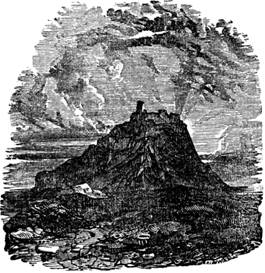
Fig. 79—Birs Nimrud
From the Holy Scriptures it appears that when Nebuchadnezzar conquered Jerusalem and leveled most of the city with the ground, ’he brought away the treasures of the temple, and the treasures of the king’s house, and put them all into the temple of Bel at Babylon.’ The brazen and other vessels which Solomon had caused to be made for the service of Jehovah are said to have been broken up by order of the Assyrian monarch, and formed into the famous gates of brass which so long adorned the superb entrances into the great area of the temple of Belus. The purposes to which this splendid edifice was appropriated varied in some degree with the changes in opinions and manners which successive ages brought. Consecrated at the first, as it probably was, to the immoderate ambition of the monotheistic children of the Deluge, it passed to the Sabian religion, and thus falling one degree from purity of worship, became a temple of the sun and the rest of the host of heaven, till, in the natural progress of corruption, it sank into gross idolatry; and was polluted by the vices which generally accompanied the observances of heathen superstition. In one purpose it undoubtedly proved of service to mankind. The Babylonians were given to the study of astronomy. This ennobling pursuit was one of the peculiar functions of the learned men, denominated by Herodotus, Chaldeans, the priests of Belus; and the temple was crowned by an astronomical observatory, from the elevation of which the starry heavens could be most advantageously studied over plains so open and wide, and in an atmosphere so clear and bright, as those of Babylonia.
The present appearance of the tower as preserved in the Birs Nimrud is deeply impressive, rising suddenly as it does out of a wide desert plain, with its rent, fragmentary, and fire-blasted pile, masses of vitrified matter lying around, and the whole hill itself on which it stands caked and hardened out of the materials with which the temple had been built. A very considerable space round the tower, forming a vast court or area, is covered with ruins, affording abundant vestiges of former buildings; exhibiting uneven heaps of various sizes, covered with masses of broken brick, tiles, and vitrified fragments—all bespeaking some signal overthrow in former days. The towerlike ruin on the summit is a solid mass 28 feet broad, constructed of the most beautiful brick masonry. It is rent from the top nearly halfway to the bottom. It is perforated in ranges of square openings. At its base lie several immense unshapen masses of fine brickwork—some changed to a state of the hardest vitrification, affording evidence of the action of fire which seems to have been the lightning of heaven. The base of the tower, at present, measures 2082 feet in circumference. Hardly half of its former altitude remains. From its summit, the view in the distance presents to the south an arid desert plain; to the west the same trackless waste; towards the north-east marks of buried ruins are visible to a vast distance.
The great pyramid was much higher, being 480 ft. The temple at Warka is of ruder style than the tower of Babel (Genesis 11). The bricks are sun-dried, and of different sizes and shapes. The cement is mud; whereas in the tower of Babel they" burnt them thoroughly," and had bitumen ("slime") "for mortar." The Mugheir temple is exactly such in materials. The writing found in it is assigned to 2300 B.C. The tower of Babel was probably synchronous with Peleg (Gen 10:25) when the earth was divided, somewhat earlier than 2300 B.C. The phrase "whose top (may reach) unto heaven" is a figure for great height (compare Deu 1:28). Abydenus in Eusebius’ Praep. Evan. 9:14-15, preserves the Babylonian tradition. "Not long after the flood men were so puffed up with their strength and stature that they began to despise the gods, and labored to erect the tower now called Babylon, intending thereby to settle heaven. But when the winds approached the sky, lo, the gods called in the aid of the winds and overturned the tower.
The ruin is still called Babel, because until this time all men had used the same speech, but now there was sent on them a confusion of diverse tongues." The Greek myth of the giants’ war with the gods, and attempt to scale heaven by piling one mountain upon another, is another corrupted form of the same truth. The character of the language in the earliest Babylonian monuments, as far back as 2800 B.C., is remarkably mixed: Turanian in structure, Ethiopian (Cushite) mainly in vocabulary, with Semitic and Aryan elements, conformably with the Bible account that Babel was the scene of the confusion of tongues. Turano Cushite themselves, they adopted several terms from the Aryan and Semitic races, of whom some must have remained at Babel after the migration of the majority. This mixed character is not so observable in other early languages.
By: Morris Jastrow, Jr., Ira Maurice Price, Marcus Jastrow, Louis Ginzberg, Duncan B. McDonald
—Biblical Data:
The story of the building of the city and the Tower of Babel as found in Gen. xi. 1-9 is briefly as follows: The whole human race spoke one and the same language, and formed one community. This community or clan settled permanently in the land of Shinar, not far from the Euphrates river. Here they built a city and a tower of such materials as a great river-basin would afford and the genius of man could manufacture. Apparently this was done to prevent their scattering abroad and losing their tribal unity, to make a great center about which they might gather, and to obtain for themselves a name. Yhwh came down to investigate the purpose of all this unusual enterprise. The self-confidence and unity of the people were everywhere prominent. Fearful that the accomplishment of this project might embolden them to still more independent movements,Yhwh said, "Let us go down, and there confound their language." Consequently they were scattered abroad upon the face of all the earth; "and they left off to build the city." The name of it was therefore called "Babel," because there Yhwh confounded the one language of the earth.
J. Jr. I. M. P.—In Rabbinical Literature:
The Midrashim give different accounts of the real cause for building the Tower of Babel, and of the intentions of its builders. It was regarded even in the Tannaite tradition as a rebellion against God (Mek., Mishpaṭim, 20, ed. Weiss, p. 107; Gen. R. xxxviii. 9), and the later Midrash records that the builders of the Tower, called  , "the generation of secession" in the Jewish sources, said: "He—God—has no right to choose the upper world for Himself, and to leave the lower world to us; therefore we will build us a tower, with an idol on the top holding a sword, so that it may appear as if it intended to war with God" (Gen. R. xxxviii. 7; Tan., ed. Buber, Noaḥ, xxvii. et seq.). The building of the Tower was meant to bid defiance not only to God, but also to Abraham, who exhorted the builders to reverence: therefore the Bible (Gen. xi. 1) speaks of the
  , "one speech," which is interpreted as signifying speech against "the One," against God, and against His one, only follower (compare Ezek. xxxiii. 24). The passage furthermore mentions that the builders spoke sharp words—
 —against God, not cited in the Bible, saying that once every 1,656 years—according to Seder 'Olam, 1,656 years elapsed between the Creation and the Flood—heaven tottered so that the water poured down upon the earth, therefore they would support it by columns that there might not be another deluge (Gen. R. l.c.; Tan. l.c.; similarly Josephus, "Ant." i. 4, § 2). Some among that sinful generation even wanted to war against God in heaven (Sanh. 109a, and the passage from the Sibylline Books iii. 100, cited by Josephus, l.c.). They were encouraged in this wild undertaking by the fact that arrows which they shot into the sky fell back dripping with blood, so that the people really believed that they could wage war against the inhabitants of the heavens ("Sefer ha-Yashar," Noaḥ, ed. Leghorn, 12b). According to Josephus and Pirḳe R. El. xxiv., it was mainly Nimrod who persuaded his contemporaries to build the Tower, while other rabbinical sources assert, on the contrary, that Nimrod separated from the builders (compare Ginzberg, "Die Haggada bei den Kirchenvätern," pp. 88, 89).
Tower of Babel.(From the Sarajevo Haggadah.)
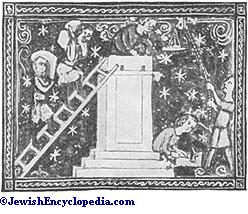
Building of the Tower.
Six hundred thousand men ("Sefer ha-Yashar," 12a) were engaged for forty-three years (Book of Jubilees x.) in building the Tower. The Tower had reached such a height that it took a whole year to hoist up necessary building-material to the top; in consequence, materials became so valuable that they cried when a brick fell and broke, while they remained indifferent when a man fell and was killed. They behaved also very heartlessly toward the weak and sick who could not assist to any great extent in the building; they would not even allow a woman in travail to leave the work (Greek Apocalypse of Baruch iii.). God at first permitted the people to continue with their work, waiting to see whether they would not desist from their sinful undertaking, and when they still continued, He endeavored to induce them to repent (Gen. R. l.c.; Tan. l.c.; Mek., Beshallaḥ, Shirah, 5), but all in vain. The confounding of the languages—before that they all had spoken Hebrew—then compelled them to give up the work, many also perishing on the occasion; for if any one received stones instead of mortar through the misunderstanding of his fellow-workers, he grew angry and threw the stones upon the one who had given them ("Sefer ha-Yashar," 12b). A part of the builders were changed into apes, evil spirits, demons, and ghosts walking by night (Sanh. l.c.; Greek Apocalypse of Baruch ii.), and the rest were scattered over the whole earth. The mighty Tower was blown down by winds (Sibyllines l.c.; Josephus, l.c.; Mek., Beshallaḥ, 4, ed. Weiss, 37); according to the opinion of others, one-third of the building was consumed by fire, one-third sank into the earth, and one-third remained standing (Sanh. l.c.; Gen. R. l.c. 8). In order to convey an idea of the height of the Tower, it is said that to any one who even now stands upon the ruins, tall palmtrees below him appear like grasshoppers. This remnant of the Tower is said to be at Borsippa.
Although the generation of the builders of the Tower was much more wicked than that which perished during the Flood, the punishment of the latter was much more severe, because they were robbers, while the former lived in peace with one another, and peace is of such supreme importance that God spares even idolaters so long as they live peaceably (Gen. R. l.c. 7). Compare Languages, Seventy.
Bibliography:
Ginzberg, Die Haggada bei den Kirchenvätern, pp. 88, 91-94.
—In Mohammedan Literature:
That some story about Babel had reached Mohammed appears to be certain; but it was in a singularly imperfect form and was confused by him with another story about Khordad and Mordad, two of the Parsi Amshaspands. The one reference appears in Koran (sura ii. 96):
"But they followed that which the Satans recited against the kingship of Solomon—and Solomon was no unbeliever, but theSatans are unbelievers, teaching men magic—and that which was revealed to the two angels in Babil, Harut, and Marut. They do not teach any one until they say, 'We are nothing but a temptation, so be not an unbeliever.' The people learn from them that by which they may divide between man and wife, yet they injure none thereby, save by the permission of God; they learn that which hurts themselves and profits them not."
Here all that is left of the Babel story is the name and the idea that there separation may be brought about. As to Harut and Marut, the Moslem commentators explain that they were two angels sent down by God to teach men magic, in order to try them and to show them the difference between magic and miracle. It is a story of the Jews, continues the commentator Baidawi (in loco), but to be rejected, that they assumed flesh, were seduced by a woman Zuhara into lust and rebellion against God, and taught her how to ascend up into the heavens. But later Islam embraced this Jewish legend in its full extent, and exhausted its imagination in portraying the well at Babil with the rebellious angels hung in it by the heels and giving lessons in magic to whomever would come to them (see Lane's "Arabian Nights," chap. iii., note 14, and Al-Tha'labi's "Ḳiṣaṣ al-Anbiyya," pp. 43 et seq.; compare Cairo ed., 1298).
With so vague a reference in the Koran and with a fundamental confusion like this to contend against, the stories of the Tower and of the confusion of tongues have left little or no mark on popular Islam; the "Arabian Nights" know nothing of them. Some of the historians know of the confusion of tongues only. Thus in Yaḳut (i. 448 et seq.) and the "Lisan al-'Arab" (xiii. 72) God brought mankind into the plain afterward called "Babil," by means of winds sweeping them together. There He assigned to each his separate speech, and the winds again scattered them to their appointed lands.
In one place Tabari ("Annales," ed. de Goeje, i. 220) gives a tradition that Nimrod ruled at Babil and his people were Moslems. But he seduced them to idolatry, and in a single day God confused their speech, which had been Syriac, and they became of seventy-two tongues. In another place (p. 224) Tabari tells the story practically as in Genesis. Ibn Wadiḥ (i. 17) has a longer narrative on the same lines. Abu 'Isa, the astronomer quoted by Abu al-Fida ("Hist. Anteisl.," ed. Fleischer, p. 18), also tells the Biblical story of the Tower and the confusion. He adds that Eber alone, because he did not join the others in their impious attempt, was permitted to retain the original Hebrew language. This is in curious contrast with the other narratives, which view Syriac as the original tongue. It is possible that the belief, current in all the Moslem world, that Syriac was the original language, is to be traced to the influence of the Syriac "Cave of Treasures" and the Arabic "Kitab al-Majall," with their anti-Jewish polemics.
—Critical View: Etymology: "Gate of God."
According to the modern analysis of the Pentateuch, the section Gen. xi. 1-9 is derived from J, or the Jahvistic writer. The name is there explained as from a stem-word "balal" (confound). This is probably a folk-etymology founded upon the similarity of the proper name to the Hebrew stem or to the event that occurred at Babel. The Babylonian language, probably indigenous to this region, gives the true etymology of "Babel." It is compounded of "bab" (gate) and "ili" (God), literally, "the gate of God." It should be noticed, too, that this name was given to both the Tower and the city, and that the cessation of building operations is referred to in connection with the city only, the tower not even being mentioned. The records of Gen. x. give a picture of the settlement of mankind upon various portions of the earth's surface. This "table of the nations" is an ethnographical map of the ancient Oriental world. The exact time of its preparation can not, with the present data, be fixed. The location of the great majority of the peoples has been determined. It has been noted, too, that the inhabitants of these communities, districts, provinces, and cities spoke different languages. The questions, how men were scattered from one common center to all these sections of the ancient world, and how they happened to speak diverse tongues, are answered by the insertion, after ch. x., of Gen. xi. 1-9.
Up to the present time no ancient documents, giving a parallel legend, such as those of the Babylonian accounts of the Creation and the Deluge, have been discovered. But another class of facts may point in the direction of answering the above question. Philologists have not yet solved the question as to the common origin of all the languages of mankind; but scientists agree that the physiognomy, the physiology, the psychology, and the religious nature of man are practically the same all over the world. This is not an absolute proof of the unity of the race; but it points to a dispersion of men from a common center, and as the descendants of a common stock.
Position of Babel.
There is general agreement that the Tower of Babel was in lower Babylonia, not far from the River Euphrates. Two principal locations are given in the literature of the subject: (1) the ruins of Birs-Nimrud at old Borsippa, south of the site of old Babylon; and (2) the ruins within the circuit of ancient Babylon itself. In the first case, Nebuchadnezzar (in his Borsippa inscription, cols. i. and ii.) tells how he repaired and finished a "ziḳḳurat," or tower, which had been left unfinished, at a height of 42 ells, by a former king. This tower, dedicated to Nebo, was called "E-zida" (Enduring Temple or House), and consisted of seven stages or stories. The conspicuous character of the present-day remains of this Tower has attracted attention since the time of Benjamin of Tudela (about 1160); and many scholars have found in this mass of ruins the remains of the Tower of Babel of Gen. xi. The latest expositor of this view is John P. Peters ("Jour. Biblical Literature," 1896, xv. 106 et seq.).
Nebuchadnezzar's Borsippa Inscription.
The second view is that the ruins of old Babylon include the site of the Tower of the record. The narrative itself speaks of a city and a tower; and, as stated above, the cessation of labor is mentioned with regard to the city only. The name "Babel" would most naturally connect this event with the city of Babylon. Nebuchadnezzar, too (in his Borsippainscription), states that he built and finished at Babylon "E-sag-ila" (Temple of Heaven and Earth), the dwelling of the god of gods, Marduk; and likewise the story-tower, "E-temen an-ki" (Temple of the Foundation of Heaven and Earth). Of this latter he says (Rawlinson, "Cuneiform Inscriptions of Western Asia," v. 34, col. i. 53, 54): "E-temen-an-ki, the ziḳḳurat of Babylon I built anew," and adds immediately thereafter: "E-zida, the lasting house, beloved of Nebo, in Borsippa, I built anew." The same language is used with reference to the construction of both of these edifices. This being so, there must be a preference for Babylon as the probable site of the Babel of Gen. ix. 1-9, the ruins of which answer the requirements of both a tower and a city. See Babylon and Shinar.
Bibliography:
H. Rawlinson, in Smith-Sayce, Chaldean Genesis, pp. 171 et seq. For the critical analysis of the eleventh chapter of Genesis and the various problems connected with the tradition of the Tower of Babel, see Budde, Biblische Urgeschichte, and the commentaries of Dillmann, Strack, Holzinger, and Gunkel; J. P. Peters, as above.
BABEL, TOWER OF.—See Tower of Babel.
The "Tower of Babel" is the name of the building mentioned in Genesis 11:1-9.History of the TowerThe descendants of Noe had migrated from the "east" (Armenia) first southward, along the course of the Tigris, then westward across the Tigris into "a plain in the land of Sennar". As their growing number forced them to live in localities more and more distant from their patriarchal homes, "they said: Come, let us make a city and a tower, the top whereof may reach to heaven; and let us make our name famous before we be scattered abroad into all lands." The work was soon fairly under way; "and they had brick instead of stones, and slime (asphalt) instead of mortar." But God confounded their tongue, so that they did not understand one another’s speech, and thus scattered them from that place into all lands, and they ceased to build the city.This is the Biblical account of the Tower of Babel. Thus far no Babylonian document has been discovered which refers clearly to the subject. Authorities like George Smith, Chad Boscawen, and Sayce believed they had discovered a reference to the Tower of Babel; but Frd. Delitzch pointed out that the translation of the precise words which determine the meaning of the text is most uncertain (Smith-Delitzsch. "Chaldaische Genesis", 1876, 120-124; Anmerk., p. 310).Oppert finds an allusion to the Tower of Babel in a text of Nabuchodonosor; but this opinion is hardly more than a theory (cf. "The Cuneiform Inscriptions of Western Asia", I, pl. 38, col. 2, line 62; pl. 41, col. 1, I. 27, col. 2, 1. 15; Nikel, "Genesis und Keilschriftforschung", 188 sqq.; Bezold, "Ninive und Babylon", 128; Jeremias, "Das alte Testament im Lichte des alten Orients", 2nd ed., Leipzig, 1906, 286; Kaulen, "Assyrien und Babylonien", 89).A more probable reference to the Tower of Babel we find in the "History" of Berosus as it is handed down to us in two variations by Abydenus and Alexander Polyhistor respectively ("Histor. Graec. Fragm.", ed. Didot, II, 512; IV, 282; Euseb., "Chron.", I, 18, in P.G., XIX, 123; "Praep. Evang.", IX, 14, in P.G., XXI, 705). Special interest attaches to this reference, since Berosus is now supposed to have drawn his material from Babylonian sources.Site of the Tower of BabelBoth the inspired writer of Genesis and Berosus place the Tower of Babel somewhere in Babylon. But there are three principal opinions as to its precise position in the city.(1) Pietro della Valle ("Viaggi descritti", Rome, 1650) located the tower in the north of the city, on the left bank of the Euphrates, where now lie the ruins called Babil. Schrader inclines to the same opinion in Riehm’s "Handworterbuch des biblischen Altertums" (I, 138), while in "The Cuneiform Inscriptions" (I, 108) he leaves to his reader the choice between Babil and the temple of Borsippa. The position of Babil within the limits of the ancient Babylon agrees with the Biblical location of the tower; the name Babil itself may be regarded as a traditional relic of the name Babel interpreted by the inspired writer as referring to the confusion of tongues.(2) Rawlinson (Smith-Sayce, "Chaldean account of the Genesis", 1880, pp. 74, 171) places the tower on the ruins of Tell-Amram, regarded by Oppert as the remnants of the hanging gardens. These ruins are situated on the same side of the Euphrates as those of the Babil, and also within the ancient city limits. The excavations of the German Orientgesellschaft have laid bare on this spot the ancient national sanctuary Esagila, sacred to Marduk-Bel, with the documentary testimony that the top of the building had been made to reach Heaven. This agrees with the description of the Tower of Babel as found in Genesis 11:4: "The top whereof may reach to heaven". To this locality belongs also the tower Etemenanki, or house of the foundation of Heaven and earth, which is composed of six gigantic steps.(3) Sayce (Lectures on the Religion of the Ancient Babylonians, p. 112-3, 405-7), Oppert ("Expédition en Mésopotamie", I, 200-16; "Études assyriennes", pp. 91-132), and others follow the more common opinion which identifies the tower of Babel with the ruins of the Birs-Nimrud, in Borsippa, situated on the right side of the Euphrates, some seven or eight miles from the ruins of the city proper. They are the ruins of the temple Ezida, sacred to Nebo, which according to the above-cited inscription of Nabuchodonosor, was repaired and completed by that king; for it had been left incomplete by a former ruler in far distant days. These data are too vague to form the basis of an apodictic argument. The Babylonian Talmud (Buxtorf, "Lexicon talmudicum", col. 313) connects Borsippa with the confusion of tongues; but a long period elapsed from the time of the composition of Genesis 11 to the time of the Babylonian Talmud. Besides, the Biblical account seems to imply that the tower was within the city limits, while it is hardly probably that the city limits extended to Borsippa in very ancient times. The historical character of the tower is not impaired by our inability to point out its location with certainty.Form of the Tower of BabelThe form of the tower must have resembled the constructions which today exist only in a ruined condition in Babylonia; the most ancient pyramids of Egypt present a vestige of the same form. Cubic blocks of masonry, decreasing in size, are piled one on top of the other, thus forming separate stories; an inclined plane or stairway leads from one story to the other. The towers of Ur and Arach contained only two or three stories, but that of Birs-Nimrud numbered seven, not counting the high platform on which the building was erected. Each story was painted in its own peculiar colour according to the planet to which it was dedicated. Generally the corners of these towers faced the four points of the compass, while in Egypt this position was held by the sides of the pyramids. On top of these constructions there was a sanctuary, so that they served both as temples and observatories. Their interior consisted of sun-dried clay, but the outer walls were coated with fire-baker brick. The asphalt peculiar to the Babylonian neighbourhood served as mortar; all these details are in keeping with the report of Genesis. Though some writers maintain that every Babylonian city possessed such a tower, or zikkurat (meaning "pointed" according to Schrader, "raised on high" according to Haupt, "memorial" according to Vigouroux), no complete specimen has been preserved to us. The Tower of Khorsabad is perhaps the best preserved, but Assyrian sculpture supplements our knowledge of even this construction. The only indication of the time at which the Tower of Babel was erected, we find in the name of Phaleg (Genesis 11:10-17), the grandnephew of Heber; this places the date somewhere between 101 and 870 years after the Flood. The limits are so unsatisfactory, because the Greek Version differs in its numbers from the Massoretic text.-----------------------------------Besides the works indicted in the course of the articles, see RAWLINSON, The Five Great Monarchies, II (London, 1862-7, 1878), 534-5; SCHRADER-WHITEHOUSE, The Cuneiform Inscriptions and the Old Testament, I (London, 1885-8), 106-14; HOBERG, Genesis, 2nd ed. (Freiburg, 1899), 129. For critical view, see SKINNER, Genesis (New York, 1910, 228 sqq.A.J. MAAS Transcribed by Thomas M. Barrett Dedicated to those studying linguistics and ancient languages The Catholic Encyclopedia, Volume XVCopyright © 1912 by Robert Appleton CompanyOnline Edition Copyright © 2003 by K. KnightNihil Obstat, October 1, 1912. Remy Lafort, S.T.D., CensorImprimatur. +John Cardinal Farley, Archbishop of New York
This expression does not occur in the Old Testament, but is used popularly for the tower
1. General Form of Babylonian Temple-Towers
There was a great difference, however, between a Canaanite
2. Their Babylonian Name
These erections had, with the Babylonians, a special name:
3. Whereabouts of the Tower of Babel
There has been much difference of opinion as to the geographical position of the Tower of Babel. Most writers upon the subject, following the tradition handed down by the Jews and Arabs, have identified it with the great Temple of Nebo in the city of Borsippa, now called the
4. Its Position at Babylon
This structure was situated in the southern portion of the city, not far from the right bank of the Euphrates, and according to Weissbach, is now represented by a depression within which is the original rectangular core of unbaked brick. From its shape, the Arabs have made this site
5. A Babylonian Description of the Tower
First there was the outer court called the “grand court,” measuring, according to G. Smith’s estimate, 1,156 ft. by 900 ft., and a smaller one, called “the court of Ishtar and Zagaga,” 1,056 ft. by 450 ft. Round the court were six gates admitting to the temples: (1) The grand gate; (2) The gate of the rising sun (east); (3) The great gate; (4) The gate of the colossi; (5) The gate of the canal; and (6) The gate of the tower-view.
6. The Platform
After this came a space or platform apparently walled - a
7. The Chapels and Shrines
Round the base of the Tower were small temples or chapels dedicated to the various gods of the Babylonians. On the East were 16 shrines, the principal of them being dedicated to Nebo and
8. The Tower in Its First Stage
In the center of these groups of buildings stood the great Tower in stages, called by the Babylonians “the Tower of Babel” (
9. The Remaining Stages
The second stage was 13
10. The Chapel at the Top
On this was raised what Smith calls the 7th stage, namely, the upper temple or sanctuary of the god Bel-Merodach, 4
11. Herodotus’ Description
With this detailed description, which is quite what would be expected in a Babylonian account of such a celebrated temple, the description in Herodotus (i.181ff) agrees. He states that it was a temple square in form, two furlongs (1, 213 ft.) each way, in the midst of which was built a solid tower a furlong square (nearly 607 ft.). This, however, must have been the platform, which, with the six stages and the chapel on the top, would make up the total of eight stages of which Herodotus speaks. The ascent by which the top was reached he describes as running “outside round about all the towers” - wording which suggests, though not necessarily, that it was spiral - i.e. one had to walk round the structure 7 times to reach the top. Representations on Babylonian boundary-stones suggest that this view would be correct, though a symmetrical arrangement of inclined paths might have been constructed which would have greatly improved the design. At the middle of the ascent, Herodotus says, there was a stopping-place with seats to rest upon, which rather favors this idea. At the top of the last tower there was a large cell, and in the cell a large couch was laid, well covered; and by it a golden table. There was no image there, nor did any human being spend the night there, except only a woman of the natives of the place chosen by the god, “as say the Chaldeans who are the priests of this god.” These men told Herodotus that the god often came to the cell, and rested upon the couch, “but,” he adds, “I do not believe them.” After mentioning parallels to this at Egyptian Thebes and Patam in Lycia, he goes on to speak of another cell below (that referred to in G. Smith’s tablet) wherein was a great image of Zeus (Bel-Merodach) sitting, with a footstool and a large table, all of gold, and weighing no less than 800 talents. Outside of this cell was an altar to the god, made of gold; and also another altar, whereon full-grown animals were sacrificed, the golden altar being for sucklings only. The Chaldeans also told him that there was, in the precincts of the building, a statue 12 cubits high, and of solid gold. Darius Hystaspis desired to take possession of this valuable object, but did not venture. His son Xerxes, however, was not so considerate of the feelings of the people and the priesthood, for he also killed the priest when he forbade him to meddle with it.
12. The Builders of the Tower
The Bible record does not state who the people were who journeyed in the East and built the city and the Tower. The indefinite “they” might be taken to mean whatever people were there at the time the record was written, and probably presupposes that the reader would certainly know. As the Tower of Babel bears, in the native inscriptions, a Sumero-Akkadian name, it may be supposed that the builders referred to belonged to that race.
13. Traditions Concerning Its Destruction
It is noteworthy that nothing is said in Gen concerning the stoppage of the erection, though they ceased to build the city. Bochart records a Jewish tradition which makes the tower to have been split through to its foundation by fire which fell from heaven - suggested probably by the condition of the tower at “the second Babylon,” i.e. the Birs Nimroud. Another tradition, recorded by Eusebius (Prep. Evang., ix; Chronicon, 13; Syncel. Chron., 44) makes it to have been blown down by the winds; “but when it approached the heavens, the winds assisted the gods, and overturned the work upon its contrivers: and the gods introduced a diversity of tongues among men, who, until that time, had all spoken the same language.”
14. The Meaning of “Babel”
The place where they built the Tower was called Babylon, on account of the confusion of languages. Here we have again the statement as in Gen that the meaning of Babel is “confusion.” This, as is well known, is based upon the purely Hebrew etymological law, which makes
15. The Ultimate Destruction of the Tower
That the building of the city would have been stopped when the confusion of tongues took place is natural - the departure of the greater part of the inhabitants made this inevitable. When the population increased again, the building of the city was continued, with the result that Babylon ultimately became the greatest city of then known world. The Tower, notwithstanding what had been said as to its destruction, remained, and when, as happened from time to time, its condition became ruinous, some energetic Babylonian king would restore it. Alexander and Philip of Macedon began clearing away the rubbish to rebuild the great temple of bclus (Bel-Merodach) connected with it and there is hardly any doubt that the Tower would have been restored likewise, but the untimely death of the former, and the deficient mental caliber of the latter for the ruling of a great empire, put an end to the work. The Tower therefore remained unrepaired - “The tower was exceedingly tall. The third part of it sank down into the ground, a second third was burned down, and the remaining third was standing until the time of the destruction of Babylon” (
16. No Idea of Reaching Heaven
Concerning the reputed intention of the builders of the Tower, to carry it as high as the heavens, that, notwithstanding the Talmud and other writings, may be dismissed at once. The intention was to build a very high tower, and that is all that is implied by the words employed. That the Babylonians would have liked their tower to reach heaven may be conceded, and the idea may be taken as symbolical of Babylon’s pride, the more especially as they regarded it as “the house of the foundation of heaven and earth.” Though at present brought lower than the other temple-towers of Babylonia, its renown remains as one of the great glories of that renowned capital. Dedicated as it was to the gods whom they worshipped, and chiefly to the glory of Merodach, the representative of Babylonian monotheism, the Babylonians’ descendants, the native Christians, have no reason to remember this erection of their forefathers with shame, but rather with pride. The rallyingpoint of nations, Babylon, while it existed, was always a great commercial center, and many are the languages which have resounded in the Tower’s vicinity. The confusion of tongues led to the Jewish fiction that the air of Babylon and Borsippa caused forgetfulness, and was therefore injurious to students of the Law, causing them to forget it as the builders of the Tower had of old forgotten their speech (Rashi,
The tower built the builders at Babel constructed which became a symbol of their defiance against God (Gen 11:1-6). It was probably modeled after a ziggurat which is a mound of sun-dried bricks and was probably constructed before 4,000 BC.