
This was another of the heathen idols, and as we learn from the book of Joshua, (chap. xi, 17.) was set up in the valley of Lebanon.. Gad means fortune; so that Baal - gad means a lord of fortune.
Ba´al-Gad, a city ’in the valley of Lebanon under Mount Hermon’ (Jos 11:17; Jos 12:7). We are also informed that among those parts of Palestine which were unsubdued by the Hebrews at the death of Joshua, was ’all Lebanon towards the sun-rising, from Baal-gad, under Mount Hermon unto the entering into Hamath’ (Jos 13:5). This position of Baal-Gad is not unfavorable to the conclusion which some have reached, that it is no other than the place which, from a temple consecrated to the sun, that stood there, was called by the Greeks Heliopolis, i.e. city of the sun; and which the natives called and still call Baalbek, a word apparently of the same meaning.
Baalbek is pleasantly situated on the lowest declivity of Anti-Libanus, at the opening of a small valley into the plain El-Bekaa. Through this valley runs a small stream, divided into numberless rills for irrigation. The place is in N. lat. 34° 1′ 30″, and E. 36° 11″, distant 109 geog. miles from Palmyra, and 38¾ from Tripoli.
Its origin appears to be lost in the most remote antiquity, and the historical notices of it are very scanty. In the absence of more positive information we can only conjecture that its situation on the high-road of commerce between Tyre, Palmyra, and the farther East, must have contributed largely to the wealth and magnificence which it manifestly attained. It is mentioned under the name of Heliopolis by Josephus, and also by Pliny. From the reverses of Roman coins we learn that Heliopolis was constituted a colony by Julius Caesar; that it was the seat of a Roman garrison in the time of Augustus. Some of the coins of later date contain curious representations of the temple.
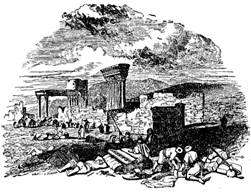
Fig. 78—Heliopolis
After the age of Constantine the splendid temples of Baalbek were probably consigned to neglect and decay, unless indeed, as some appearances indicate, they were then consecrated to Christian worship. From the accounts of Oriental writers Baalbek seems to have continued a place of importance down to the time of the Muslim invasion of Syria. They describe it as one of the most splendid of Syrian cities, enriched with stately palaces, adorned with monuments of ancient times, and abounding with trees, fountains, and whatever contributes to luxurious enjoyment. On the advance of the Muslims, it was reported to the emperor Heraclius as protected by a citadel of great strength, and well able to sustain a siege. After the capture of Damascus it was regularly invested by the Muslims, and—containing an overflowing population, amply supplied with provisions and military stores—it made a courageous defense, but at length capitulated. Its importance at that period is attested by the ransom exacted by the conquerors, consisting of 2000 ounces of gold, 4000 ounces of silver, 2000 silk vests, and 1000 swords, together with the arms of the garrison. It afterwards became the mart for the rich pillage of Syria: but its prosperity soon received a fatal blow from the caliph of Damascus, by whom it was sacked and dismantled, and the principal inhabitants put to the sword (A.D. 748). During the Crusades, being incapable of making any resistance, it seems to have quietly submitted to the strongest. In the year 1400 it was pillaged by Timour Beg, in his progress to Damascus, after he had taken Aleppo. Afterwards it fell into the hands of the Metaweli—a barbarous predatory tribe, who were nearly exterminated when Djezzar Pasha permanently subjected the whole district to Turkish supremacy.
The ruins of Heliopolis lie on an eastern branch of the mountain, and are called, by way of eminence, the Castle. The most prominent objects visible from the plain are a lofty portico of six columns, part of the great temple, and the walls and columns of another smaller temple a little below, surrounded by green trees. There is also a singular and unique circular temple, if it may be so called, of which we give a figure. These, with a curious column on the highest point within the walls, form the only erect portions of the ruins. The ruins at Baalbek in the mass are apparently of three successive eras: first, the gigantic hewn stones, in the face of the platform or basement on which the temple stands, and which appear to be remains of older buildings, perhaps of the more ancient temple which occupied the site. These celebrated blocks, which in fact form the great wonder of the place, vary from 30 to 40 feet in length; but there are three, forming an upper course 20 feet from the ground, which together measure 190 feet, being severally of the enormous dimensions of 63 and 64 feet in length, by 12 in breadth and thickness. ’They are,’ says Richter, ’the largest stones I have ever seen, and might of themselves have easily given rise to the popular opinion that Baalbek was built by angels at the command of Solomon. The whole wall, indeed, is composed of immense stones, and its resemblance to the remains of the Temple of Solomon, which are still shown in the foundations of the mosque Es-Sakkara on Mount Moriah, cannot fail to be observed.’ In the neighboring quarries, from which they were cut, one stone, hewn out but not carried away, is of much larger dimensions than any of those which have been mentioned. To the second and third eras belong the Roman temples, which, being of and about the time of Antoninus Pius, present some of the finest specimens of Corinthian architecture in existence, and possess a wonderful grandeur and majesty from their lofty and imposing situation (Addison, ii. 57).
The present Baalbek is a small village to the east of the ruins, in a sad state of wretchedness and decay. It is little more than a heap of rubbish, the houses being built of mud and sun-dried bricks. The population of 5000, which the place is said to have contained in 1751, is now reduced to barely 2000 persons; the two handsome mosques and fine serai of the Emir, mentioned by Burckhardt, are no longer distinguishable; and travelers may now inquire in vain for the grapes, the pomegranates, and the fruits which were formerly so abundant.
A city in the valley of Lebanon at the foot of Hermon; the northernmost point, to which the wars of Joshua reached, Jos 11:17 ; 12:7; 13:5. It was perhaps the same as Baal-Hermon. Some have supposed it was Baalbek; but this lay further north.\par
(Heb. id.,
By: Morris Jastrow, Jr., Frants Buhl
A place situated at the northern limit of Palestine, in the valley of Lebanon, near Mount Hermon (Josh. xi. 17, xii. 7, xiii. 5). Since I Chron. v. 23 mentions Baal-hermon as the northern limit of the tribe of Manasseh, it has been supposed that Baal-gad and Baal-hermon are identical. This conjecture is quite possible, and more plausible than that of Gesenius, Raumer, Robinson, and others, according to whom Baal-gad (Hermon) is identical with the later celebrated Paneas (Bâniâs); for Paneas can hardly be said to lie in the valley of Lebanon. Others have connected Baal-gad with Ḥâṣbêjâ in the Biḳa'.
BAAL-GAD (? ‘Baal of fortune’).—A place under Hermon, in the valley of Lebanon, referred to only as the northern limit of the country conquered by Joshua (Jos 11:17; Jos 12:7; Jos 13:5). Various identifications have been suggested, all uncertain. Perhaps Banias is the most probable. See Cæsarea Philippi.
R. A. S. Macalister.