
New Guinea
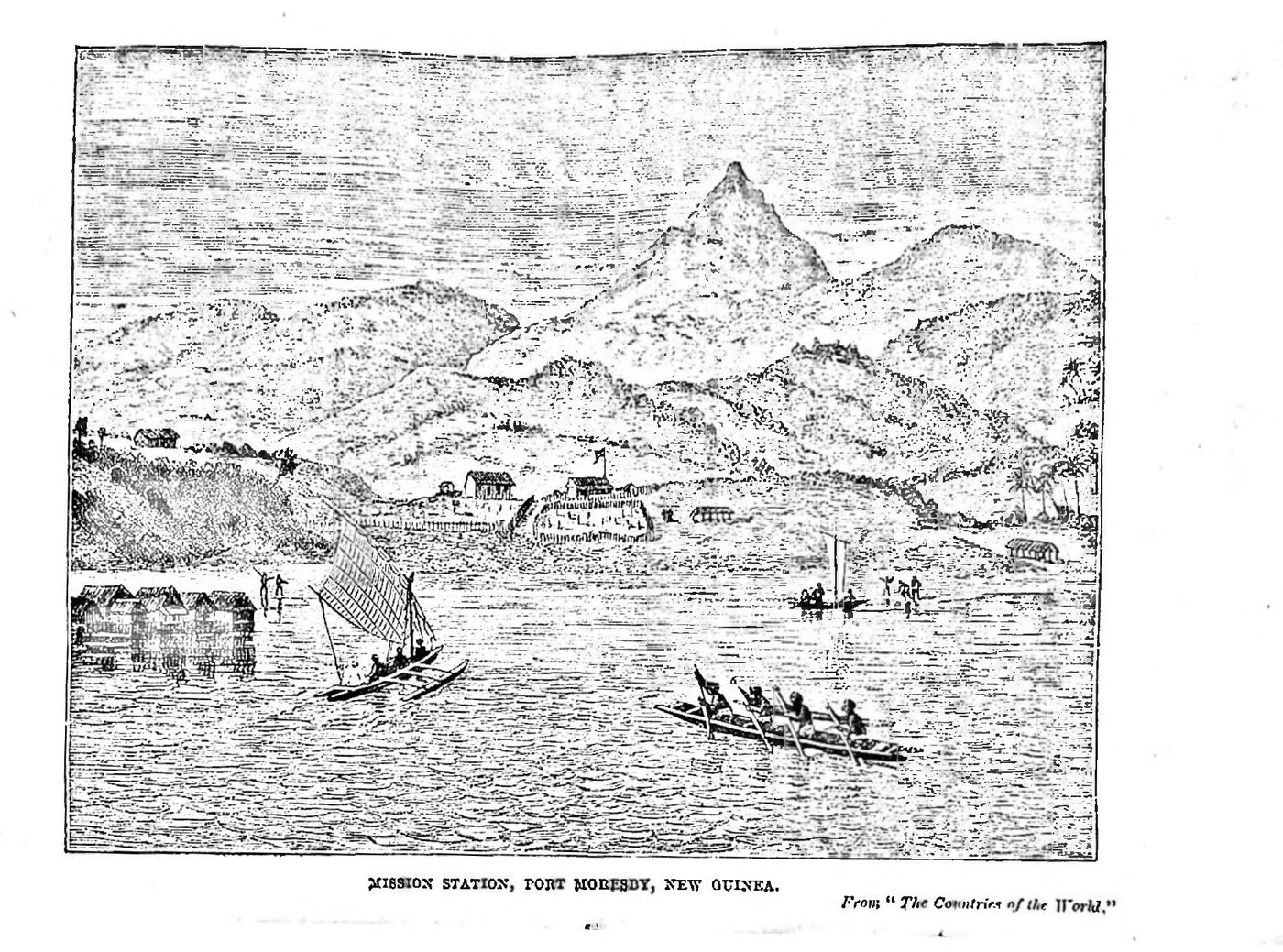
A FIRESIDE traveller may make a competent acquaintance with the various natives and climes of this wonderful globe by looking through the six volumes of "The Countries of the World," by Dr. Robert Brown, published by Messrs. Cassell, Potter, and Galpin. The hundreds of fine engravings, which illustrate Dr. Brown's text, educate the eye in the happiest manner; and while making plain what might not easily be explained by words, they constitute a gallery of original pictures highly creditable to the enterprise of the publishers. Such a work helps us to realize the vast size of this round world of ours, and to estimate the surprising needs of its many races, some of which have not yet emerged from barbarism. Why is it that people still prefer to waste their reading hours over sensational fiction when so much of the romance of real life invites attention?
Though it is one of the least known regions in the world, and one of the last of the great fields which missionary enterprise has invaded, New Guinea, as an island, is only exceeded in size by Australia and Borneo. Including the peninsulas at its extremities the entire length is one thousand four hundred miles, while the breadth varies from over three hundred to twenty miles. The contrasts of the Old World appear to be found in abundance within its ample area. There are plains, swamps, forests rich in rare timber, and valleys overshadowed by mountains rivalling in their gigantic altitude the Alps and the Pyrenees. "Nearly the whole country is covered with a luxuriant forest vegetation," remarks Dr. Brown, "matured by the hot uniform climate and abundant rainfall." The mammals do not appear to be numerous; but it is a paradise for birds, many being of magnificent plumage, and it is even supposed that there are species which have not been discovered. Parrots and pigeons of such brilliant bues are not to be seen elsewhere in the world. The mineral and agricultural resources of the country are practically limitless. The inhabitants, who for the most part are woolly-haired Papuans, are spoken of by certain gold-hunting adventurers as "a most interesting race; of thrifty, industrious habits; and having a kindliness of disposition entirely at variance with our expectations." The total number of aborigines in New Guinea and the neighbouring islands is roughly guessed at 880,000; but that estimate is doubtless very far below the actual number.
The triumphs of the gospel in the South Seas are among the brightest conquests of the church in these later times; but although New Guinea was discovered in 1511 by the Portuguese, the first efforts of the London Missionary Society only carry us back a dozen years. Stimulated in their enterprise by the directors at home, the missionaries of the Loyalty Islands, Messrs. A. W. Murray and S. Macfarlane, fitted out the Surprise, under Captain Paget, in the spring of 1871, and set out on an adventurous voyage, accompanied by eight native teachers, their wives and children. The farewell meeting, at which the adventurers were commended to the Lord's keeping, was held at Lifu on Sunday, the 23rd of April, and on the 29th of June, after a pleasantly prosperous voyage, the mountains of New Guinea were described through a heavy mist which was sadly typical of the moral darkness overshadowing the people. As they approached the great island, the Englishmen of the party especially regarded the scene spreading before them with a prayerful interest which took into account the possibilities of the future. They were in Hood's Bay, at the south-east side of the eastern peninsula; and the scene from the deck of the little vessel is described as having been strikingly interesting. The canoes of the natives were seen close to the shore; and surprised at the unusual
* I. The Countries of the World: being a Popular Description of the Various Continents, Islands, Rivers, Seas, and Peoples of the Globe. By Robert Brown, M.A. Six vols., crown lto. Price 7s. 6d. each. Cassell, Potter, Galpin, and Co.
II. Various papers and reports issued by the London Missionary Society.
phenomenon of a foreign vessel, the men made earnest signals for the strangers to land. They did not do so, however; for as night was coming on, and no boat was sent out, caution appeared to be necessary. The Surprise—never was a pioneer vessel more significantly named—held on her way, and cast anchor at Darnley Island on the 1st of July.
Though the adventure we are writing of took place only twelve years ago, it was really one of the earliest friendly visits which the poor heathen in that remote and out-of-the-way region had ever received from representatives of the Christian church. After its original discovery in 1511, the great island was allowed to remain in its native darkness, the first landing of Europeans having occurred more than a century later, or in 1615. In subsequent times the captains of English and Dutch vessels occasionally called; but as the two missionaries we have named remark in a paper issued in 1872, "the names given by the early Dutch voyagers to the two principal rivers, Moordenaar, or Murderer; and Doodslaager, or Slaughter, prove their intercourse to have been anything but friendly." Captain Cook made a call in 1770; and for fifty-eight years after that date, Cook's meagre account constituted about all the information possessed by geographers concerning a country containing hundreds of thousands of inhabitants, and abounding in the richest gifts of nature. Indeed, there is no reason under this head why New Guinea should not become in the future one of the great nations of the world. "Its shores are covered with groves of cocoa-nuts," remark the two missionaries, who are perhaps better acquainted with the country and its people than any other Englishmen; "and it produces in abundance the banana, sago, betel, figs, oranges, lemons, and other tropical fruits. The interior abounds with valuable timber, as iron-wood, ebony, canary-wood, and also with valuable spices and fragrant bark. Its forests, rivalling those of South America and Ceylon in luxuriance, afford shelter to multitudes of beautiful birds, among which are crown pigeons, black cockatoos, parrots, lories, and birds of paradise. The sea that washes its shores supplies an almost inexhaustible mine of wealth in the shape of trepang, pearls, tortoise-shell, etc. To this catalogue, it is said, gold may be added."
Such a country has certainly not been neglected in consequence of the paucity of its attractions or resources; and thinking of its vast capabilities of development, and of its million—or millions, for aught we know to the contrary—of unenlightened pagans, the pioneer evangelists might well experience some little flutter of excitement on sighting Darnley Island at noon, on Saturday, July 1st, 1871. A solitary man of unprepossessing appearance was on the shore; and though he hesitated at first to visit the ship, this stranger, who turned out to be one of the aristocracy of Darnley, gained so much confidence on receiving a present, that he returned on the Sabbath morning with a number of others whose curiosity had been excited. The service in the Lifu language is supposed to have been the first act of worship rendered to God, the Creator and Lord of all things, which these pagans had ever witnessed. On the same day a conference was held on shore; and in spite of some evil counsels, on the part of those who were too ignorant to comprehend the self-denial of the missionaries, an arrangement was made for the teacher and his family to remain on the island for a year. The inevitable presents were made to the chiefs; and then it was generally understood, that if the presence of the teachers became objectionable they would be removed.
Thus was the great work commenced on Darnley Island, which in itself is not more than eight miles in circumference; and though pretty in the interior, has the disadvantages of a rough coast and of being insufficiently watered; while the inhabitants are described as "a poor, down-trodden-looking race." Those engaged in such an inauguration were not the kind of men and women who would be tempted to despise the day of small things; and although the New Guinea Mission has already had its martyrs, the faith which prompted the grand enterprise has already been rewarded beyond the expectation of the earliest occupiers of the field. The first days were naturally days of difficulty
191
and of discouragement; and while we admire the tact and the wisdom which characterised the procedure of the English missionaries who superintended the operations, we must also yield our tribute of admiration to the heroic converts from neighbouring islands who volunteered to do the sapper-and-miner work of the holy crusade. Their trust and determination were superior to any sense of trial or peril. When it was proposed to set up a station on Murray Island there were some who discouraged the enterprise on account of several terrible obstacles. The place was tenanted by alligators, snakes, and centipedes, the people themselves were savages of so low a type that no Christian could live among them. One of the native teachers, however, had in his mind the command of Christ, and hence he silenced all intimidation by saying that wherever there were men thither missionaries were bound to go.
When the first missionary settlement was founded as described, the Surprise went on her way, the next call having been made at Warrior Island, fifty miles distant. The pioneer company on board had been disappointed in not having found interpreters for the mainland at the last station; but some compensation was found in their meeting with a man named Joseph John, whose extensive knowledge of the sea, the islands, and the various tribes, was of immense service to the mission. Joe, as he was called, became the recognised pilot of the expedition; and having met with adventures in various parts of the world, both in peace and war, he was now moved by a commendable zeal for the diffusion of the gospel among the islanders.
The next call was at Tauan, with the chief of which John was on friendly terms; and after the usual introduction, the chief welcomed the teachers in very cordial terms, offering the most eligible site for building, and lodging the visitors during their stay in the best house in the village—that is to say, his own. It was not the most sumptuous of lodgings according to the standard of our English ideas; but with hearts full of gratitude on account of the success of their cause, the travellers were not discouraged by the straitness of their hut, unlighted as it was by aught save the wood-fire on the floor. The weather had been wet; but though the darkened sky still rendered the outlook sufficiently cheerless, the natives for the first time in their lives were called together to evening prayer. Some friendly conversation followed, and then, as they themselves tell us, the evangelistic pioneers sought that retirement which was congenial with their emotions—"Outside the house, under the canopy of heaven, and with the great dark land of New Guinea before us and close at hand, we sang, 'Jesus shall reign where'er the sun,' etc., poured out our hearts in fervent prayer and thanksgiving, and talked of the spread of his blessed reign, and the far-reaching consequences of the step we had been privileged to take on that ever-memorable evening." On retiring to rest in the upper story of the hut, the adventurers were in no mood to sleep, proving that the poet was wide of the truth when he showed that, "tired nature's sweet restorer . . . his ready visit pays where fortune smiles." It has often been otherwise, and will be so again.
While they were thus engaged in inaugurating the great mission to New Guinea, the voyagers acted with wise foresight in confining their preliminary operations to the islands; for as these are generally far more healthy than the shores of the mainland, they not only served for a series of convenient outposts to begin with, but they promised to be houses of refuge for invalided members of the vanguard who might invade the mighty island later on.
Saibai, another island, is only four miles from Tauan, and on landing here, accompanied by the friendly chief of the latter place, the white skins of the English party, and an umbrella carried by one of the visitors, excited the astonishment of the entire community. The people are described as a superior race to their neighbours on several other islands, though the men are everywhere somewhat indolent, and the women are debased in a deplorable degree. The inhabitants of the islands very greatly differ, as do also the natural characteristics of the islands themselves.
After the out-stations were founded as described, the company on the Surprise
felt that they had inaugurated a work which would probably develop into one of the greatest missionary enterprises of modern times. Going on their way, they next visited Cape York, the northern limit of Australia, for the purpose of conferring with two Christian friends, Mr. Jardine, of the Queensland Government, and Lieutenant Chester, an ex-magistrate, who undertook to do what they could to further the work, and to protect the pioneers who were being stationed on the outlying islands.
A few days later the evangelistic adventurers turned the helm of their little vessel towards the mainland; and they cast anchor at Katan, the mouth of a great river, on July 17th, 1871. Landing unarmed, as became their profession, the missionaries encountered an unarmed population who accorded them the most friendly greeting. There was confidence on both sides; and after the men, and especially the women, had partially gratified their curiosity by gazing at the white men, the like of whom they had never seen before, the object of the mission was described. The chief and his dependents listened in wonder to what his visitors had to say concerning their doings at Tauan, Darnley, and Saibai; and having received some glimmering of the benefits which would spring from resident teachers, he approved of the enterprise, and desired that he might be favoured in common with others. Grateful for having been thus far successful, one of the adventurers wrote: "Thus have we got one open door on the mainland of New Guinea, and who can tell the mighty results to which that may lead? There are some six hundred or seven hundred people connected with the village we visited; there is another settlement a little further up the river on the same side; and there is doubtless a large population on the banks of the river, stretching away into the great unknown interior." While the chief welcomed his new friends, however, he at first desired to enlist their service in aiding him to fight a tribe, with whom he had a quarrel, on the other side of the river. He had yet to learn that the gospel was wholly a message of peace. Apart from this, the people on the mainland were not found to be so warlike nor so ferocious as they had been represented by such roving crews as may possibly have given some occasion for their alleged barbarism. The cruelty of uncivilized tribes has to be cured by gentle means: it is stimulated rather than repressed by the harsh prescription of the rifle and the sword.
Mr. Murray, who had a chief hand in founding the mission in 1871, appears to have had control of the work for about two years; and during that period he continued his work of exploration and visited at short intervals the stations already established. Though the Surprise was the brave little vessel which acted the pioneer with the gospel message, the John Williams afterwards appeared on the scene, as well as the Ellengowan, a convenient little steamer specially provided for the New Guinea Mission by Miss Baxter of Dundee. This was used for six years, and was then, we believe, replaced by a schooner, as being possibly better adapted for the work than a steamer.
Thus was the work commenced; and in another brief paper we purpose noting the progress which has been made in later years. As a mission-field, the great island of the south is not only one of the finest, but one of the most interesting in the wide world. In a cruise undertaken along the south coast in the opening months of 1878, Mr. and Mrs. Chalmers communicated with no less than two hundred villages, more than half of these were personally visited, and ninety out of the number had never been invaded by a white man before. Indeed, Mr. Chalmers was an intrepid explorer of the true Livingstone type; and though frequently exposed to peril, he was continually preserved. There is undoubtedly some risk to be incurred from the treachery of tribes who have been cannibals for generations; but this danger will rapidly diminish as the work extends, and even at present it is hardly so formidable an obstacle as the fever-engendering malaria of the low-lying lands of the coast. In different ways, however, such a work is sure to prosper, until, like Madagascar, New Guinea becomes one of the most distinguished trophies of missionary enterprise.
G. H. P.