
New Mission-Hall, Bermondsey New Bond
BERMONDSEY is a name by no means fragrant to the possessor of a nose, who has passed over it soon after leaving London Bridge, on his way to the sea-breezes of Brighton. But, gentle reader, the smells of tanneries and leather-works, although they are not the odours of sanctity, are said to be those of sanity, and it is currently reported that when the Great Pest devoured the citizens of London, Bermondsey escaped, and its inhabitants were allowed to travel freely where residents of the infected districts were zealously excluded. It is a region where now the philanthropist finds much to attract his notice, for it swarms with working-people, quietly toiling for their daily bread. Innumerable factories carry on a multiform business, employing countless hands, every pair of which is linked with an immortal soul. Walk through its thronged thoroughfares, its dingy streets, its close courts, and try to get some idea of the multitude of bees in this busy hive. You will see something to cheer you, but more to make your heart heavy if you enter the closely-packed abodes, where almost every house lodges two or three families, or even more. It is by no means a place for your man of fashion, or your comfortable, retired tradesman: it is the abode of the strong-sinewed and hard-handed, by whose industry our nation flourishes.
Our principal concern with the region is a religious one. There may be "nothing like leather," but we have not called your attention to Bermondsey because we have hides to sell or skins to buy, nor even that we may indulge you with one of Messrs. Peek and Frcan's biscuits and a morsel of cheese. As those who called at Joppa, at the house of one Simon, a tanner, took little note of his savoury pits, but had spiritual business with Peter, so our mission in Bermondsey is not with skin and wool, but with men and their destinies. The church at the Metropolitan Tabernacle has a warm place in its heart for Bermondsey, and we want you to hear the reason of it, and get you to sympathize therein—sympathize practically too, with that kind of sympathy which means business.
In the old Puritan times our Tabernacle church abode in the then rural region of Horselydown:—what a name! One sees the horses lying down on the common: do horses in London ever lie down now? The very sound of the word raises visions of an old meeting-house surrounded by happy grazing grounds, undefiled by the dust of trams, and omnibuses, and waggons. The church had once been in Goat-yard, and it had a sister-church in Unicorn-yard, and a daughter down in Maze Pond; all the names have a countrified smell about them: it is evident that Tanner's Town was then a rustic region, and happily also a place where godly people were by no means few. Our Keach and Gill were there, and Rippon was on the borders of that region, holding well together the assembly which in these modern days has migrated to where the Butts once stood at Newington. God has blessed that church, and now, in remembering all the way whereby the Lord hath led it, it remembers Bermondsey as Jacob remembered Bethel, and it would fain build a memorial there of which it shall be said by thousands of converted souls, "This is none other than the house of God, and this is the gate of heaven."
This might have been mere sentiment; but Providence has made it into practical necessity. We care for Bermondsey at this time especially because it contains more than 50,000 persons for whom no religious accommodation is provided either in churches or chapels. We put that passage in italics, we should like to print it in letters of fire, that it might burn into every Christian's heart. The printer does not keep such type in stock, and so we beg the reader, if he be a child of God, to turn it over in his mind, and say, "Fifty thousand! Fifty thousand!! No provision for fifty thousand souls!!!" If we were in a right state of heart we should need no other argument, but we should hasten to be among the first to relieve the present distress.
51
From London Bridge to the Old Kent Road, and from the Borough to Dockhead, is a smart walk, but let us take it. Plenty of gin-palaces here, good comrade! More than enough of publics and beerhouses! Surely, it must be what the publicans call "a good drinking neighbourhood"! Work for your blue-ribbon men here, good sir! But where are your places of worship? There does not seem to be much religious rivalry here, at any rate. Salt ran rather short when this region was savoured with religious means. But do these people crowd the few places provided for them? Let us visit the religious edifices. We cannot call on all the ministers, or it might be much to our profit; but we may stand at the door, and watch the multitudes rush in. No, they do not come! How is this? So few places,—will they not be crammed? We see no throngs about the gates; on the average they are no better and no worse attended than in other busy haunts of London. It looks as if the fewer the places the thinner the congregations. What becomes of those many thousands who do not come where there is room, and of the other thousands who could not get in if they did come? Ah, good sir, our somewhat dreary walk is over, and if you will sit down I will tell you a little more about the matter.
We blame nobody for what we are about to state, and certainly mean no reflection upon any of the Clergy or ministers of the neighbourhood, who are all a friendly band: but we know on good authority that in many of these streets there will be found not more than two or three persons who habitually attend any place of worship. The bulk of the population do not care for either churches or chapels; they are neither High Church, nor Low Church, nor Broad Church; but as a rule they may be described as No CHURCH. Therefore we want to build them a Mission-Hall where they may come when they please, dressed how they like, and feel at home. This seems to be their fancy, and it is not altogether an unaccountable one, for they naturally do not care to go in where everybody is in his go to-meeting clothes. If such is their pleasure let us drop into their way, and build them a Hall—a rose by any other name will smell as sweet—and the place will be just as much a place of worship as if we called it Temple or Tabernacle. Let us try any legitimate means to draw these good folks to hear of Jesus.
But will they come into "the Hall" when it is built? That is just the point. We have a gallant band ready to lead the way, and a tried and proved leader, who has in the Green Walk Club-room already raised the standard, and gathered all the makings of a large congregation.
About thirteen years ago a firm of London bankers, who were desirous of benefiting the working-classes in some way, fitted up a building in Green-walk as a Club and Institute, the large upper room being made available for concerts and other entertainments. At that time Mr. W. Olney, jun., was a teacher in the Sunday-school at the Metropolitan Tabernacle. He and about half a dozen members of our church, several of them from Mr. Bowker's Bible-class, thought they would try the experiment of holding a short series of Sabbath services at the Green-walk Institute, and although at first there was no thought of these services becoming permanent, they really became so on account of the success which attended them. After a time a week-night service was added; then followed the establishment of a Sunday-school, and a Loan Tract Society, which now actively carries on operations week by week. Other agencies, such as a Benevolent Fund, a Dorcas Society, and Mothers'-meetings, were added in due course. In addition to all these, however, open-air services on Sunday mornings, and on three nights of the week, became a principal feature of the Mission. The meeting-place is at a corner of Bermondsey New-road; and, with a small harmonium and a choir, the singing invariably attracts a good congregation, to which several addresses are given. Year by year the work has grown, as hundreds of converts can testify, many of whom are now engaged as voluntary assistants in the Mission. Of course the congregation grew also, and the meeting-place at Green-walk having become too straitened for the numbers who attended, the large room of
Bermondsey Town-hall was hired nearly a year ago, and there, on every Sunday evening, about seven hundred persons assemble to benefit by young Mr. William Olney's ministry. Among these are some of the most fervent Christians of our acquaintance, who form a splendid little band, well qualified to lead the van.
Is not this a grand start? We think so. The aforesaid Mr. William Olney is the son and grandson of deacons of the Tabernacle. The name is a worthy one, and he is worthy who now bears it. Without fee or reward he consecrates his life to this work, and the least that the rest of us can do is to assist to build a suitable place for him and his helpers. The work is now fully entered upon, and it ought to be carried on and carried out with enthusiasm. Never was there a more deserving or more hopeful cause.
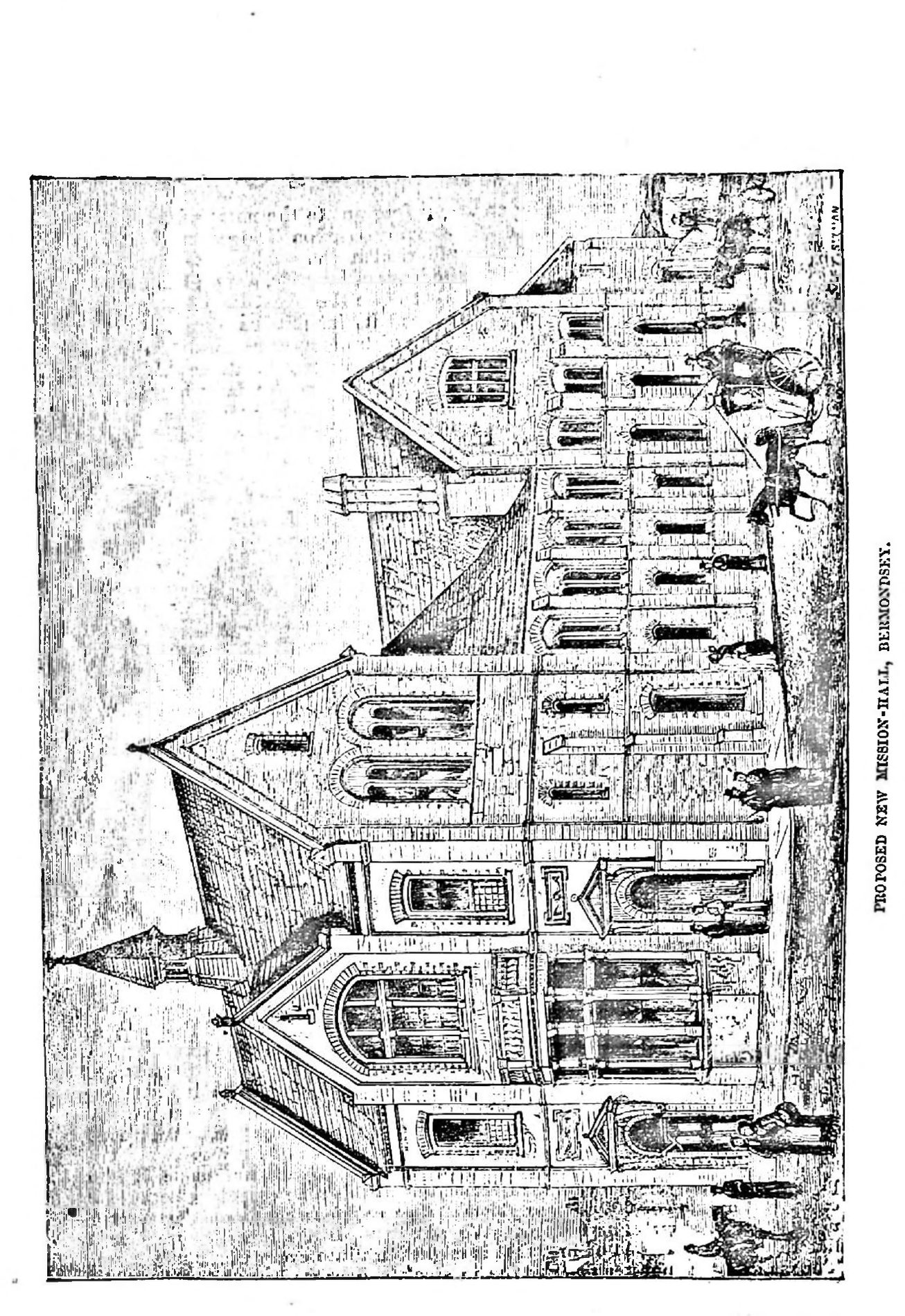
Thus far has been settled. A site, close to Green-walk, measuring forty-five feet by one hundred and twenty-nine feet, has been secured on a long lease from the Corporation of the City of London. On this it is intended at once to commence the erection of the building as represented in the annexed engraving. The hall will be constructed to accommodate seven hundred persons; and in addition to school and class-rooms there will be a reading-room supplied with newspapers and magazines for working-men. Since these people are unable to provide for themselves any such place of worship as it is now proposed to build, it must be done for them by the Christian public, or it will not be done at all. We are hoping that the present scheme will be carried out with spirit, and that the premises will be opened free of debt. It is estimated that the buildings will cost between £4000 and £5000. Several large sums, already promised, bring the contributions up to £2,000, and other subscriptions are now invited. During the first week of the New Year it is intended to hold a grand bazaar at the Metropolitan Tabernacle, where gifts addressed to Mr. W. C. Murrell will be thankfully received. When completed, the new building will be held in trust by several gentlemen, among whom is the Pastor of the Tabernacle: a guarantee being thus afforded that the building will be dedicated to its avowed purpose, and kept for it in perpetuity.
Gentle reader, do not be uneasy; the work is not done: there is room for you yet. A good beginning is made, but we would say to you what David said to Solomon, "Thou mayest add thereto."
Here are people perishing for lack of knowledge, not in the Cannibal Islands, but in the south of London; here is a church loaded up to the last ounce with burdens, yet willing to undertake another enterprise; here is an earnest brother crippled in his holy service for want of room; here is a fine field, and a prospect of a glorious harvest: will you lend a hand? As God's stewards, we ask you whether something of your Lord's goods may not wisely come this way. As our brethren in Christ, we ask you—will you not aid us in a design which is purely and only for the glory of Him who loved us, and gave Himself for us? The Treasurer of the Fund is Mr. T. H. Olney, Fountain Court, Aldermanbury, London; or, if you prefer it, you may forward your help to the writer of this appeal, who is
Your humble servant,
C. H. SPURGEON.
Metropolitan Tabernacle,
Newington Butts.
THE