
Notices of Books
Spurgeon's Illustrated Almanack for 1882. Price One Penny. John Ploughman's Sheet Almanack for 1882. Price One Penny. Passmore and Alabaster.
IN our own judgment these almanacks are rather better than those of last year. The book almanack has always been a great favourite if we may judge from the number sold. John Ploughman's Sheet is very popular, but it ought to be much more freely scattered. Will our readers oblige us by sticking up copies wherever working men meet together? John covets a place in every cottage, workshop, stable, harness-room, kitchen, cabmen's shelter, and coffee-house. Those who buy this sheet one year are sure to become regular annual subscribers. The publishers can adapt this sheet for local circulation in all places where a certain number can be taken.
Life and Sermons of Daniel Smart. E. Wilmshurst, Warwick Buildings.
WE have always heard of Mr. Daniel Smart as a faithful preacher of the gospel, pleading for holiness in the life as the consequence of grace in the heart. As the minister of the Huntingtonian congregation in Cranbrook, Mr. Smart is not only thoroughly Calvinistic, but may be classed with the "Standard" school of deep-experience preachers, and yet there is about his sermons such a tenderness towards sinners as we seldom see in brethren of that order. There are many shrewd as well as gracious remarks in the unpretentious life, and the sermons are such as simple-hearted believers will feed upon with a relish. Plain spoken discourses they are; just the sort for country people. While they are full of cheering words for the afflicted, they deal out heavy blows for loose Antinomians.
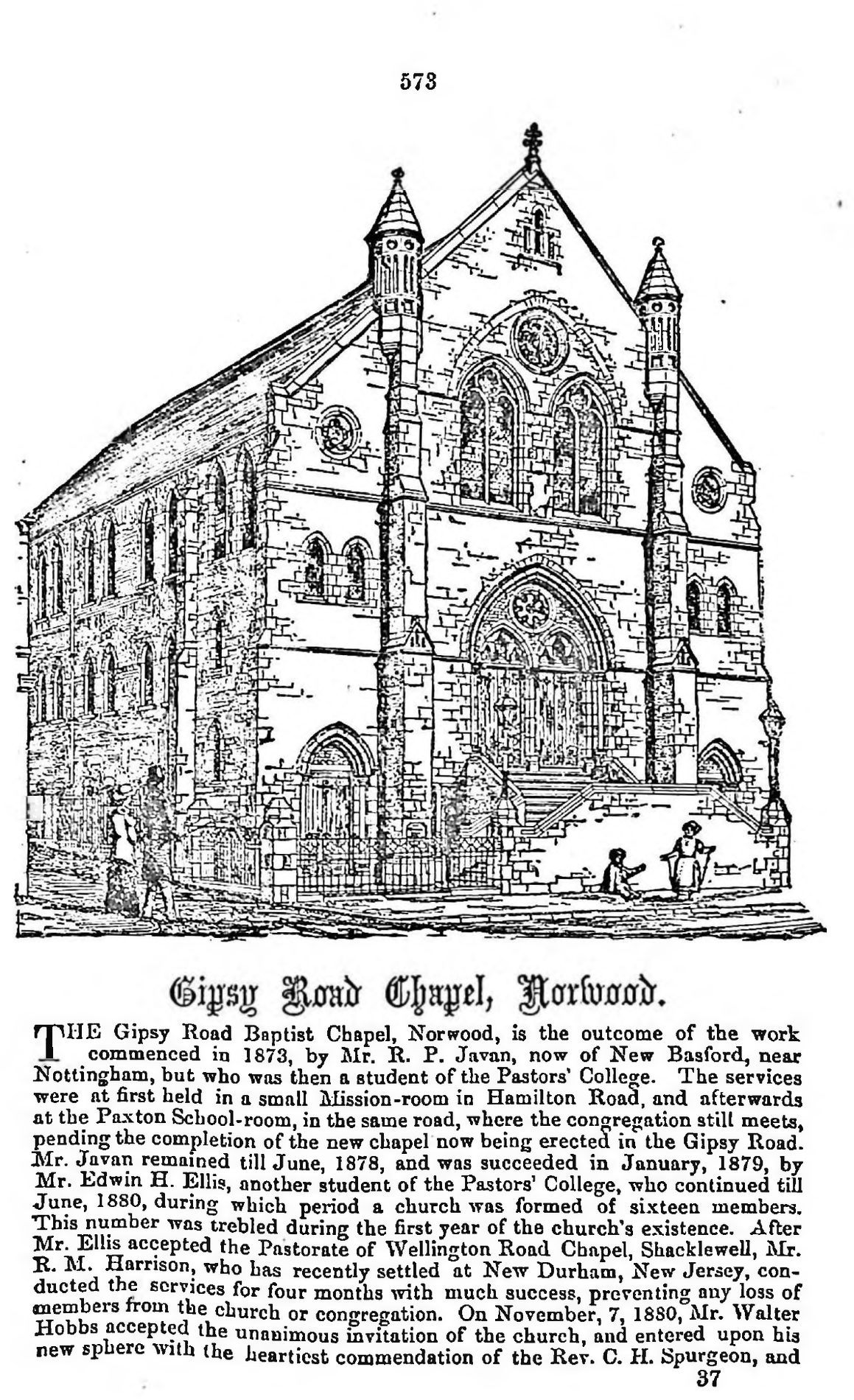
* As this church is in our immediate neighbourhood we take a special interest in it, and shall be glad of help towards its erection. The artist has made the place look like a ruin, but it will never, we trust, be anything of the kind.—C. H. S.
575
The New Testament. American revised edition. Philadelphia: American Baptist Publication Society, 1420, Chestnut Street.
IT was most fitting that our American brethren should bring out an edition of the revised version with the commendations suggested by the American Committee incorporated in the text. For the most part these corrections are of much value, and if our English revisers had not been timid they would have adopted them. It will strike most observers that in omitting them our own revisers have used more caution than courage, and by no means improved their work. The more we read our own revision, the more we feel its great value, and at the same time the deeper is our conviction that our old form of the New Testament will not be superseded for many a day, and certainly not by the present attempt at revision, admirable though it be.
The Sick Man's Comfort Book. By the Rev. P. B. POWER, M.A. Hamilton, Adams, and Co.
THIS is a choice word of comfort,—exactly what it professes to be. We wish we could put a copy under every sick man's pillow. We have placed a short chapter in this month's magazine with the view of pressing it upon the notice of our readers.
Messiah the Prince; or, The Mediatorial Dominion of Jesus Christ. By WILLIAM SYMINGTON, D.D., with a Memoir of the Author. T. Nelson and Sons.
THIS great work is most handsomely brought out by the Messrs. Nelson. The memoir is, we suppose, all that could be written, but it is short and sweet. As to the treatise itself, wherein it teaches the supremacy of Christ over all nations, and the duty of nations to serve him, we are heartily agreed with the learned author; but as to whether nations as nations are to set up religious establishments is quite another question, and we suspect that we should have to cross swords with Dr. Symington on that point. The proposition that the State has
nothing to do with religion we deny, and at the same moment we deny the other proposition—that it is the duty of the State to patronize and endow religion. The function of civil government is best discharged under a sense of subordination to the law of Christ, and this sense of subordination should also suggest to the civil governor the limit of his jurisdiction, and prevent his putting forth the hand of Uzzah to steady the ark of the Lord. A ruler may be all the more religious because, as a ruler, he lets religion alone: his awe of God may be best exhibited by non-intrusion into a work which the Lord has entrusted to his own church, but which he never committed to the care of princes, presidents, or parliaments.
The Brethren; their worship and the Word of God at open variance. By ROBERT H. CARSON. Elliot Stock.
THIS is a capital pamphlet for distribution where Plymouths are working after their manner. All other Christians have some feeling of respect for each other; but these do not acknowledge any but themselves, and yet they talk of the one church and of Christian love. The exclusive brethren have no ecclesiastical connection with other believers in Christ, and refuse officially to acknowledge or reply to any communications from them; at least, such is our personal experience. You might as well expect Cardinal Manning to acknowledge the ministerial standing of a Methodist local preacher as hope to have any church dealing with an assembly of brethren. Their spirit, as a body, is the reverse of that of our Lord Jesus. We speak advisedly, and mean all that we say. Dr. Carson handles them as they ought to be handled, that is to say, vigorously and with plain speech, but not with reviling. Their ecclesiastical history becomes more and more sorrowful, for it is a reproduction of the divisions and contentions which other bodies have had to deplore, and yet they are the accusers and the judges of us all. May the Lord give them a better mind. When once they are known their power to proselytize is gone; but such is their subtlety that they need searching out by some such light as Dr. Carson casts upon them.
Half-hearted Churchmen: a Correspondence in "Church Bells" with various writers. By the Rev. CHARLES BULLOCK, B.D. "Home Words" Publishing Office, 1, Paternoster Buildings.
MR. BULLOCK confounds his adversaries by the exhibition of Christian charity, which is a rare grace among those who call him a half-hearted churchman. If he were not very deeply a churchman he would long ago have been with dissenters. He is far more a Christian than an Episcopalian, and in this we could wish that his opponents would copy him; he does honour to himself and pours confusion upon them by simply writing in the spirit of his Lord and Master. In fifty years time it will be difficult to make men believe that it was necessary seriously to advocate the views here set forth by Mr. Bullock: the brutish intolerance of those who denounce all communions but that of the Episcopal body will by that time be universally hooted at. This collection of letters will be exceedingly interesting to all who are concerned in the Non-conformist struggle: they reveal the difficulties of a good man in the Establishment and show how the grace of God expels the bigotry of sect.
The Life of Francis Murphy, Gospel Temperance Advocate, and Founder of the Blue Ribbon Army in America. "Christian Herald," 2, Ivy Lane.
SIXPENNYWORTH of information about a good man who is doing a thoroughly good work. The gospel is the glory of the Blue Ribbon Army, and no one takes more delight in it than Francis Murphy. To our great joy we saw Messrs. Murphy and Noble in our College lecture hall the other day, and we gripped their hands with peculiar satisfaction, as true servants of the Lord. Total abstinence is never in their case put before the gospel or in the stead of it, but it is used as an assistant to raise those from the ditch of drunkenness who have fallen therein.
In Bible Lands. By Rev. RICHARD NEWTON, D.D. T. Nelson and Sons.
A book of travel in the Holy Land written for the young. A capital idea, carried out by an author who, above all
other men, is suited for the work. He has produced a child's book which those of older growth will love to read. The engravings are excellent, for they are of the usual quality of Nelson and Sons' work; and the letter-press is as instructive as the most learned works, but happily denuded of the hard words which so often deface them. A book of books for the family library.
Reminiscences of Congregationalism Fifty Years Ago. Prepared for the Jubilee Meeting of 1881. By JOHN STOUGHTON, D.D. Hodder and Stoughton.
IF all those who have had large dealings with men and things would imitate Dr. Stoughton by leaving behind them their own reminiscences, history would become easy work. Our good friend has seen fifty good years, and the story which he has to tell is worthy of a royal listener; as to how well he tells it our readers need not to be informed. Where lives there a better ecclesiastical historian than John Stoughton? A shilling could hardly be better spent than in buying this tractate of about 100 pages.
Companion to the Revised Version of the English New Testament. By A. ROBERTS, D.D. Cassell, Petter, Galpin, and Co.
EVERY student of the Bible who can afford half-a-crown should get this most useful and entertaining volume. It contains the sort of reading which has the most charm for us, for it deals with the Scriptures themselves and their meaning in a most pleasant manner. Reading this "Companion," the alterations of the Revised Version become vastly more intelligible; for one sees the why and the wherefore for each of them. Sitting down to these pages with the two versions before us we forget all the worries of life, and beguile the hour in a manner which leaves substantial profit behind. Even if the reader should be innocent of Greek, Dr. Roberts will give him abundant instruction; but if he has a thorough acquaintance with the sacred tongue he will not find the work superfluous. We take the utmost pleasure in commending the little book to all Christian people, especially to those who are teachers of others.
577
Worthies of the World. A series of original Biographical Sketches. 13 parts, 6d. each. Ward and Lock.
THESE thirteen parts will make a noble volume of biographies. Part 12 contains C. H. Spurgeon, Victor Hugo, Homer, and John Bright—a rather singular quartette. Our life will never be quite accurately sketched till we take it in hand on our own account, but in this instance it is exceedingly well done, and the reader will not wonder that it is so, if he recognizes the initials G. H. P. at the end of the article. Of the whole series we are bound to speak in the highest terms. Ward, Lock, and Co. were fortunate in fixing upon the idea, and they have carried it out in a masterly manner. A better sixpenny-worth than one of these parts it would be hard to meet with in the realm of books.
Monaco, and its Gaming Tables. By JOHN POLSON. Elliot Stock.
ANOTHER bomb-shell for the gambling Hall of Monte-Carlo. It will be destroyed at last, but a public opinion has first to be formed. Families with sons who are young had better keep clear of Nice and Mentone till these seductive tables are over-turned, for the place is attractive, and the play enchants, and men are ruined before they know it. The passion for gambling is not the only one to which Monaco appeals. Satan's seat is on that charming headland.
Friendly Chats with Young Men and Maidens. By H. O. MACKEY. Sunday School Union.
RIGHT glad are we to see Pastor H. O. Mackey, of Southampton, producing a book. Our friend and brother was once a student of the Pastors' College, and he is now in many ways an honour to his Alma Mater. These "friendly chats" are instructive and inspiring, and have all the freshness and naturalness of a young man's words to young men. The Sunday School Union people have done well to adopt the little work as one of their own. Whatever meritorious publications they may issue, Mr. Mackey's book will not dishonour them; it is full of grace and common sense. Let young men and maidens read it, and attend to its admonitions.
Moses or Christ? Being the Argument of the Epistle to the Galatians. By R. GOVETT. Norwich: Fletcher and Son.
VIRTUALLY a commentary upon the Galatians, written in that deeply spiritual vein which is characteristic of Mr. Govett. He has given the heart of the controversy between Paul and the Judaisers in his title — "Moses or Christ?" This is to many poor bewildered minds still the question. Happy are they who are free from the law by union to the Law-fulfiller.
Poets, Painters, and Players. By GEORGE WILSON M'CREE. National Temperance Depot, 337, Strand.
THERE is more of interesting reading in this sixpenny pamphlet than will be commonly found in a six shilling volume. We scarcely remember learning so many facts in so short a time as that which we spent in perusing Mr. M'Cree's hundred pages. Specially were we touched by the story of Turner. To be so great a painter, and so small a man morally and spiritually is a most unhappy combination. Hartley Coleridge again, drunk in a ditch! Oh! drink, those whom thou hast not slain thou hast wounded, and thou hast not spared the most gifted of mankind.
We would suggest that a copy of this fascinating book should be given to every young man of ability. He will read it, he must read it, and he will see how genius itself may become a curse if it be enslaved by the drink-demon. How happy are they who have clean escaped from the ensnaring vice. How earnestly should they employ every hopeful means by which the slaves of this tyrant may be rescued from his chains. Such writing as Mr. M'Cree's acts as a hammer to dash the fetters to pieces.
The portion devoted to players is a sad revelation, and we are glad to see it close with Pollok's lines :—
"The theatre was, from the very first,
The favourite haunt of sin, though honest men—
Some very honest, wise, and worthy men—
Maintain'd it might be turn'd to good account:
And so, perhaps, it might, but never was;—
From first to last it was an evil place."
Holy-Days and Holidays; or, Memories of the Calendar for Young People. By J. R. S. CLIFFORD. 66, Paternoster-row.
ALTHOUGH most of these holy-days and holidays are the offspring of sheer superstition, yet we may as well know the ways and follies of our neighbours, and this book sets them forth in a pleasant manner. It is clear that our forefathers in the days of "merrie England" went very earnestly into the work of making fools of themselves.
Plutarch's Lives; containing the most interesting of the incidents in the lives of celebrated Greeks and Romans. Arranged for the use of everyday readers. Whittaker and Co.
WE fear that Plutarch is not read by our younger generation as he deserves to be. The Puritans were wont to adorn and enrich their sermons with the incidents of antiquity stored up in Plutarch's Lives, and to this day there is no better storehouse of classic anecdote and illustration. For a shilling each this and several other first-class books are issued by Messrs. Whittaker, who deserve to be encouraged by all reading men.
Papal Infallibility and Supremacy, Tried by Ecclesiastical History, Scripture, and Reason. By A. E. GAYER, Esq., Q.C., LL.D. Partridge and Co.
THE point is well discussed. Few of our readers will think the Pope's claims worth a thought as far as they are concerned; but they may find it convenient to have weapons near at hand for the demolition of this hideous imposture. In these days it is needful to fight over again questions which we thought were settled for ever. Up rises Protection again, and old giant Pope is abroad; we should not be surprised to see giant Pagan also revive. It is well that when the need arises, the man is sure to be forthcoming. Mr. Gayer has done his work very well, and his book ought to be placed in all libraries of reference.
A Book about Criminals. By Mrs. MEREDITH. London: James Nisbet and Co., Berners Street, 1881.
THROUGH a strangely unprepossessing preliminary chapter of crude theories
concerning "heredity," "penetrability," "unalterable state," "brain disease," "instability," and other matters more or less incomprehensibly treated, we come upon a readable and even interesting collection of narratives concerning criminals who have come within the influence of the Nine Elms Mission. A noble and extremely difficult work is being done by that agency, and some of the incidents here related illustrate too clearly the inveterate and all but incurable deceit which characterises many of the criminal class. On the other hand, there are encouraging instances of reclamation. Christians should read the book to enlighten their minds as to the terrible needs of human nature.
The Life and Times of Sir Walter Raleigh, Pioneer of Anglo-American Colonization. By CHARLES K. TRUE, D.D. Wesleyan Conference Office.
SIR WALTER was one of the most brilliant ornaments of a brilliant age, and his story is here excellently and briefly told. His universal genius made him shine in every position. A brilliant courtier, a daring adventurer, an assiduous investigator in scientific discovery, the redoubtable annihilator of the navies of Spain, the munificent colonizer spending for his country £40,000 out of his own fortune in endeavours to plant colonies across the Atlantic, a foremost literary genius in England's most splendid literary age, he was, in its fullest sense, the representative of the accomplished English gentleman. He contrived to live through the dangers of the court of the great, penurious, capricious Queen Elizabeth, and was unjustly beheaded in the reign of her poor, drivelling successor, James I. Read the story in this well-written and well-printed little book.
The Thirty-Nine Articles of the Church of England: an Historical and Speculative Exposition. By Rev. JOSEPH MILLER, B.D. Hodder & Stoughton.
WE suppose that these exhaustive expositions of the church's articles are both attractive and valuable to students for priest's orders; but for ourselves they are far too discursive and uninteresting. The best thing about them is their pronounced evangelical tone.
579
Freedom of the Will. By the Rev. W. TAYLOR. Hamilton, Adams, & Co.
THE author has succeeded, we think, in establishing the fact of the self-determining power of the will by showing the unreasonableness of any other conclusion respecting it. He has been less successful in its application to religious doctrines and duties. His philosophy is better than his theology. His avowed object has been to show that the distinctive doctrines of Calvinism are opposed to the freedom of the will. The apparent difficulty of reconciling the decrees of God with the free agency of man is removed by the assertion that human volitions are independent of divine decrees; and all questions respecting natural and moral ability to repent and believe the gospel are silenced by the denial of any distinction between them. How the delivering up of Christ by the Jews to be crucified could be by the determinate counsel as well as the foreknowledge of God, we are not informed; nor how prophecies, depending upon the free agency of thousands and in different ages, could have been fulfilled. The influence of the Spirit of God is admitted in conversion, but in no other way than by external inducement, such as is not more powerful in those who comply with it than in those who reject it. Our author affirms that there is no natural or moral inability to sin either on earth or in heaven. We remain content with the assurance that he who made the human will knows how to influence it, without destroying its freedom or interfering with the consciousness of its freedom; how to make it willing in the day of his power here, and how to secure its voluntary and yet eternal enjoyment of him hereafter.
A History of Christian Doctrines. By the late Dr. K. R. HAGENBACH, Professor of Theology at Basel. Translated from the last German edition, with an Introduction by E. H. PLUMPTRE, D.D. (Two vols.) Edinburgh: T. and T. Clark.
THIS is not exactly a new work, although there is the charm of novelty about Messrs. Clark's edition, which forms one of a fresh series in their foreign theological library. More than forty years ago the original treatise was published in the
German language. On both sides of the Atlantic it has been rendered several times into the Anglo-Saxon tongue. Here, however, we get a fresh translation, in clearer and more flowing style, of the author's latest edition, as he revised and re-edited it shortly before his decease. To metaphysical thinkers these substantial volumes need no commendation; but the imprimatur of Dr. Plumptre will doubtless enhance their value amongst a select circle of scholars. Still there is a large and intelligent constituency outside the universities to whom these subtle enquiries and expressions are very repulsive. They believe in God; they believe also in Christ; but from theologies and Christologies they turn aside, and not without good reason; for if you once begin to give ear to them, there will follow in their wake an endless variety of cosmologies, angelologies, demonologies, anthropologies, soteriologies, eschatologies, and the like, all owing their origin to what Dr. Hagenbach defines as Apologetico-dogmatic prolegomena. Pastors and teachers who aim at the perfecting of the saints, the work of the ministry, and the building up of the body of Christ, generally prefer to get their cisterns replenished higher up the river, above the bridges, and nearer the springs. By the industry and skill of the accomplished Professor in collecting, classifying, and cataloguing the diverging theories and the distracting heresies that have tantalized the church since the Patristic age, that is to say, from the times of Justin Martyr, Tertullian, Origen, and the Ante-Nicene fathers down to the present time, we are supplied with a cyclopedia which may sometimes prove useful for reference.
Gospel Types and Shadows of the Old Testament. By the Rev. W. ODOM. Nisbet and Co.
VERY good indeed. The man who could not get fifty-two sermons out of these types must be a poor preacher. Paper cover, 6d.; cloth, 1s. This expenditure will break no one. We do not see anything new, but the old explanations are not to be improved, and it is most helpful to have them arranged and condensed as they are here. We commend the investment to those who have few books and little time.
John's Apocalypse: Literally Translated and Spiritually Interpreted. By H. BROWN, M.A. Simpkin, Marshall, and Co.
AN ingenious little volume. The text is translated with bold literality, preserving the Greek idiom at the expense of our vernacular. For our own part, we should think it rather perilous to follow the lead of any private personal enterprise in promoting a new version of Scripture. We can only afford space for a short specimen. Rev. xi. 7, S: "And when they shall-have-ended their witnessing, the wildbeast, the one coming-up from-out-of the abyss shall cause-to-be war along-with them, and shall-conquer them and shall-kill them. And their fallen-body is upon the broad-way of a city, the great one, whichever is-being-called spiritually Sodom and Egypt, where also their Lord was crucified." From the interpretation we cull the following extract:— "The spiritual name of Sodom is given to the unfaithful Israel by Isaiah, Jeremiah, and the apostle Paul. Isaiah i. 10: Hear the word of Jehovah, ye, rulers of Sodom, give ear to the law of our God, ye people of Gomorrah. Jeremiah xxiii. 14, . . . And they have been to Me . . . as Sodom and . . . as Gomorrah. Romans ix. 29, And, according-as Isaiah has-said before, If Lord of Sabaoth did not purposely leave to us a seed, then we-were-become as Sodom, and then we were likened as Gomorrah." Advantageous as it may be for teachers to know a little of the ancient languages, it must be equally desirable that they should have some acquaintance with our modern dialects, that the church may receive edifying. A translator should be master of two languages, but Mr. Browne appears to hold to one and despise the other.
John Blackie, the Bridgeton Colporteur. A Memoir. By his son, Rev. JOHN BLACKIE. Edinburgh: Religious Tract and Book Society of Scotland.
AN interesting narrative of the life and work of a plain, common-sense, quaint, vigorous man who laboured with much success amongst the poor of Glasgow. Christian Colportage wrought great things in the dawn of evangelical light after the dark ages, and its
revival in our day is already conferring great benefit on our land. Those who contemplate the employment of a Colporteur in their neighbourhood should read this book; as also should those who require to be prompted to such a good work.
The Happiness of full Consecration: being brief Memorials of Emmeline Duncan. S. W. Partridge.
A SWEET little story of a most devoted life, showing how much may be achieved by whole-hearted godliness. Miss Duncan's was a choice spirit, and this is a worthy miniature of her character and work.
The Doctrines of Annihilation and Universalism viewed in the light of Reason, Analogy, and Revelation: with Critical Notes and a Review of "Salvator Mundi." By Rev. T. Wood. Wesleyan Conference Office.
THIS is a second edition of a work which we favourably reviewed some two years ago. It is now furnished with additional notes on "Salvator Mundi." It is a good antidote to the pernicious assumptions of the Universalist school and therefore it deserves a large sale; but we are sick of the whole controversy. It is a remarkable thing to note the limited range of heresy, and how it is obliged to dish up its old, old fragments, and palm them off as novelties labelled "Modern Thought." Mr. Wood does excellent service to the cause of truth.
The Latest of Questions Answered in the Earliest of Books: Five Sermons preached in Octagon Chapel, Bath, by Rev. W. ANDERSON, M.A. Elliot Stock.
THESE sermons were preached with the view of showing that the questions of Creation, Man's Nature, the Origin of Evil, etc., etc., are best explained in the Book of Genesis. We judge them to have been fairly successful, but we are much afraid that the persons they were intended to convince will never read them; or, if they do, will not be persuaded of their own folly. Unbelief is largely moral, and only the Spirit of God can change the heart. Still, the sermons have our word of commendation.
581
The Tract Magazine and Christian Miscellany. Vol. 12. New Series. Religious Tract Society.
AN old-fashioned magazine, but thoroughly good. Ministers and teachers would find many illustrations in it. Mothers' meetings would be enlivened by its being read aloud.
The Child's Companion and Juvenile Instructor. Religious Tract Society.
WHAT more can be done with this magazine? Is it not at length absolutely perfect? We are pleased to notice the prominence given in this volume for 1881 to kindness to animals. These are truly the child's companions, and too often their little masters are great tyrants to them. This magazine will help to their better treatment. The volume is a delight. How happy ought children to be for whom such pleasant pages are provided!
The Boy's Own Annual. The Girl's Own Annual. "Leisure Hour" Office, 56, Paternoster Row.
THESE publications mark an era in the history of juvenile periodical literature. They are intended to forestall the sensational tales which our youths have been all too ready to read—tales which have insinuated the poison of vice, and suggested evil which had else been unknown. These volumes are striking, amusing, exciting, and yet pure as the snow from heaven; nay more their tendency is to exalt and ennoble, by cheerfully presenting choice examples and prompting the desire to imitate them. We know that some raise objections to any reading which is not altogether religious, but with such we have scant sympathy. If our young folks cannot yet digest our strong meat, are we to leave them to be poisoned till their digestion has been strengthened? No. We would mix the saving truth even with books of games and tales of mirth, and thus take the young by holy guile. Our families owe the Tract Society a debt of gratitude. It would be an act well pleasing to God if some of our readers would introduce these papers to boys and girls of the lower order who are now feasting on impure and questionable literature. The better sort will naturally prefer these
papers; but there is a class who need to be educated up to them, and it would be a worthy deed to attempt their education.
Outlines of the Life of Christ. By EUSTACE R. CONDER, M.A. London: The Religious Tract Society.
The Life of our Lord, with Compared References. By FRANCIS SANGSTER. Elliot Stock, 62, Paternoster Row.
The Words of Christ, Collated from the Four Gospels. By T. B. London: James Nisbet and Co.
HELPS to study and hints to students, how to enlarge the sphere of their knowledge and to cultivate exactness are welcome in every branch of instruction. In our classical schools the modern system is to use small books. When we were young we had a Simpson's Euclid, but we are afraid few of our fellows got half through the first six books. "Our boys" are favoured with a copy of the first book at the cost of a few pence, and they will not be supplied with the advanced lessons till they have mastered the rudiments. This is an improvement; and we are heartily glad to see that our renowned publishers, with the Religious Tract Society in the van, are moving onward with Biblical literature in the same direction. Outlines and handbooks prepare the way for bodies of divinity, and are aids to those who cannot yet reach to greater things.
Grace and Glory. Sermons for the life that now is and that which is to come. By A. J. GORDON, Pastor of Clarendon Street Church, Boston. Boston: Howard Gannett, Tremont Temple.
Sermons which will make their mark. Here we have power without sensationalism, a rather unusual thing in American preachers whose sermons cross the Atlantic. Calm thought, living and earnest, is here expressed in forcible language, pruned of all redundancy. The doctrine is that of the orthodox Baptist, evangelical and practical. We are bound to hear much more of Mr. Gordon, and we shall be surprised if these discourses are not reprinted by an English house.
NOTICES OF BOOKS.
The Christian's Plea against Modern Unbelief. A handbook of Christian Evidence. By R. A. REDFORD, M.A., LL.B., Professor of Systematic Theology, New College. Hodder and Stoughton.
THE argument, the author, and the auspices under which this treatise is brought out, all combine to bespeak for it a favourable consideration. As a manual, prepared at the request of "The Christian Evidence Society," it deals mainly with the outworks of the church's citadel. In discussing first principles—such as the existence of God, the possibility of revelation, the credibility of miracles, the fulfilment of prophecy, or the canon of Scripture—with professed sceptics and positive opponents of the gospel, those who plead for truth are often awkwardly apologetic. Too much deference is shown to the doubter, and if he has an academical degree, it is supposed to impart authority to his dogged disbelief. Mr. Redford has acquitted himself well in furnishing the Christian advocate with a systematic view, on the one hand, of the various phases of infidelity, skilfully focussed; and, on the other hand, of the facts, historic or rational, which bear witness to those truths that cannot be shaken, however much they may be assailed. But what about those individuals whose proclivities are in a greater or lesser degree atheistic? Have we an essay here that is likely to reclaim them? Our author imagines that simple theism may become an adymum to the inner sanctuary of more select evidences. "Like travellers passing through various regions, (of desert land and cloudy atmosphere!) and being variously affected on the way; having reached the end of the journey, the retrospect is an unbroken and restful assurance." We are not so sanguine. Such pilgrims to the promised land have never crossed our path. We have never witnessed any real converting power till we could get people within those lines that he scrupulously avoids. To his idea it is not only permissible, but helpful to separate the theism of Christianity from the doctrines of the Christian faith; and the authority of Scripture from the interpretation of its contents; in a word, by reasoning,
to break down their negations without instructing them in any positives in lieu thereof. This is a curious experiment; but let a lady, who had studied more philosophy, ancient and modern, than the most of us, relate her experience in better words than we can aspire to:—
"I read books bad and good—some bad and good
At once: (good aims not always make good books;
Well-tempered spades turn up ill-smelling soils
In digging vineyards even) books that prove
God's being so definitely, that man's doubt
Grows self-defined the other side the line,
Made atheist by suggestion." . . .
For other reasons than Mrs. Barrett Browning would assign, we are convinced that the cold logic of Christian evidences is a poor specific that has seldom or never proved a cure for unbelief. That department of polite literature called Natural Religion leads nowhere and profiteth nothing, so far as we could ever ascertain. It fills the air with volatile sentiment, and expresses itself in lackadaisical phrases about "the benevolence of the Creator," "the beauty of his works," or "the traces of design that are scattered through the universe." Simple theism is a paltry subterfuge. What these poor souls need is saving faith. Why should we dally with their prejudices? The first postulate is this: "He that cometh to God must believe that he is, and that he is a rewarder of them that diligently seek him." The second postulate is, "He that believeth in God must accept Christ as a mediator." And the third postulate is, "He that accepteth the one mediator between God and men must receive the atonement." Or otherwise, should the honest sceptic be persuaded to acknowledge a deity, he cannot possibly rejoice in God or sing praises unto the Lord with the spirit and the understanding. For a Christian minister to plead with an infidel to become a theist sounds preposterous to us. If it is only an initiative, yet it is such an initiative as one might use in attempting gradually to reform criminals by intreating burglars not to carry fire-arms. The ministry of the Holy Spirit knows no half measures.
583
The Philosophy of Prayer, with other essays. By H. R. REYNOLDS, D.D. Religious Tract Society.
A MISCELLANEOUS collection of papers on various subjects, the first of which
does not cover a fifth part of the little volume. They are all more or less interesting; but the one which is entitled "The Mission of Apollos" deserves special mention.