
EXPLANATORY NOTES AND QUAINT SAYINGS
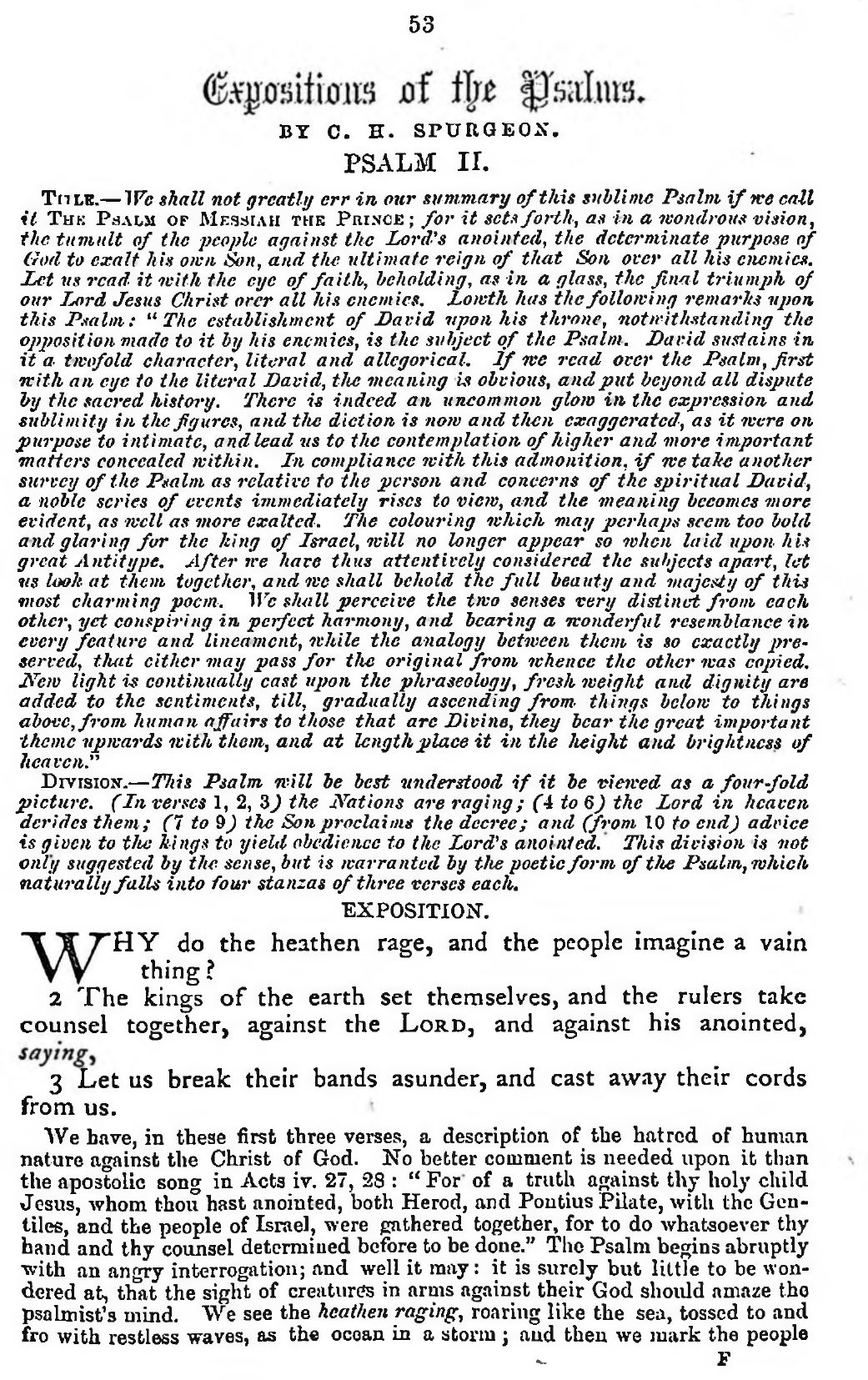
Verse 1.—Rage. The word with which Paul renders this in the Greek, denotes rage, pride, and restiveness, as of horses that neigh, and rush into the battle. Εφραξαν, from φρικων to snort or neigh, properly applied to a high-mettled horse. See Acts iv. 25.
"A vain thing." A medal was struck by Diocletian, which still remains, bearing the inscription. "The name of Christians being extinguished." And in Spain, two monumental pillars were raised, on which were written:—I. "Diocletian Jovian Maximian Herculeus Cæsares Augusti, for having extended the Roman Empire in the east and the west, and for having extinguished the name of Christians, who brought the Republic to ruin." II. "Diocletian Jovian Maximian Herculeus Cæsares Augusti, for having adopted Galerius in the east, for having everywhere abolished the superstition of Christ, for having extended the worship of the gods." As a modern writer has elegantly observed: "We have here a monument raised by Paganism, over the grave of its vanquished foe. But in this, 'the people imagined a vain thing;' so far from being deceased, Christianity was on the eve of its final and permanent triumph, and the stone guarded a sepulchre empty as the urn which Electra washed with her tears. Neither in Spain, nor elsewhere, can be pointed out the burial place of Christianity; 'it is not, for the living have no tomb'"
Verse 2.—The many had done their part, and now the mighty show themselves.—Trapp.
Verse 3.—Resolved they were to run riot, as lawless and awless, and therefore they slander the sweet laws of Christ's kingdom as bonds and thick cords, which are signs of slavery. Jer. xxvii. 2, 6, 7. But what saith our Saviour? "My yoke is easy, and my burden is light." It is no more burden to a regenerate man than wings to a bird. The law of Christ is no more as bands and cords, but as girdles and garters which gird up his loins and expedite his course.—Trapp.
Verse 4.—"He that sitteth in the heavens." Hereby it is clearly intimated, (1) that the Lord is far above all their malice and power, (2) that he seeth all their plots, looking down on all; (3) that he is of Omnipotent power, and so can do with his enemies as he lists. "Our God is in the heavens: he hath done whatsoever he pleased." Psalm cxv. 3.—A. Jackson.
"The Lord,"—in Hebrew, Adonai, mystically signifieth my stays, or my sustainers—my pillars. Our English word "Lord" hath much the same force, being contracted of the old Saxon word "Laford," or "Hlafford," which cometh from "Laef," to sustain, refresh, cherish.—Ainsworth.
Verse 5.—"Vex them," either by horror of conscience, or corporal plagues; one way or the other he will have his pennyworths of them, as he always has had of the persecutors of his people.—Trapp.
Verse 11.—The fear of God promotes spiritual joy; it is the morning star which ushers in the sunlight of comfort. "Walking in the fear of God, and in the comfort of the Holy Ghost." God mingles joy with fear, that fear may not be slavish.—Watson.
Verse 12.—Kiss, a sign of love among equals; Gen. xxxiii. 4; 1 Sam. xx. 41; Rom. xvi. 16; 1 Cor. xvi. 20. Of subjection in inferiors; 1 Sam. x. 1. Of religious adoration in worshippers; 1 Kings xix. 18; Job xxxi. 27.—Bishop Richardson.