
The inns or caravanserais of the east, in which travellers are accommodated, are not all alike, some being simply places of rest, by the side of a fountain, if possible, and at a proper distance on the road. Many of these places are nothing more than naked walls; others have an attendant, who subsists either by some charitable donation, or the benevolence of passengers; others are more considerable establishments, where families reside, and take care of them, and furnish the necessary provisions. “Caravanserais,” says Campbell, “were originally intended for, and are now pretty generally applied to, the accommodation of strangers and travellers, though, like every other good institution, sometimes perverted to the purposes of private emolument, or public job. They are built at proper distances through the roads of the Turkish dominions, and afford to the indigent or weary traveller an asylum from the inclemency of the weather, are in general built of the most solid and durable materials, have commonly one story above the ground floor, the lower of which is arched, and serves for warehouses to store goods, for lodgings, and for stables, while the upper is used merely for lodging; beside which they are always accommodated with a fountain, and have cooks’ shops and other conveniences to supply the wants of lodgers. In Aleppo, the caravanserais are almost exclusively occupied by merchants, to whom they are, like other houses, rented.” “In all other Turkish provinces,” observes Antes, “particularly those in Asia, which are often thinly inhabited, travelling is subject to numberless inconveniences, since it is necessary not only to carry all sorts of provisions along with one, but even the very utensils to dress them in, beside a tent for shelter at night and in bad weather, as there are no inns, except here and there a caravanserai, where nothing but bare rooms, and those often very bad, and infested with all sorts of vermin, can be procured.” “There are no inns any where,” says Volney, “but the cities, and commonly the villages, have a large building called a kan or kervanserai, which serves as an asylum for all travellers. These houses of reception are always built without the precincts of towns, and consist of four wings round a square court, which serves by way of enclosure for the beasts of burden. The lodgings are cells, where you find nothing but bare walls, dust, and sometimes scorpions. The keeper of this kan gives the traveller the key and a mat, and he provides himself the rest; he must therefore carry with him his bed, his kitchen utensils, and even his provisions, for frequently not even bread is to be found in the villages. On this account the orientals contrive their equipage in the most simple and portable form. The baggage of a man who wishes to be completely provided, consists in a carpet, a mattress, a blanket, two sauce pans with lids contained within each other, two dishes, two plates, and a coffee pot, all of copper, well tinned, a small wooden box for salt and pepper, a round leathern table, which he suspends from the saddle of his horse, small leathern bottles or bags for oil, melted butter, water, and brandy, if the traveller be a Christian, a tinder box, a cup of cocoa nut, some rice, dried raisins, dates, Cyprus cheese, and, above all, coffee berries, with a roaster and wooden mortar to pound them.” The Scriptures use two words to express a caravanserai, in both instances translated inn: “There was no room for them in the inn,”
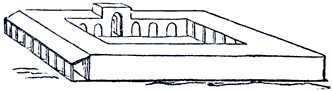
Caravanserais
In the days of the elder patriarchs there seem to have been no places specially devoted to the reception of travelers, at least in the pastoral districts frequented by those venerable nomads; for we find Abraham, like the Oriental shepherds of the present day, under a strong sense of the difficulties and privations with which journeying in those regions was attended, deeming it a sacred duty to keep on the outlook, and offer the wayfaring man the rites of hospitality in his own tent. Nor could the towns of Palestine, as it would seem, at that remote period, boast of any greater advance with respect to establishments of this sort (see Gen 19:2); from which it is evident that the custom, which is still frequently witnessed in the cities of the East, was then not uncommon, for travelers who were late in arriving, and who had no introductions to a private family, to bivouac in the streets, or wrapping themselves up in the ample folds of their hykes, to pass the night as they best could in the open air (see also Jdg 19:15). In the Arab towns and villages, however, when a traveler arrives in the daytime, the sheikh, or some principal person of the place, goes out to welcome him, and treats him with great civility in his own house; or else he conducts him to the menzil, which, though a place of rather a nondescript character, is understood to be the house occupied by those who entertain strangers, when there are no other lodgings, and to which the women in the sheikh’s house, having surveyed the number of the guests, send provisions of every kind, according to the season, and provide every accommodation the place can afford.
The first mention of an inn, or house set apart for the accommodation of travelers, occurs in the account of the return of Jacob’s sons from Egypt (Gen 42:27); and as it was situated within the confines of that country, and at the first stage from the metropolis, it is probable that the erection of such places of entertainment originated with the Egyptians, who were far superior to all their contemporaries in the habits and the arts of civilized life. The Egyptian inn, where the sons of Israel halted to bait their asses, was probably, from the remote period to which it belonged, of a rude and humble description, in point both of appearance and accommodation; and such is the low state of art, or the tyrannical force of custom in the East, that establishments of this kind in the present day can, with few exceptions, boast of improvements, that render them superior to the mean and naked poverty of those which received the pilgrims of the patriarchal age.
Khan, or karavanserai, is the name which this kind of building bears; and though the terms are often applied indiscriminately, there is an acknowledged distinction, which seems to be, that khan is applied to those which are situated in or near towns, whereas caravanserais (a lodge for caravans, as the compound word imports) is the more appropriate designation of such as are erected in desert and sequestered places. Some of these buildings are provided at the public expense, or owe their existence to devoted Mussulmans, who bestow a portion of their wealth, as a meritorious act of charity, in promoting the comfort and refreshment of pilgrims; while others are erected by the contributions of private merchants for their own accommodation. The latter, of course, are the most spacious, the most elegant, and best appointed; but though varying in character and size, this class of establishments preserves so generally the same uniform plan of construction, that a description of one may serve to convey an idea of all. The caravanserai then is a large edifice presenting the form of a square, the sides of which, about 100 yards in length each, are surrounded by an external wall of fine brickwork, based on stone, rising generally to the height of twenty feet. In the middle of the front wall there is a wide and lofty archway, having on one or both sides a lodge for the porter and other attendants; while the upper part of it, being faced with carving or ornamental mason-work, and containing several rooms, surmounted by elegant domes, is considered the most honorable place of the building, and is therefore appropriated to the use of the better sort. This archway leads into a spacious rectangle, the area forming a courtyard for cattle, in the midst of which is a well or fountain. Along the sides of the rectangle are piazzas extending the whole length, and opening at every few steps into arched and open recesses, which are the entrances into the travelers’ apartments. An inner door behind each of these conducts to a small oblong chamber, deriving all its light from the door, or from a small open window in the back wall entirely destitute of furniture, and affording no kind of accommodation in the way of presses or shelves, except some rude niches excavated in the thick walls. This cell is intended for the dormitory of the traveler, who generally prefers, however, the recess in front for sitting in under shade during the daytime, as well as for sleeping in during the night, when the season allows. There being no other door but the entrance arch, each occupant remains isolated in his own quarters, and is cut off from all communication with the other inmates of the caravanserai. But in the middle of one of the three sides, or in large caravanserais of each of the sides, there is a large hall, which serves as a travelers’ room, where all may indiscriminately assemble: while at the end of each side there is a staircase leading to the flat roof of the house, where the cool breeze and a view of the surrounding country may be enjoyed. These chambers generally stand on the ground-floor, which is a few feet above the level of the court-yard; but in the few buildings of this sort which have two stories, the travelers are accommodated above, while the under flat is reserved for the use of their servants, or appropriated as warehouses for goods. And in such establishments there is found one other additional advantage in having a supply of servants and cooks, as well as a shop in the porter’s house, where all commodities may be procured. Caravanserais of this superior class, however, are rarely to be met with. The most part are but wretched lodging-places—filled, it may be, with dirt and vermin—consisting only of bare walls, in which not an article of furniture is to be seen, nor a cooking utensil to be found, nor provisions of any sort to be obtained for love or money. The traveler must carry along with him, as well as provide with his own hands, whatever is necessary for his use and comfort. He must also subsist on the supply of food and articles of luxury he may have had the foresight to provide, as no addition to his stores can be made till he reaches the next town. In short, in many of the khans or caravanserais to which he may come, he can look for nothing from the keeper except to show him the way to his chamber, and give him the key if it is furnished with a door. One assistance only he may depend upon, and it is no inconsiderable one—that of receiving some attendance and aid if overtaken by sickness; for one of the requisite qualifications for the office is, that the functionary possess a knowledge of simples, and the most approved practice in case of fracture or common ailments. And hence the good Samaritan in the parable (Luk 10:30), although he was obliged, in the urgency of the case, himself to apply from his own store a few simple remedies for the relief of the distressed man, left him with full confidence to be treated and nursed by the keeper of the khan, whose assiduities in dressing the wounds and bruises of his patient might be quickened, perhaps, by the liberal remuneration he was promised, as well as by the example of the humane traveler.
Among the Egyptians, and indeed among the ancients generally, the keepers of houses of public entertainment were always women; and hence we can easily account for the ready admission which the spies obtained into the house of Rahab, ’on the wall of Jericho,’ situated, as such houses were, for the reception of strangers, for the most part at the gate or entrance into the town (Jos 2:1). This woman is called a harlot in our translation, but the original Hebrew admits of being translated by another word, to which no degrading or infamous associations are attached.
Although it is probable that the state of Judea in the time of Christ and the Apostles was, in respect to means of communication, much superior to that of any Oriental country in the present day, yet the warm commendations of hospitality so frequently met with in the works of contemporary classical writers, as well as the pressing exhortations of the inspired Apostle to the practice of that virtue, too plainly prove that travelers were then chiefly dependent on the kindness of private individuals. The strong probability is, that the ’inns’ mentioned in the New Testament find their true and correct representations in the Eastern khans and caravanserais of the present day; and that the Jews of that period had experience of nothing better than the bare walls and cell-like apartments of such edifices as we have described above.
This subject acquires additional interest from its connection with the birth of our Lord; and there has been a good deal of controversy both respecting the character of the building from which Mary was excluded by the influx of company, and also the nature of the place where she ’brought forth her first-born son.’ No explanation, however, that we have met with, appears so satisfactory, and conveys such an intelligible picture to the eye, as that given by the editor of the Pictorial Bible (Luk 2:7); with whose words we shall conclude this article. ’The most complete establishments have very excellent stables in covered avenues, which extend behind the ranges of apartments—that is, between the back wall of these ranges of building and the external wall of the khan; and the entrance to it is by a covered passage at one of the corners of the quadrangle. The stable is on a level with the court, and consequently below the level of the buildings, by the height of the platform on which they stand. Nevertheless, this platform is allowed to project behind into the stable, so as to form a bench, to which the horses’ heads are turned, and on which they can, if they like, rest the nose-bag of hair-cloth, from which they eat, to enable them to reach the bottom when its contents get low. It also often happens that not only this bench exists in the stable, but also recesses corresponding to those in front of the apartments, and formed by the side walls which divide the rooms, being allowed to project behind into the stable, just as the projection of the same walls into the great area forms the recesses in front. These recesses in the stable, or the bench if there are no recesses, furnish accommodation to the servants and others who have charge of the beasts; and when persons find on their arrival that the apartments usually appropriated to travelers are already occupied, they are glad to find accommodation in the stable, particularly when the nights are cold or the season inclement. It is evident, then, from this description, that the part of the stable called ’the manger,’ could not reasonably have been other than one of those recesses, or at least a portion of the bench which we have mentioned, as affording accommodation to travelers under certain circumstances.’
Inn. The Hebrew word (malon) thus rendered literally signified "a lodging-place for the night". Inns, in our sense of the term were, as they still are, unknown in the East, where hospitality is religiously practiced.
The khans or caravanserais are the representatives of European inns, and these were established but gradually. The halting-place of a caravan was selected originally on account of its proximity to water or pasture, by which the travellers pitched their tents and passed the night. Such was undoubtedly the "inn" at which occurred the incident in the life of Moses narrated in Exo 4:24. Compare Gen 42:27. On the more frequented routes, remote from towns, Jer 9:2, caravanserais were, in course of time, erected, often at the expense of the wealthy.
(A caravanserai is a large and substantial square building. Passing through strong gateway, the guest enters a large court, in the centre of which is a spacious raised platform, used for sleeping upon at night or for the devotions of the faithful during the day. Around this court are arranged the rooms of the building. -- Editor.)
Hebrew
The "manger" in Luk 2:7 was a crib in a stable attached to a
Inn. In the Bible the "inn" was not a hotel in our sense. The word so translated means either a "lodging-place for the night"—not necessarily a covered place, but a mere station of caravans, where water could be obtained; such was the "inn," R. V. "lodging-place," at which Joseph’s brethren stopped, and where Moses was met by the Lord, Gen 42:27; Exo 4:24—or else a khan or caravanserai, which was, and is, a large square building enclosing an open court, in whose centre is a fountain; the building contains a number of rooms. There is no provision for meals or feed for the animals; the travellers carry such necessaries with them. These caravanserais are often built by benevolent persons. Jer 9:2. Another kind of "inn" is that mentioned in the parable of the Good Samaritan. Luk 10:34. This had a host, who was probably paid to attend to the wants of travellers. And it was in one of the stables of a mere caravanserai provided for the horses of travellers that our Lord was born. In modern Syria, in villages where there is no khan, there is a house for the entertainment of travellers, with a man appointed to look after it: for its accommodations, meagre as they are, payment is exacted, and the keeper likewise gets a fee.
We read of the inn as early as Gen 42:27; Gen 43:21, when Jacob sent to Egypt for corn. As the word malon signifies simply ’lodging place,’ at first nothing more may be implied than a place near water, where travellers usually rested. It would soon have been found that persons travelling long distances needed protection and some better resting place at night, which led to such places being provided at certain stations. Those known in the East were merely enclosures walled round for security, with covered compartments attached to the walls, where travellers could recline, and place their goods. It was at an inn that Zipporah circumcised her son. Exo 4:24.
In the N.T. when the Lord was born, the word for ’inn’ is
INN.—Inns in the time of Christ were neither so infrequent nor so ill-equipped as many writers have represented.
Thus Stapfer (Palestine in the Time of Christ, 1866, p. 232), quoting from the Talmud a story of some Levites, who, travelling from Zoar, left at an inn one of their number who had fallen ill upon the road (Yeb. xvi. 7), adds the comment, ‘Such hostelries were rare, add were found only in very remote places.’ Other writers convey the impression that the only in as existing in Palestine were a few khans, as bare and comfortless as those now found in many parts of the East, and often described by modern travellers (see, e.g., Burckhardt, Travels in Syria, 1822, p. 36; Layard, Nin. and Bab. 1853, p. 498; Kinglake, Eothen, ch. xvii.; also Kitto’s Cyc., art. ‘Caravanserais’; and Vigouroux’s Dict., art. ‘Caravansérail’).
This seems to the present writer a mistaken inference, arising partly from exaggerated notions of Oriental hospitality, and partly from attributing to the 1st cent. a.d. social conditions which prevailed, it is true, in patriarchal times, and are found even now on the great trade and pilgrim routes across the desert, but did not obtain to anything like the same degree in the busy, populated, and prosperous country of the Herods. The customary hospitality of the East (see Hasting’s Dictionary of the Bible , s.v., and art. ‘Gast’ in Hamburger’s RE) may, of course, be a reason why inns in the modern sense of the word should be less needed than in Western countries; but the statement that ‘the warm commendations of hospitality in the NT show that even in the Roman period the buildings set apart for strangers to lodge in were of a simple character in Palestine’ (Encyc. Bibl. art. ‘Inn’), requires considerable modification.
Some of these commendations obviously refer to the interchange of courtesies among members of the Christian community only (e.g. Rom 12:13 a, 1Pe 4:9, 3Jn 1:5), while others which definitely mention ‘strangers’ and ‘enemies’ are not necessarily any indication of the rarity and poverty of existing places of entertainment, but a sign of the new Christian spirit (Rom 12:20, Heb 13:2). Ramsay argues (Hasting’s Dictionary of the Bible , Ext. Vol. p. 394a) that the motive of this urging of hospitality was the desire to preserve Christian converts from the corrupting influences among which they would be thrown at the public inns.
Numerous passages are cited from the Talmud to prove the extent to which hospitality prevailed among the Jews; but this traditional virtue was probably more praised than practised in the 1st century. The conditions peculiar to a nomad life came to be very materially modified when the countryside was covered with populous villages and towns. It is true that, at the Passover, if a Jew came up to Jerusalem from any part of the empire, he would find entertainment at a private house. It was the boast of the Rabbis that, notwithstanding the crowds, no man could say, ‘I have not found a bed in Jerusalem to lie in’ (Light-foot, Works, 1823, ix. p. 128); but what if the Jew came at some other time than at one of the great national feasts? What if a Samaritan came? Moreover, there was a large population of heathen; and even if Jewish habits of hospitality to Jews were equal in practice to the theory, no provision was made for the Gentile. Even to a Jew a Jew would shut his door. When Jesus is sending out His disciples to preach, He does not take it for granted that they will always find a ready welcome or free entertainment (Mat 10:11-14, Mar 6:10-11, Luk 10:10-11).
Nor is it safe to argue from the comparative silence of contemporary records that inns were rare. It would not be guessed by a reader of the Gospels that in Jerusalem there were many synagogues.* [Note: See Talm. Bah. Kethub. 105a; Jerus. Megilla, 73d (although, of course, the 400 is a characteristic exaggeration).] It is quite possible that there were almost as many inns in Jerusalem. At any rate, it is misleading to make the general statement, as though it applied to all periods of Jewish history, that ‘inns in our sense of the term were, as they still are, unknown in the East’ (M‘Clintock and Strong, Cyc. s.v.). A truer view is given in the Jewish Encye. (art. ‘Caravanserai’): ‘By NT times the Holy Land had been sufficiently developed to afford opportunity for real inns.’
The influx of Greeks into Palestine, the constant presence of a large Roman element, civil and military, the mixed retinue attached to the Herodian court, the increase of trade, the importation of foreign workmen, the presence in several towns of companies of gladiators, actors, and the like,—would necessitate not only inns, but various kinds and grades of inns.
There were inns built on a large scale, comfortable and elegant, suited for high officials (see CIL [Note: IL Corpus Inscriptionum Latinarum.] iii. 6123, where Mommsen explains praetoria as ‘diversoria nobiliora magistratibus iter facientibus reliquisque honestioribus destinata’). Epictetus draws a picture of a traveller lingering at a fine hotel because he finds everything agreeable there (Diss. ii. xxiii. 36). Josephus (Ant. xv. v. 1) relates that when Herod the Great was celebrating games at Caesarea, he entertained a number of ambassadors and other visitors at the public inns (
There can be little doubt that there were numerous taverns where food as well as drink could be obtained (cf. Franz Delitzsch, Jewish Artizan Life in the Time of Christ, p. 47). Not only heathen were innkeepers, but Jews; not only men, but women. ‘A Jewish woman dealing in wine once left her keys in charge of a heathen, and the question came up whether her wine she has in the tavern is allowed’ (Aboda Zara, v. 3).
Jülicher (Gleichnisreden, ii. p. 590; cf. Bertholet, Dic Stellung der Israeliten und der Juden zu den Fremden, p. 24) rightly maintains that the inn of Luk 10:34, to which the good Samaritan took his patient, was a hostelry (‘nicht blos Caravanserai sondern Gasthaus’). The word used in this passage (
It is difficult to fix the exact significance of
In this connexion it is interesting to note that the Talmud has the following passage: ‘In the time of the Messiah the people will be impudent, and be given to drinking; public-houses will flourish, and the vine will be dear’ (Sota, quoted in M‘Clintock and Strong’s Cyc., art. ‘Inn’).
The reputation of inns seems to have been generally bad; they were very often houses of ill-fame, and hostesses were looked upon with suspicion. Yet some of the larger inns would bear a better character and be centres of influence, and there is no reason why Jesus should not have visited them. In most countries and periods the itinerant preacher has found the public inn to be a soil where the word might readily take root. (Cf. Fox, Journal, 1901, vol. i. pp. 118, 261, 258; Wesley, Journal, under March 1738; Borrow, Bible in Spain, passim).
Literature.—Ramsay, art. ‘Roads and Travel (in NT)’ in Hasting’s Dictionary of the Bible , Ext. Vol., under Inns and Entertainment.
J. Ross Murray.
By: Richard Gottheil, Joseph Jacobs
House of entertainment for travelers. In the Bible references are made to lodging-places ("malon") where caravans or parties of travelers stopped for the night (comp. Gen. xlii. 27, xliii. 21; Ex. iv. 24). This does not necessarily imply a separate building; a wall or enclosure to prevent the cattle from straying, with room to pitch tents and with accessibility to a well, would be sufficient to constitute such a lodging-place in early times, when it would scarcely have been to the advantage of any one individual to attempt to make a living out of passing travelers. According to tradition, there was an inn ("gerut"), built by Chimham, near Bethlehem (II Sam. xix. 37-40; but comp. Targum. ad loc.). By New Testament times the Holy Land had been sufficiently developed to afford opportunity for real inns, which are referred to in the New Testament (Luke x. 34, 35) and in the Talmud under the same word ( ). That in both cases the house of entertainment was strictly of the nature of an inn is shown by the fact that there was a special word for "host" or "innkeeper" (
 ). The good Samaritan left his patient at an inn (Luke x. 34), just as a company of Levites traveling to Zoar left at an inn one of their comrades who had fallen sick (Yeb. xvi. 7). The character of female inn-keepers was by no means above suspicion, as in the instance of Rahab, who is credited with being of that calling (Yer. Targ, Josh. ii. 1). Nevertheless, Rabbi Ishmael bar Jose declared that his father used to pray in an inn (Yer. Ber. iv. 7). Cattle as well as men were put up at inns ('Ab. Zarah ii. 1). The ancient inn was probably unfurnished, like the modern khan or caravansary, but probably had arches in the walls in which the travelers could shelter themselves.
In the Middle Ages each Jewish community had a communal inn where wandering travelers who had no acquaintances in the town could put up for a night or two without cost. These would usually be connected with the dancing-hall, or "Tanzhaus," where entertainments too large for private houses were given. Jews' inns occur in early Spanish records, and were probably of this kind. In Paris during the eighteenth century there was a special Jews' inn, or "auberge Juive," where all Jewish travelers had to stop, and which often became the subject of blackmail by the police under the charge of being disreputable (L. Kahn, "Les Juifs de Paris," passim). These communal inns were maintained out of the communal funds; wandering beggars being entertained on the ground floor, while paying guests could take rooms on the upper story. The use of Christian inns was often forbidden to Jews in medieval regulations (Gudemann, "Gesch." i. 260). An instance occurs where a Jew in England himself kept an inn (Jacobs, "Jews of Angevin England," p. 153).
Bibliography:
Abrahams, Jewish Life in the Middle Ages, pp. 74, 314;
Levy, Neuhebr. Wörterb.
INN.—See Hospitality.
(
1. Earliest Night Resting-Places
The Hebrew word
2. Public Inns
It is noteworthy that all the indisputable designations of “inn” come in with the Greek period. Josephus (Ant., XV, v, 1; BJ, I, xxi, 7) speaks of “Public inns” under the name of
3. Their Evil Name
There is usually a well of good water in the center of the quadrangle, and travelers as a rule bring their own food and often that of their animals (Jdg 19:19) with them. There are no fixed payments, and on departure, the arranging of
The best-known khans in Palestine are
4. Guest Chambers
The Greek word
5. Birth of Christ
Judging from the word used, and the conditions implied, we are led to believe that Joseph and Mary had at first expected reception in the upper room or