
A city, and the capital of Assyria. Derived from Naah, handsome. We have a very interesting account in the book of Jonah concerning the Ninevites, and the number of souls it then contained, when the prophet was sent to exercise his ministry there: to which I therefore refer. Historians give wonderful accounts of Nineveh. They make it the most ancient as well as the most populous and powerful city of the world. The founder of it certainly was Nimrod. (See Gen. x. 10 - 12.) It stood on the banks of the Tigris, supposed to be seven leagues long; for Jonah relates that it was three days journey to go through it. And where is it now? Where is Nineveh and Babylon, and the seven churches of proconsular Asia? Alas! not a vestige of either remains. Let the reader turn to the thirteenth chapter of Isaiah’s prophecy, and read from the nineteenth verse to the end, to see a picture of God’s desolation upon sinful nations and kingdoms. Thus do all monarchies fade and die away, while the kingdom of God and his Christ shall endure for ever. How sweetly Paul speaks on the subject. (Heb. x2: 28.)
This capital of the Assyrian empire could boast of the remotest antiquity. Tacitus styles it, “Vetustissima sedes Assyriae;” [the most ancient seat of Assyria;] and Scripture informs us that Nimrod, after he had built Babel, in the land of Shinar, invaded Assyria, where he built Nineveh, and several other cities, Gen 10:11. Its name denotes “the habitation of Nin,” which seems to have been the proper name of “that rebel,” as Nimrod signifies. And it is uniformly styled by Herodotus, Xenophon, Diodorus, Lucian, &c, ‘
The threatened overthrow of Nineveh within three days, was, by the general repentance and humiliation of the inhabitants, from the highest to the lowest, suspended for near two hundred years, until “their iniquity came to the full;” and then the prophecy was literally accomplished, in the third year of the siege of the city, by the combined Medes and Babylonians; the king, Sardanapalus, being encouraged to hold out in consequence of an ancient prophecy, that Nineveh should never be taken by assault, till the river became its enemy; when a mighty inundation of the river, swollen by continual rains, came up against a part of the city, and threw down twenty stadia of the wall in length; upon which, the king, conceiving that the oracle was accomplished, burned himself, his concubines, eunuchs, and treasures; and the enemy, entering by the breach, sacked and rased the city, about B.C. 606. Diodorus, also, relates that Belesis, the governor of Babylon. obtained from Arbaces, the king of Media, the ashes of the palace, to erect a mount with them near the temple of Belus at Babylon; and that he forthwith prepared shipping, and, together with the ashes, carried away most of the gold and silver, of which he had private information given him by one of the eunuchs who escaped the fire. Dr. Gillies thinks it incredible that these could be transported from Nineveh to Babylon, three hundred miles distant; but likely enough, if Nineveh was only fifty miles from Babylon, with a large canal of communication between them, the Nahar Malka, or Royal River. But we learn from Niebuhr, that the conveyance of goods from Mosul to Bagdat by the Tigris is very commodious, in the very large boats called helleks; in which, in spring, when the river is rapid, the voyage may be made in three or four days, which would take fifteen by land. The complete demolition of such immense piles as the walls and towers of Nineveh may seem a matter of surprise to those who do not consider the nature of the materials of which they were constructed, that is, of bricks, dried or baked in the sun, and cemented with bitumen, which were apt to be “dissolved” by water, or to moulder away by the injuries of the weather. Beside, in the east, the materials of ancient cities have been often employed in the building of new ones in the neighbourhood. Thus Mosul was built with the spoils of Nineveh. Tauk Kesra, or the Palace of Chosroes, appears to have been built of bricks brought from the ruins of Babylon; and so was Hellah, as the dimensions are nearly the same, and the proportions so singular. And when such materials could conveniently be transported by inland navigations, they are to be found at very great distances from their ancient place, much farther, indeed, than are Bagdat and Seleucia, or Ctesiphon, from Babylon.
The book of Nahum was avowedly prophetic of the destruction of Nineveh; and it is there foretold that “the gates of the river shall be opened, and the palace shall be dissolved. Nineveh of old, like a pool of water, with an overflowing flood he will make an utter end of the place thereof,”
Nah 2:6; Nah 1:8-9. The historian describes the facts by which the other predictions of the prophet were as literally fulfilled. He relates that the king of Assyria, elated with his former victories, and ignorant of the revolt of the Bactrians, had abandoned himself to scandalous inaction; had appointed a time of festivity, and supplied his soldiers with abundance of wine; and that the general of the enemy, apprised by deserters, of their negligence and drunkenness, attacked the Assyrian army while the whole of them were fearlessly giving way to indulgence, destroyed great part of them, and drove the rest into the city. The words of the prophet were hereby verified: “While they be folden together as thorns, and while they are drunken as drunkards, they shall be devoured as stubble fully dry,” Nah 1:10. The prophet promised much spoil to the enemy: “Take the spoil of silver, take the spoil of gold; for there is no end of the store and glory out of all the pleasant furniture,” Nah 2:9. And the historian affirms that many talents of gold and silver, preserved from the fire, were carried to Ecbatana. According to Nah 3:15, the city was not only to be destroyed by an overflowing flood, but the fire, also, was to devour it; and, as Diodorus relates, partly by water, partly by fire, it was destroyed.
The utter and perpetual destruction and desolation of Nineveh were foretold: “The Lord will make an utter end of the place thereof. Affliction shall not rise up the second time, She is empty, void, and waste,”
Nah 1:8-9; Nah 2:10; Nah 3:17-19. “The Lord will stretch out his hand against the north, and destroy Assyria, and will make Nineveh a desolation, and dry like a wilderness. How is she become a desolation, a place for beasts to lie down in,” Zep 2:13-15. In the second century, Lucian, a native of a city on the banks of the Euphrates, testified that Nineveh was utterly perished, that there was no vestige of it remaining, and that none could tell where once it was situated. This testimony of Lucian, and the lapse of many ages during which the place was not known where it stood, render it at least somewhat doubtful whether the remains of an ancient city, opposite to Mosul, which have been described as such by travellers, be indeed those of ancient Nineveh. It is, perhaps, probable that they are the remains of the city which succeeded Nineveh, or of a Persian city of the same name, which was built on the banks of the Tigris by the Persians subsequently to A.D. 230, and demolished by the Saracens, A.D. 632. In contrasting the then existing great and increasing population, and the accumulating wealth of the proud inhabitants of the mighty Nineveh, with the utter ruin that awaited it, the word of God by the Prophet Nahum, was, “Make thyself many as the canker worm, make thyself many as the locusts. Thou hast multiplied thy merchants above the stars of heaven: the canker worm spoileth and flieth away. Thy crowned are as the locusts, and thy captains as the great grasshoppers which camp in the hedges in the cold day: but when the sun riseth, they flee away; and their place is not known where they are,” or were. Whether these words imply that even the site of Nineveh would in future ages be uncertain or unknown; or, as they rather seem to intimate, that every vestige of the palaces of its monarchs, of the greatness of its nobles, and of the wealth of its numerous merchants, would wholly disappear; the truth of the prediction cannot be invalidated under either interpretation. The avowed ignorance respecting Nineveh, and the oblivion which passed over it, for many an age, conjoined with the meagreness of evidence to identify it, still prove that the place where it stood was long unknown, and that, even now, it can scarcely with certainty be determined. And if the only spot that bears its name, or that can be said to be the place where it was, be indeed the site of one of the most extensive of cities on which the sun ever shone, and which continued for many centuries to be the capital of Assyria,—the principal mounds, few in number, which show neither bricks, stones, nor other materials of building,—but are in many places overgrown with grass, and resemble the mounds left by intrenchments and fortifications of ancient Roman camps, and the appearances of other mounds and ruins less marked than even these, extending for ten miles, and widely spread, and seeming to be the wreck of former buildings,—show that Nineveh is left without one monument of royalty, without any token whatever of its splendour or wealth: that their place is not known where they were; and that it is indeed a desolation, “empty, void, and waste,” its very ruins perished, and less than the wreck of what it was. Such an utter ruin, in every view, has been made of it; and such is the truth of the divine predictions!
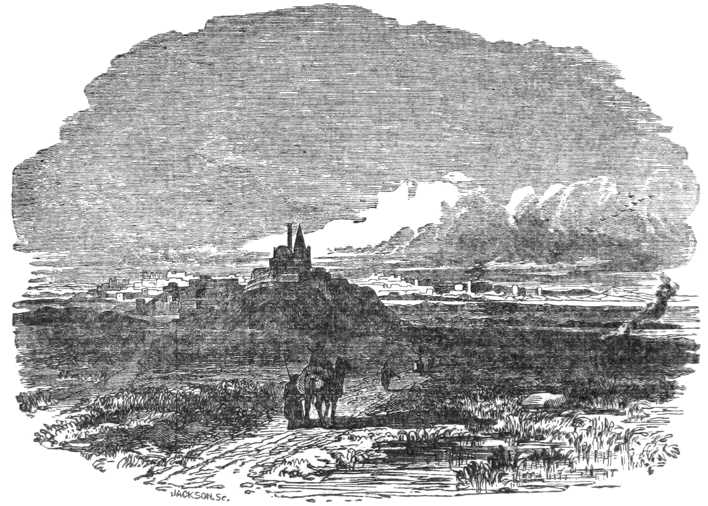
Fig. 280—Nineveh
Nin´eveh, meaning the dwelling of Ninus; a famous city of the ancient world, capital of the great Assyrian Empire, which stood on the eastern bank of the river Tigris, opposite to the present Mosul; its actual site being most probably the same with that of Nunia and the tomb of Jonah, about three-fourths of a mile from the river, in the midst of ruins, N. lat. 36° 20′ 17″; E. long. 43° 10′ 17″. The Bible makes the city a sort of colony from Babylon or Babel, Shinar [see BABEL], stating (Gen 10:11), ’out of that land (Babel, etc. in the land of Shinar) went forth Asshur and builded Nineveh.’ After this simple statement the sacred record is for a long time entirely silent respecting Nineveh, which, we may therefore presume, remained inconsiderable for many generations. At length, some fifteen hundred years after the first mention of the place, in the days of Jeroboam II., king of Israel (B.C. 825), Nineveh again enters by name on the Biblical record, having meanwhile grown into a mighty power. This reappearance of Nineveh is accidental, and shows that the Bible does not profess to give any orderly and systematic history of the world. Other countries come on the scene and disappear, just as the course of events in the kingdoms of Judah and Israel seems to require or may chance to occasion. Nineveh is described in the book of Jonah as ’that great city,’ ’an exceeding great city of three days’ journey,’ probably in a straight line through the place, as the large cities of Asia stood on a great extent of country, having gardens, and even fields, in the midst of them; and Jonah is said to enter into the city a day’s journey’ (Jon 3:4) before he began to foretell its overthrow; that is, as is most likely, he penetrated into the heart of the place, as being that which was most suitable for delivering his burden. The magnitude of the place may also be gathered from what is said in the last verse of the book: ’That great city wherein are more than six score thousand persons that cannot discern between their right hand and their left hand, and also much cattle (grazing).’ The population of a place must have been immense in which there were no fewer than 120,000 children—young children the language employed seems to denote. It also appears from the same book that the state of society was highly complex, organized in divers ranks from the king and the noble to the peasant; and, if we may argue from the exactness with which the number of children is given, we should be justified in asserting that the people were in an advanced stage of civilization, seeing that their social statistics were well attended to and carefully preserved. Civilization, however, had brought luxury, and luxury corruption of morals, for ’their wickedness had gone up before God’ (Jon 1:2). Yet was not their iniquity of the lowest kind, for the Ninevites repented at the preaching of Jonah.
A few years later we find the prophet Nahum entrusted with ’the burden of Nineveh.’ From this book it would appear that the repentance of the city, if sincere, was not durable. Therefore was the anger of Jehovah about to fall upon it and make it a perpetual waste. The impending destruction of this ’great city’ was also foretold by Zephaniah (Zep 2:13), and by Isaiah (Isa 14:24) in language which gives a striking view of its commercial greatness (it was the entrepôt for the trade of Eastern and Western Asia), its surpassing-opulence, its high culture, its immense population, and deep criminality (see Nahum 3, and Ezekiel 31). From Strabo we learn that the place was much greater than even Babylon; and from Diodorus Siculus, that it measured 480 stadia in circumference, having very high and broad walls, which, aided by the river, rendered it impregnable. This safety was, however merely imaginary. Sardanapalus, who had a full share of the vices of his subjects, endured in the eighth century before Christ a siege of three years’ duration at the hands of the Medes, under Arbaces, which led to the overthrow of the city (Diod. Sic. ii. 26). But so large and so powerful a capital was not easily destroyed. Nineveh was the seat of an Assyrian kingdom till the year B.C. 625, when it was taken by Nabopolassar of Babylon, and Cyaxares, king of the Medes, which led to the destruction of the Assyrian kingdom. Nineveh flourished no more. Strabo represents it as lying waste; though in the times of the Roman emperors some remains of it seem to have survived, as a Nineveh on the Tigris is mentioned in Tacitus, and is characterized as a fort, probably some small fortification raised out of the ruins of the city for predatory purposes.
The present remains comprise a rampart and fosse, four miles in circuit, with a moss-covered wall about twenty feet in height. The ruins at first sight present a range of hills. From these hills large stones are constantly dug out, from which probably a bridge over the Tigris has been built.
Jonah’s connection with the city is still preserved in a tomb which bears his name; but how far back in antiquity this building runs, it is now impossible to say. The tomb stands on a hill, and is covered by a mosque which is held in great veneration. Bricks, partly whole, partly in fragments, and pieces of gypsum with inscriptions in the arrow-head character, are found from time to time. Landseer, in his Sabæan Researches, gives an engraving of cylinders dug up at Nineveh, which he states to be numerous in the East, and supposes to have been employed as signets: they are of jasper, chalcedony, and jade, and bear astronomical emblems, the graving of which, especially considering the hardness of the materials, shows a high state of art.
Mosul, with which Nineveh is commonly identified, stands on the opposite, or western, bank of the Tigris, and lies so near the river that its streets are often flooded. This place, like its great prototype, carries on a trade (though to a small extent) between the East and the West. The climate is stated to be very healthy: the average temperature of summer not exceeding 66˚ F.; but in spring, during the floods, epidemics are common, though not fatal.
Dwelling of Ninus, the metropolis of ancient Assyria, called by the Greeks and Romans "the great Ninus;" situated on the east bank of the Tigris, opposite and below the modern Mosul. Its origin is traced to the times near the flood. See NIMROD. For nearly fifteen centuries afterwards it is not mentioned. In the books of Jonah, and Nahum it is described as an immense city, three days’ journey in circuit, containing more than one hundred and twenty thousand young children, or probably six hundred thousand souls. It contained "much cattle," and numerous parks, garden groves, etc. Its inhabitants were wealthy, warlike, and far advanced in civilization. It had numerous strongholds with gates and bars; and had multiplied its merchants above the stars: its crowned princes were as locusts, and its captains as grasshoppers. With this description agrees that of the historian Diodorus Siculus, who says Nineveh was twenty-one miles long, nine miles broad, and fifty-four miles in circumference; that its walls were a hundred feet high, and so broad that three chariots could drive upon them abreast; and that it had fifteen hundred towers, each two hundred feet high.\par Nineveh had long been the mistress of the East; but for her great luxury and wickedness, the prophet Jonah was sent, more than eight hundred years before Christ, to warn the Ninevites of her speedy destruction. See also Isa 14:24,25 . Their timely repentance delayed for a time the fall of the city; but about 753 B. C., the period of the foundation of Rome, it was taken by the Medes under Arbaces; and nearly a century and a half later, according to the predictions of Nahum, Jon 1:1-3:19, and Zep 2:13, it was a second time taken by Cyaraxes and Nabopolassar; after which it no more recovered its former splendor. Subsequent writers mention it but seldom, and as an unimportant place; so complete was its destruction, that for ages its site has been well-nigh lost, and infidels have even denied that the Nineveh of the Bible ever existed. The mounds which were the "grave" of its ruins, Jon 1:14, were covered with soil as to seem like natural hills. But since 1841, Layard, Botta, and others have been exploring its remains, so long undisturbed. The mounds chiefly explored lie at three corners of a trapezium about eighteen miles long, and twelve miles wide, and nearly sixty in circumference, thus confirming the ancient accounts of its vast extent. The recent excavations disclose temples and palaces, guarded by huge winged bulls and lions with human heads. The apartments of these buildings are lined with slabs of stone, covered with sculptures in basrelief, and inscriptions in arrow-headed characters which have been in part deciphered; and these sculptured memorials of the history and customs of the Assyrians, together with the various articles made of glass, wood, ivory, and metals, now brought to light after a burial of twenty-four centuries, furnish invaluable aid in the interpretation of Scripture, and most signally confirm its truth. Our surprise is equal to our gratification, when we behold the actual Assyrian account of events recorded in Kings and Chraonicles. Not only do we find mention made of Jehu, Menehem, Hezekiah, Omri, Hazael, etc., and of various cities in Judea and Syria; but we discover Sennacherib’s own account of his invasion of Palestine, and of the amount of tribute which king Hezekiah was forced to pay him; also pictures representing his capture of Lachish, 2Ki 18:14, and his officers, perhaps the railing Rabshakeh himself, presenting Jewish captives to the king, etc. (See cut and details in SENNACHERIB.)\par These mural tablets also furnish a graphic comment on the language of the prophet Ezekiel; and as he was a captive in the region of Ninveh, he had no doubt heard of, and had probably seen these very "chambers of imagery," as well as the objects they represent. We there find reproduced to our view the men and scenes he describes in Eze 23:6,14,15, etc.; Eze 26:7-12: "Captains and rulers clothed most gorgeously," "portrayed with vermilion," "girded with girdles upon their loins," "exceeding in dyed attire upon their heads." The "vermilion" or red color is quite prevalent among the various brilliant colors with which these tablets were painted, Eze 23:14,15 . Here are "horsemen riding upon horses," "princes to look to" in respect to war-like vigor and courage; and their horses of high spirit, noble form, and attitudes, and decked with showy trappings. Here, in fine, are the idols, kings, and warriors of Nineveh, in various scenes of worship, hunting, and war; fortresses attacked and taken; prisoners led in triumph, impaled, flayed, and otherwise tortured; and sometimes actually held by cords attached to hooks which pierce the nose or the lips, 2Ki 19:28 Isa 37:29, and having their eyes put out by the point of a spear, 2Ki 25:7 . For other cuts see NISROCH, SENNACHERIB, SHALMANEZER, and WAR.\par The Christian world is under great obligations to Layard and Botta for their enterprising explorations, and to Rawlinson and Hincks for their literary investigations of these remains. To the student of the Bible especially these buried treasures are of the highest value, and we may well rejoice not only in this new accumulation of evidence to the truth of the history and prophecies of Scripture, but in the additional light thus thrown on its meaning. How impressive too the warning which these newly found memorials of a city once so vast and powerful bring to us in these latter days and in lands then unknown, to beware of the luxury, pride, and ungodliness that caused her ruin.\par
Nin’eveh. (abode of Ninus). The capital of the ancient kingdom and empire of Assyria. The name appears to be compounded, from that of an Assyrian deity, "Nin," corresponding, it is conjectured, with the Greek Hercules, and occurring in the names of several Assyrian kings, as in "Ninus," the mythic founder, according to Greek tradition of the city.
Nineveh is situated on the eastern bank of the river Tigris, 50 miles from its mouth and 250 miles north of Babylon. It is first mentioned in the Old Testament, in connection with the primitive dispersement and migrations of the human race. Asshur, or according to the marginal reading, which is generally preferred, Nimrod is there described, Gen 10:11, as extending his kingdom from the land of Shinar or Babylonia, in the south, to Assyria in the north and founding four cities, of which the most famous was Nineveh. Hence, Assyria was subsequently known to the Jews as, "the land of Nimrod," compare Mic 5:6, and was believed to have been first peopled by a colony from Babylon.
The kingdom of Assyria and of the Assyrians is referred to in the Old Testament as connected with the Jews at a very early period, as in Num 24:22: Num 24:24, and Psa 83:8. But after the notice of the foundation of Nineveh in Genesis, no further mention is made of the city, until the time of the book of Jonah, or the eighth century B.C. In this book, no mention is made of Assyria or the Assyrians, the king to whom the prophet was sent being termed the, "king of Nineveh," and his subjects "the people of Nineveh."
Assyria is first called a kingdom in the time of Menahem, about B.C. 770. Nahum, (? B.C. 645), directs his prophecies against Nineveh, only once against the king of Assyria. Nah 3:18. In 2Ki 19:36 and Isa 37:37, the city is first distinctly mentioned as the residence of the monarch. Sennacherib was slain there, when worshipping in the temple of Nisroch, his god. Zephaniah, about B.C. 630, couples the capital and the kingdom together, Zep 2:13, and this is the last mention of Nineveh as an existing city.
The destruction of Nineveh occurred B.C. 606. The city was then laid waste, its monuments destroyed, and its inhabitants scattered or carried away into captivity. It never rose again from its ruins. This total disappearance of Nineveh is fully confirmed by the records of profane history. The political history of Nineveh is that of Assyria, of which a sketch has already been given. See Assyria.
Previous to recent excavations and researches, the ruins which occupied the presumed site of Nineveh seemed to consist of mere shapeless heaps or mounds of earth and rubbish. Unlike the vast masses of brick masonry which mark the site of Babylon, they showed externally no signs of artificial construction, except, perhaps, here and there, the traces of a rude wall of sun-dried bricks. Some of these mounds were of enormous dimensions, looking, in the distance, rather like natural elevations, than the work of men’s hands. They differ greatly in form, size and height. Some are mere conical heaps, varying from 50 to 150 feet high; others have a broad flat summit, and very precipitous cliff-like sites furrowed by deep ravines worn by the winter rains.
The principal ruins are -- (1) The group immediately opposite Mosul, including the great mounds of Kouyunjik and Nebbi Yunus;
(2) that near the junction of the Tigris and Zab comprising the mounds of Nimroud and Athur;
(3) Khorsabad, about ten miles to the east of the former river;
(4) Shereef Khan, about 5 1/2 miles to the north of Kouyunjik; and
(5) Selamiyah, three miles to the north of Nimroud.
Discoveries. -- The first traveller who carefully examined the supposed site of Nineveh was Mr. Rich, formerly political agent for the East India Company at Bagdad, but his investigations were almost entirely confined to Kouyunjik and the surrounding mounds, of which he made a survey in 1820. In 1843 M. Botta, the French consul at Mosul, fully explored the ruins. M. Botta’s discoveries at Khorsabad were followed by those of Mr. Layard at Nimroud and Kouyunjik, made between the years 1846 and 1850.
(Since then very many and important discoveries have been made at Nineveh, more especially those by George Smith, of the British Museum. He has discovered not only the buildings, but the remains of a fine ancient library written on stone tablets. These leaves or tablets were from an inch to 1 foot square, made of terra-cotta clay, on which, when soft, the inscriptions were written; the tablets were then hardened and placed upon the walls of the library rooms, so as to cover the walls.
This royal library contained over 10,000 tablets. It was begun by Shalmaneser, B.C. 860, his successors added to it, and Sardanapalus, (B.C. 673), almost doubled it. Stories or subjects were begun on tablets, and continued on tablets of the same size, sometimes to the number of one hundred. Some of the most interesting of these give accounts of the creation and of the deluge, and all agree with or confirm the Bible. -- Editor).
Description of remains. -- The Assyrian edifices were so nearly alike in general plan, construction and decoration that one description will suffice for all. They were built upon artificial mounds or platforms, varying in height, but generally from 30 to 50 feet above the level of the surrounding country, and solidly constructed of regular layers of sun-dried bricks, as at Nimroud, or consisting merely of earth and rubbish heaped up, as at Kouyunjik. This platform was probably faced with stone masonry, remains probable which were discovered at Nimroud, and broad flights of steps or inclined ways led up to its summit.
Although only the general plan of the ground-floor can now be traced, it is evident that the palaces had several stories built of wood and sun-dried bricks, which, when the building was deserted and allowed to fall to decay, gradually buried the lower chambers with their ruins, and protected the sculptured slabs from the effects of the weather. The depth of soil and rubbish above the alabaster slabs varied from a few inches to about 20 feet. It is to this accumulation of rubbish above them that the bas-reliefs owe their extraordinary preservation.
The portions of the edifices still remaining, consist of halls, chambers and galleries, opening, for the most part, into large, uncovered courts. The wall above the wainscoting of alabaster was plastered, and painted with figures and ornaments. The sculptured, with the exception of the human-headed lions and bulls, were for the most part in low relief, The colossal figures usually represent the king, his attendants and the gods; the smaller sculptures, which either cover the whole face of the slab, or are divided into two compartments by bands of inscriptions, represent battles sieges, the chase, single combats with wild beasts, religious ceremonies, etc., etc. All refer to public or national events; the hunting-scenes evidently recording the prowess and personal valor of the king as the head of the people -- "the mighty hunter before the Lord."
The sculptures appear to have been painted, remains of color having been found on most of them. Thus decorated without and within, the Assyrian palaces must have displayed a barbaric magnificence, not, however, devoid of a certain grandeur and beauty, which probably no ancient or modern edifice has exceeded. These great edifices, the depositories of the national records, appear to have been at the same time, the abode of the king, and the temple of the gods.
Prophecies relating to Nineveh, and illustrations of the Old Testament. These are exclusively contained in the books of Nahum and Zephaniah. Nahum threatens the entire destruction of the city, so that it shall not rise again from its ruins. The city was to be partly destroyed by fire. Nah 3:13; Nah 3:16. The gateway in the northern wall of the Kouyunjik enclosure had been destroyed by fire as well as the palaces. The population was to be surprised when unprepared: "while they are drunk as drunkards, they shall be devoured as stubble fully dry." Nah 1:10. Diodorus states that the last and fatal assault was made when they were overcome with wine. The captivity of the inhabitants and their removal to distant provinces are predicted. Nah 3:18. The fullest and the most vivid and poetical picture of Nineveh’s ruined and deserted condition is that given by Zephaniah, who probably lived to see its fall. Zep 2:13-15.
Site of the city. -- Much diversity of opinion exists as to the identification of the ruins, which may be properly included within the site of ancient Nineveh. According to Sir H. Rawlinson and those who concur in his interpretation of the cuneiform characters, each group of mounds already mentioned represents a separate and distinct city.
On the other hand, it has been conjectured, with much probability, that these groups of mounds are not ruins of separate cities, but of fortified royal residences, each combining palaces, temples, propylaea, gardens and parks, and having its peculiar name, and that they all formed as part of one great city, built and added to at different periods, and consisting of distinct quarters scattered over a very large, and frequently very distant, one from the other. Thus the city would be, as Layard says, in the form of a parallelogram 18 to 20 miles long by 12 to 14 wide, or, as Diodorus Siculus says, 55 miles in circumference.
Writing and language. -- The ruins of Nineveh have furnished a vast collection of inscriptions, partly carved on marble or stone slabs, and partly impressed upon bricks and upon clay cylinders, or sixsided and eight-sided prisms, barrels and tablets, which, used for the purpose when still moist, were afterward, baked in a furnace or kiln. Compare Eze 4:4. The character employed was the arrow-headed or cuneiform -- so called from each letter being formed by marks or elements resembling an arrow-head or a wedge.
These inscribed bricks are of the greatest value in restoring the royal dynasties. The most important inscription, hitherto, discovered in connection with biblical history, is that upon a pair of colossal human-headed bulls from Kouyunjik, now in the British Museum, containing the records of Sennacherib, and describing, among other events, his wars with Hezekiah. It is accompanied by a series of bas-reliefs believed to represent the siege and capture of Lachish.
A list of nineteen or twenty kings can already be compiled, and the annals of the greater number of them will probably be restored to the lost history, of one of the most powerful empires of the ancient world, and of one which appears to have exercised, perhaps, greater influence than any other, upon the subsequent condition and development of civilized man. The people of Nineveh spoke a Shemitic dialect, connected with the Hebrew, and with the so called Chaldee of the books of Daniel and Ezra. This agrees with the testimony of the Old Testament.
The parallelogram in Assyria covered with remains has Khorsabad N.E.; Koyunjik and Nebi Yunus (Nineveh in the narrow sense) near the Tigris N.W.; Nimrud and Athur between the Tigris and Zab, N.W.; and Karamles at a distance inward from the Zab S.E. From Koyunjik to Nimrud is 18 miles; from Khorsabad to Karamles 18; from Koyunjik to Khorsabad 13 or 14; from Nimrud to Karamles 14. The length was greater than the breadth; so Jon 3:4 "entered into the city a day’s journey." The longer sides were 150 furlongs each, the shorter 90 furlongs, the whole circuit 480 or 460 miles. Babylon had a circuit of only 385 miles (Clitarchus in Diod. ii. 7, Strabo xvi. 737). The walls were 100 ft. high, with 1,500 towers, and broad enough for three chariots abreast. Shereef Khan is the northern extremity of the collection of mounds on the eastern bank of the Tigris, and is five and a half miles N. of Koyunjik. There is also an enclosure, 5,000 yards in circuit, once enclosed by a moat at Selamivah three miles N. of Nimrud. Nimrud in inscriptions is called Kalkhu or Calah in Gen 10:11; Khorsabad is called Sargina from Sargon. At Kileh Sherghat is the presumed original capital," Asshur," 60 miles S. of Mosul, on the right or western bank of the Tigris.
Sennacherib first made Nineveh the capital. Nineveh was at first only a fort to keep the Babylonian conquests around. It subsequently, with Rehoboth, Ir, Calah, and Resen, formed one great city, "Nineveh" in the larger sense. Thothmes III of Egypt is mentioned in inscriptions as capturing Nineveh. Phraortes the Mede perished in attempting to do so (Herodotus i. 102). Cyaxares his successor, after at first raising the siege owing to a Scythic invasion (Herodotus i. 103, 106) 625 B.C., finally succeeded in concert with the Babylonian Nabopolassar, 606 B.C., Saracus the last king, Esarhaddon’s grandson, set fire to the palace and perished in the flames, as Ctesias states, and as the marks of fire on the walls still confirm. So Nah 3:13; Nah 3:15, "fire shall devour thy bars." Charred wood, calcined alabaster, and heat splintered figures abound. Nahum (Nahum 2) and Zephaniah (Zep 2:13-15) foretold its doom; and Ezekiel (Ezekiel 31) shortly after attests the completeness of its overthrow, as a warning of the fatal issue of pride, Isa 10:7-14; Diodorus (ii. 27) says there was a prophecy that Nineveh should not fall until the river became its enemy.
The immediate cause of capture was the city walls destruction by a sudden rise in the river. So Nahum (Nah 1:8; Nah 2:6; Nah 2:8) foretold "with an over running flood He will make an utter end of the place;" "the gates of the rivers shall be opened and the palace shall be dissolved," namely, by the inundation; "Nineveh is of old like a pool of water (though of old defended by water around), yet (its inhabitants) shall flee." There was a floodgate at the N.W. angle of the city, which was swept away; and the water pouring into the city "dissolved" the palace foundation platform, of sundried bricks. Nineveh then totally disappears from history; it never rose again. Nahum (Nah 1:10; Nah 3:11) accords with Diodorus Siculus that the final assault was made during a drinking bout of king and courtiers: "while they are drunken as drunkards, they shall be devoured as stubble fully dry ... Thou shalt be drunken," etc. The treasures accumulated by many kings were rifled, as Nahum foretells; "take ye the spoil of silver ... gold, for there is none end of the store;" the people were "scattered upon the mountains" (Nah 3:18).
He calls it "the city of bloods," truly (Nah 3:1); the wall carvings represent the king in the act of putting out his captives’ eyes, and dragging others by a hook through the lips and a cord. Other cities have revived, but Nahum foretells "there is no healing of thy bruise" (Nah 3:19). Lucian of Samosara near the Euphrates asserts none in his day even knew where Nineveh stood. Its former luxury is embodied in the statue of Sardanapalus as a dancer, which he directed (Plutarch says) to be erected after his death, with the motto "eat, drink, enjoy lust ... the rest is nothing!" The language of its inscriptions is Semitic, for the main population was a colony of Asshur, son of Shem; and besides the prevalent Semitic a Turanian dialect has been found on tablets at Koyunjik, derived from its original Cushite founder Nimrod of Babylon and his band. At Nimrud the oldest palaces are in the N.W. grainer, the most recent at the S.E. The table of Karnak in Egypt (1490 B.C.) connects Niniu (Nineveh) with Naharaima or Naharaim or Mesopotamia. Sir H. Rawlinson published 1862 an Assyrian canon from the monuments.
The first kings reigned when the early Chaldee empire had its seat in lower Mesopotamia. Asshur-bil-nisis, Buzur Ashur, and Asshur Vatila from 1653 to 1550 B.C., when Purnapuriyas and Durri-galazu were the last of the early Chaldaean monarchy. Then Bel Sumill Kapi founds a dynasty after a chasm of two centuries. "Bellush, Pudil, and Ivalush" are inscribed on bricks at Kileh Sherghat, 1350-1270 B.C. Shalmaneser I, son of Ivalush I, is mentioned on a genealogical slab as founder of Nimrud. Tiglath-i-nin his son inscribes himself" conqueror of Babylon"; Sargon finally conquered it. Tiglath-inin’s successor Ivalush II (1250 B.C.) enlarged the empire and closes the dynasty. By a revolution Nin pala Zira ascends the throne, "the king of the commencement" as the Tiglath Pileser cylinder calls him. Then Asshurdahil, Mutaggil Nebo, Asshur-ris-ilim (conqueror of a Nebuchadnezzar of Babylon), Tiglath Pileser I (subdued Meshech), Asshur-belkala; a blank of two centuries follows when David’s and Solomon’s extensive dominion has place. Asshur-iddin-akhi begins the next dynasty (950-930 B.C.).
Asshur-danin-il and Iralush III follow; then Tiglath-i-nin; Asshur-idanni-pal next after ten victorious campaigns built a palace at Calah, 360 ft. long by 300 broad, with man lions at the gateways, and by a canal brought the Zab waters to Calah; he was "lord from the upper Tigris to Lebanon and the great sea." His son Shalmaneser II took tribute from Tyre and Sidon and fought Benhadad and Hazael. A picture represents him receiving from Jewish captives tribute of Jehu king of Israel, gold, pearl, and oil. He built the central palace of Nimrud, opened by Layard. The black marble obelisk (in the British Museum) records his exploits and Jehu’s name. Then Shamas-Iva, Iralush IV and his wife Semiramis, a Babylonian princess, Shalmaneser III, Asshur-danin-il II, Asshur-lush. Then Tiglath Pileser II, probably Pul, usurps the throne by revolution, for he does not mention his father as others do, 744 B.C. Under him "Menahem" appears in inscriptions, and "tribute from the house of Omri" i.e. Samaria (2Ki 15:19; 2Ki 15:29).
Ahaz enlisted him as ally against Samaria and Damascus; Tiglath Pileser conquered them and received tribute from Jahu-khazi or Ahaz. An inscription in the British Museum records Rezin’s death (Rawlinson’s Monarchies, 2:398,399). Tiglath Pileser built a new palace at Nimrud. Then Shalmaneser IV (not in the canon) (2Ki 17:3-4) assailed Samaria, upon Hoshea’s leaguing with So of Egypt, and withholding tribute. In a chamber at Koyunjik was found among other seals now in British Museum the seal of So or Sabacho and that of Sennacherib affixed to a treaty between them, of which the parchment has perished. Sargon ("king de facto") usurped the throne and took Samaria (he says in inscriptions) in his first year; he built the palace at Khorsabad. Sennacherib his son succeeded 704 B.C. and reigned 24 years. He built the palace at the S.W. corner of Koyunjik, covering 100 acres almost, excavated by Layard.
He built a temple at the S.W. corner of Nimrud, and a palace at Nebi Yunus. Asshurbani-pal succeeded, a hunter and warrior; his library of clay tablets, religious, legal, historical, and scientific, is in British Museum. He built a palace at Koyunjik, near Sennacherib’s. His son, the last king, Asshuremid-ilin or Asshur-izzir-pal (Saracus or Sardanapalus), built the S.E. edifice at Nimrud. The palace walls were from five to fifteen feet thick, erected on an artificial platform 30 to 50 ft. above the surrounding level, and paneled with slabs of coarse alabaster sculptured and inscribed. The plaster above the alabaster wainscoting was ornamented with figures; the pavement was of alabaster or flat kiln-burnt bricks resting on bitumen and fine sand. The Nimrud grand hall is only 35 ft. broad (though 160 ft. long), to admit of roofing with the short beams to be had. The ceilings were gaily colored.
The portals were guarded by colossal human headed bulls; thence was an ascent to a higher platform, and on the top a gateway, sometimes 90 ft. wide, guarded also by winged bulls; inside was the great door, opening into a sculpture adorned passage; then the inner court, then the state apartments. There may have been an upper story of sun-dried bricks and wood, for there are no stone or marble columns or burnt brick remains. The large halls may have been roofless, a ledge projecting round the four sides and supporting an awning as shelter against rain and sun. However Zep 2:14 mentions "the cedar work," cedars from Lebanon may have reached from wall to wall with openings for light.
The chambers were built round the central hall. In Nah 2:3 translated "the chariots (shall be furnished) with fire flashing scythes," literally, "with the fire of scythes" or "iron weapons." No traces of such scythe-armed chariots are found in Assyria; either then it applies to the besiegers, or "the chariots shall come with the glitter of steel weapons." The "red shield" (Nah 2:3) accords with the red painting of the shields and dresses in the sculptures. The king, with beardless eunuch behind holding an umbrella and the winged symbol of Deity above, appears in various carvings; he was despotic. Kitchen operations, husbandry and irrigation implements are represented also.
Religion. The man bull and man lion answer to Nin and Nergal, the gods of war and the chase. Nisroch the eagle-headed god and Dagon the fishheaded god often appear in the sculptures. The sacred tree answers to Asheerah, "the grove" (2Ki 21:7). The chief gods were Asshur, Bel, Beltis or Myletta, Sin the moon, Shamash (Hebrew
Language and writing. Clay cylinders pierced through so as to turn round and present their sides to the reader, bricks, and slabs are the materials inscribed on. The wedge (
↓ - prefixed marks the word as a man’s name;
↓↓ - marks the plural;
↓← - marks the dual.
It is related to Hebrew, thus,
The northwestern palace of Nineveh has the longest inscription; it records concerning Sardanapalus II. Sennacherib’s inscription concerning Hezekiah, on two man-headed bulls from Koyunjik, is the most interesting. Bas-reliefs of the siege of Lachish accompany it.
Tombs. Chaldaea is as full of tombs as Assyria is void of them. Probably Chaldaea was the burial place of the Assyrian kings; Arrian (Exped. Alex. 7:22) states that their tombs were in the marshes S. of Babylon.
Art, Commerce. Egyptian art is characterized by calm repose, Assyrian art by energy and action. Egyptian architecture is derived from a stone prototype, Assyrian from a wooden one, in agreement with the physical features of the respective countries. Solomon’s temple and palace, with grand hall and chambers, paneled with slabs sculptured with trees, the upper part of the walls painted in various colors, the winged cherubim carved all round, the flowers and pomegranates, correspond to the Nineveh palaces in a great measure. Silk, blue clothes, and embroidered work were traded in by Nineveh’s merchants (Eze 27:23-24; Nah 3:16). The Chaldaean Nestorians in the Kurdistan mountains and the villages near Mosul are the sole representatives of the ancient Assyrians and Babylonians.
Nineveh (nîn’e-veh), perhaps dwelling of Nina, the capital and greatest city of Assyria. It was founded by Nimrod, Gen 10:11, and was on the eastern bank of the river Tigris, about 250 miles in a direct lino north of the rival city of Babylon, and not far from 550 miles northwest of the Persian Gulf. Assyrian scholars are not agreed in respect to the size of this ancient city. Some, as Layard, regard it as covering a large parallelogram, whose sides were each from 18 to 20 miles long, and the ends 12 to 14 miles wide. This view would include the ruins now known as Konyunjik, Nimrud, Khorsabad, and Keremles. Diodorus Siculus makes the circumference of the city 55 miles, including pastures and pleasure grounds. This view of the great extent of the city is, on the other hand, sharply disputed by Rawlinson, who thinks it highly improbable that this ancient city should have had an area about ten times that of London. He would reject it on two grounds, the one historical and the other topographical. He maintains that the ruins of Khorsabad, Keremles, Nimrud, and Konyunjik bear on their bricks distinct local titles, and that these titles are found attaching to distant cities in the historical inscriptions. According to his view, Nimrud would be identified with Calah, and Khorsabad with Dur-sargina, or "the city of Sargon." He further claims that Assyrian writers do not consider these places to be parts of Nineveh, but distinct and separate cities; that Calah was for a longtime the capital, while Nineveh was a provincial town; that Dur-sargina was built by Sargon—not at Nineveh, but near Nineveh; and that Scripture similarly distinguishes Calah as a place separate from Nineveh, and so far from it that there was room for a great city between them. See Gen 10:12. He also suggests that a smaller city in extent would answer the requirements of the description in the book of Jonah, which makes it a city of "three days’ journey." Jon 3:3. As already stated, Nineveh was founded by Asshur, or, as the marginal reading of Gen 10:11 states, Nimrod. When Nineveh became the capital of Assyria is not definitely known, but it is generally believed it was during the reign of Sennacherib. The prophecies of the books of Jonah and Nahum are chiefly directed against this city. The latter prophet indicates the mode of its capture. Nan. 1:1-8; 2:6, 8; 3:18. Nineveh was the capital of Assyria during the height of the grandeur of that empire, and in the time of Sennacherib, Esar-haddon, and Assur-bani-pal. It was besieged for two years by the combined forces of the Medes and Babylonians, was captured, and finally destroyed b.c. 606. Excavations have been made by M. Botta, Layard, Hormuzd Rassam, Loftus, and George Smith. They have brought to light, among others, the following noted buildings: 1. Three ruined temples, built and restored by many kings in different ages. 2. The palace of Shalmaneser, as improved by subsequent rulers. 3. A palace of another ruler, restored by Sennacherib and Esar-haddon. 4. A palace of Tiglath-pileser II. 5. A temple of Nebo. 6. The southwest palace of Sennacherib. 7. The northwest palace of the same ruler. 8. The city walls built by the latter king and restored by Assur-bani-pal. See Assyria. The prophecies respecting the destruction of Nineveh are very specific; the prophet seemed to see her in her desolation and exclaims: "Nineveh hath been from of old like a pool of water... Nineveh is laid waste: who will bemoan her?... Thy worthies are at rest; thy people are scattered upon the mountains, and there is none to gather them." Nah 2:8; Nah 3:7; Nah 3:18, R. V. "The Lord... will make Nineveh a desolation, and dry like the wilderness. And herds shall lie down in the midst of her, all the beasts of the nations; both the pelican and the porcupine shall lodge in the chapiters thereof; their voice shall ring in the windows; desolation shall be in the thresholds... how is she become a desolation, a place for beasts to lie down in!" Zep 2:11; Zep 2:13-15. These prophecies have been literally fulfilled. The city was destroyed; its very site was lost and unknown for centuries; it has now been found, its ruins opened, but are uninhabited except by wild beasts.
[Nin’eveh]
The capital of the ancient kingdom of Assyria. It was founded very early by Nimrod. Gen 10:11-12; cf. Mic 5:6. It was doubtless comparatively small at first, but nothing is related of its progress until Jonah was sent, about 1,300 years after its founding, to threaten its destruction. It was then an exceeding great city (lit. ’a great city unto God’) of three days’ journey, probably signifying, its circumference. A three days ’journey’ is estimated by Niebuhr to be about ninety English miles. This area would include gardens, pastures (which the ’much cattle’ would necessitate), and pleasure grounds. The population was large, but not densely located together as in modern cities. There were 120,000 that could not discern their right hand from their left, probably children, which would give a population of about 600,000.
Jonah took a day’s journey in the city, delivering his message as he proceeded. The people believed God, and, led by the king, humbled themselves, fasted, and ceased from their evil deeds. Jonah 3, Jonah 4. God saw their works and turned from the evil that He had threatened. This king was perhaps Shalmaneser 2, whose reign has been dated at B.C. 858-823.
Nineveh is next mentioned in 2Ki 19:36; Isa 37:37, when Sennacherib, after the destruction of his army by God, retired to Nineveh, where he was slain by two of his sons.
The other references to Nineveh in scripture are occupied with its judgement and foretelling its destruction. The prophecy of Nahum is especially devoted to this. Diodorus asserts that there was an ancient prophecy that Nineveh should not fall till the river became an enemy to the city; which happened in the third year of the siege, when the river partially overflowed the city. In the prophecy of Nahum it is said, "with an overrunning flood he will make an utter end of the place"; "the gates of the rivers shall be opened, and the palace shall be dissolved." Nah 1:8; Nah 2:6. It was to be totally destroyed and not rise again. "a desolation, and dry like a wilderness." Nineveh had been very proud, and had said in its heart, "I am, and there is none beside me"; it should be a place for wild beasts. Zep 2:13-15: cf. Isa 10:5-19. It had been ’a city of blood,’ and full of lies and robbery; it should be made vile; its destruction should be final: there would be no healing of its bruise. Nah 3:1; Nah 3:19. In Eze 31:3-17 Assyria is compared to a cedar of high stature, which had been brought to utter ruin.
Nineveh may be regarded as typical of the world in its haughty pride, glorying in its prowess. It was the power used by God to carry out His indignation against Israel: it is thus called "the rod of mine anger," and the indignation of Jehovah against His land and people ceases in the destruction of the Assyrian - a reference to some power in the last days which will morally succeed to the character of the Assyrian, and be destroyed subsequent to Babylon. Isa 14:24-25. Historically Assyria fell before Babylon.
The account of the taking of Nineveh is thus given by Ctesias, preserved in Diodorus Siculus, ii. 27, 28. Cyaxares, the Median monarch, aided by the Babylonians under Nabopolassar, laid siege to the city. His efforts were in vain; he was repulsed again and again; but receiving reinforcements he overcame the Assyrian army and they were shut up in the city. He then attempted to reduce the city by blockade, but was unsuccessful for two years, till his efforts were unexpectedly assisted by an extraordinary rise of the Tigris, which swept away a part of the walls and allowed the Medes to enter. The Assyrian king Saracus, in despair, burnt himself in his palace. The conquerors gave up the whole to the flames, and it was razed to the ground.
Rawlinson and others do not credit this account, they consider it undeserving a place in history. Some such destruction would, however, agree with scripture, which, as quoted above, speaks of the water, it also refers to the place being pillaged of its gold and silver, "for there is none end of the store and glory out of all the pleasant furniture." Nah 2:9. Those who of late years have examined the mounds testify to its destruction by fire. Calcined sculptured alabaster statues split by heat, charcoal, and charred wood have been found buried in bricks and earth. For years search has been made among its ruins, and there is yet much to be examined. The principal museums of Europe are stored with the relics, and many tablets have been discovered, one of which gives a remarkable account of the deluge. It may indeed be said that the library of Nineveh has been opened in modern times, and the details of the records made thousands of years ago can now be read.
The principal ruins are found at:
1. Kouyunjik (or Nineveh proper), opposite Mosul, which is situate 36° 22’ S, 43° E.
2. Some eighteen miles south-east, lies Nimroud.
3. About twelve miles nearly northward are ruins at Karamles.
4. About twelve miles north-west lies Khorsabad.
These four places may be taken as the corners of the ancient city. They form a trapezoid of about sixty miles in circumference. The walls of the ancient city may have extended further, except where bounded by the river Tigris. The excavations reveal extensive buildings with the entrances adorned with winged bulls and other sculptures. In some places the marks of the chariot wheels can be traced on the limestone pavements.
It was destroyed about B.C. 606, by the Medes and Babylonians, and the fall of this city was the end of the kingdom of Assyria.
By: Executive Committee of the Editorial Board., J. Frederic McCurdy
City of Assyria. The form of its name is derived from the Masoretic text. It answers as nearly as possible to the native Assyrian form "Ninua." The origin of the name is obscure. Possibly it meant originally the seat of Ishtar, since Nina was one of the Babylonian names of that goddess. The ideogram means "house or place of fish," and was perhaps due to popular etymology (comp. Aramaic "nuna," denoting "fish"). Nineveh was the most famous of the cities which were in succession the residences of the kings of Assyria. It was also the latest capital of that kingdom, and as such was regarded by Greek writers as the permanent capital and as being virtually equivalent to the country itself.
Situation of the City.
Nineveh was the strongest of several fortress-cities which were built in the triangular territory between the Tigris and the upper Zab. The terrane of these cities was admirably adapted for defense, being protected on the northwest by the Khausar, a tributary of the Tigris, and on the northeast by the Gomel, a tributary of the Zab, as well as by a range of hills. Within these boundaries were contained Nineveh itself, at the confluence of the Choser and the Tigris, on the site of the mounds of Koyunjik and Nebi Yunus and opposite the modern city of Mosul; the fortress of Kalaḥ (Calah) twenty miles to the south, near the Tigris; and Khorsabad (Dur Sharrukin) fourteen miles to the north on the Choser; besides various smaller fortified towns.
Nineveh is mentioned as early as about 2900 B.C. in an inscription of Gudea (Nabu), King of Lagash in southern Babylonia, who there erected a temple in honor of Ishtar. This inscription is of great importance as showing that a Babylonian colony was planted in Assyria at a very early date. The city of Asshur, however, which gave its name to the kingdom of Assyria, must have been founded at a still earlier time, presumably also by colonists from Babylonia. It was also most frequently the capital of the kings of Assyria up to the middle of the eleventh century B.C., when it was finally abandoned as the seat of power, being less favorably situated for defense than the fortresses to the north of the upper Zab.
Later History.
Nineveh seems to have been made the capital of the whole of Assyria by Shalmaneser I. (c. 1300 B.C.) and to have retained the honor under several of the later kings. Then Tiglath-pileser I. and his immediate successors revived the glories of the city of Asshur. Thereafter Kalaḥ was made the seat of government, and it was not till the days of Sennacherib (705-681) that Nineveh attained to its historic greatness. The work which he performed in and for Nineveh is his chief title to lasting fame. He erected two magnificent palaces, each of them a fortress in itself: one in the style of Assyrian, and the other in the style of Syrian or Hittite, architecture. He also brought a splendid aqueduct into the city to furnish the inhabitants with wholesome water. From the date of these works to the fall of the empire, that is, for rather less than a century, Nineveh remained the royal residence. The next king, Esar-haddon (680-668), and above all the famous Assurbanipal (668-626), augmented the splendor of the city by new palaces and public works, until it eclipsed the fame of the contemporary Babylon. Among Oriental cities it has been surpassed only by the Babylon of Nebuchadrezzar.
Decline and Fall.
Less than twenty years elapsed between the death of the last great king and the destruction of the splendid city itself. This catastrophe has been made of late years the subject of considerable research; but much remains to be elucidated before a clear idea of the actual course of events can be obtained. The following statement summarizes the facts as far as known: With the decline of the Assyrian empire after the Scythian invasion of the regions west of the Tigris the capital itself became more open to attack. The Aryan Medes, who had attained to organized power east and northeast of Nineveh, repeatedly invaded Assyria proper, and in 607 succeeded in destroying the city. The other fortresses doubtless had been occupied some time previously. The capital was very strongly fortified. Its most vulnerable point was the River Khausar, which ran through the city, and which, while serving for defense, might be turned also to its destruction. In the time of flood its waters were stored up in reservoirs, and by breaking these a hostile army might undermine the city walls. An allusion to some such operation seems to be made in Nah. ii. 6. Such a rush of water could not of course inundate or greatly damage the city; it would be used mainly for the purpose of facilitating an entrance. The destruction was wrought by fire, and was made complete and final, so that soon the site of Nineveh proper was no longer distinguished by name from the other fortresses.
Modern Exploration.
Nineveh has been diligently excavated by modern explorers. Its site was first definitely fixed by Richin 1820. The work of exploration on the mound began with Layard in 1845, and was then continued by Rassam and George Smith. The city proper, Nineveh in the strict sense, was oblong in shape, running along the Tigris, and did not occupy more than about three square miles. In the prophetic allegory of Jonah the references to its extent and population apply to the several cities and villages included in the larger area from Khorsabad to Kalaḥ. The excavation of Koyunjik has yielded results of the greatest value. The library of Assurbanipal alone, which consisted largely of copies of precious Babylonian documents, must be counted as one of the most important of the literary collections of the world.
Bibliography:
Layard, Nineveh and Its Remains, 1849;
idem, Monuments of Nineveh, 1849-53;
Botta and Flandin, Monuments de Ninive, 1847-50;
Place, Ninive et l'Assyrie, 1866-69;
George Smith, Assyrian Discoveries, 1875;
Billerbeck and Jeremias, Der Untergang Nineves, in Delitzsch and Haupt, Beiträge zur Assyriologie, iii. 1 (has valuable maps and plates);
Johns, Nineveh, in Cheyne and Black, Encyc. Bibl.
NINEVEH (Assyr.
C. H. W. Johns.
I. BEGINNINGS, NAME, POSITION
1. First Biblical Mention
2. Etymology of the Name
3. Position on the Tigris
II. NINEVEH AND ITS SURROUNDINGS
1. Its Walls
2. Principal Mounds and Gateways
3. Extent and Population within the Walls
4. Extent outside the Walls
5. Calah, Resen and Rehoboth-Ir
6. Khorsabad
7. Sherif Khan and Selamieh
8. Nimroud
III. PALACES AT NINEVEH PROPER
1. The Palace of Sennacherib
2. The Palace of Assur-bani-apli
IV. SENNACHERIB’S DESCRIPTION OF NINEVEH
1. The Walls
2. The Gates - Northwest
3. The Gates - South and East
4. The Gates - West
5. The Outer Wall: the Plantations
6. The Water-Supply, etc.
7. How the Bas-Reliefs Illustrate the King’s Description
8. Nineveh the Later Capital
V. LAST DAYS AND FALL OF NINEVEH
LITERATURE
I. Beginnings, Name, Position.
1. First Biblical Mention:
The first Biblical mention of Nineveh is in Gen 10:11, where it is stated that NIMROD (which see) or Asshur went out into Assyria, and builded Nineveh and Rehoboth-Ir, and Calah, and Resen between Nineveh and Calah, with the addition, “the same is the great city.” Everything indicates that these statements are correct, for Nineveh was certainly at one time under Babylonian rule, and was at first not governed by Assyrian kings, but by
2. Etymology of the Name:
The Babylonian Nina was a place where fish were very abundant, and
3. Position on the Tigris:
Nineveh lay on the eastern bank of the Tigris, at the point where the Khosr falls into that stream. The outline of the wall is rectangular on the West, but of an irregular shape on the East. The western fortifications run from Northwest to Southeast, following, roughly, the course of the river, which now flows about 1,500 yards from the walls, instead of close to them, as in ancient times.
II. Nineveh and Its Surroundings.
According to the late G. Smith, the southwestern wall has a length of about 2 1/2 miles, and is joined at its western corner by the northwestern wall, which runs in a northeasterly direction for about 1 1/3 miles.
1. Its Walls:
The northeastern wall, starting here, runs at first in a southeasterly direction, but turns southward, gradually approaching the southwestern wall, to which, at the end of about 3 1/4 miles, it is joined by a short wall, facing nearly South, rather more than half a mile long.
2. Principal Mounds and Gateways:
The principal mounds are Kouyunjik, a little Northeast of the village of
3. Extent and Population Within the Walls:
According to G. Smith, the circuit of the inner wall is about 8 miles, and Captain Jones, who made a trigonometrical survey in 1854, estimated that, allotting to each inhabitant 50 square yards, the city may have contained 174,000 inhabitants. If the statement in Jon 4:11, that the city contained 120,000 persons who could not discern between their right hand and their left, be intended to give the number of the city’s children only, then the population must have numbered about 600,000, and more than three cities of the same extent would have been needed to contain them.
4. Extent Outside the Walls:
It has therefore been supposed - and that with great probability - that there was a large extension of the city outside its walls. This is not only indicated by Jon 3:3, where it is described as “an exceeding great city of three days’ journey” to traverse, but also by the extant ruins, which stretch Southeast along the banks of the Tigris as far as
5. Calah, Resen and Rehoboth-Ir:
Concerning the positions of two of the cities mentioned with Nineveh, namely, Calah and Resen, there can be no doubt, notwithstanding that Resen has not yet been identified - Calah is the modern
The name Rehoboth-Ir has not yet been found in the inscriptions, but Fried. Delitzsch has suggested that it may be the
6. Khorsabad:
Taking the outlying ruins from North to South, we begin with Khorsabad (
7. Sherif Khan and Selamieh:
Another outlying suburb was probably Tarbicu, now represented by the ruins at
8. Nimroud:
After Nineveh. itself (Kouyunjik), the ruins known as
III. Palaces at Nineveh Proper.
The palaces at Nineveh were built upon extensive artificial platforms between 30 and 50 ft. high, either of sundried brick, as at
1. The Palace of Sennacherib:
The palace of Sennacherib lay in the southeast corner of the platform, and consisted of a courtyard surrounded on all four sides by numerous long halls, and rooms, of which the innermost were capable of being rendered private. It was in this palace that were found the reliefs depicting the siege of Lachish, with the representation of Sennacherib seated on his “standing” throne, while the captives and the spoil of the city passed before him. The grand entrance was flanked by winged bulls facing toward the spectator as he entered. They were in couples, back to back, on each side of the doorway, and between each pair the ancient Babylonian hero-giant, carrying in one hand the “boomerang,” and holding tightly with his left arm a struggling lion (Layard, Nineveh and Babylon, 137) was represented, just as at his father Sargon’s palace at Khorsabad. The upper part of these imposing figures had been destroyed, but they were so massive, that the distinguished explorer attributed their overthrow not to the act of man, but to some convulsion of Nature.
2. The Palace of Assur-Bani-Apli:
In the north of the mound are the ruins of the palace of
IV. Sennacherib’s Description of Nineveh.
1. The Walls:
In all probability the best description of the city is that given by Sennacherib on the cylinder recording his expedition to Tarsus in Cilicia. From ancient times, he says, the circuit of the city had measured 9,300 cubits, and he makes the rather surprising statement that his predecessors had not built either the inner or the outer wall, which, if true, shows how confident they were of their security from attack. He claims to have enlarged the city by 12, 515 (cubits). The great defensive wall which he built was called by the Sumerian name of
2. The Gates - Northwest:
In this enclosing wall were 15 gates, which he enumerates in full. Three of these were situated in the short northwest wall - the gate of Hadad; the gate of Uru or Hadad of Tarbisu (
3. The Gates - South and East:
The gates looking toward the South and the East were the
4. The Gates - West:
The gates on the west or river-side of the city were “the gate of Ea, director of my watersprings”; the quay-gate, “bringer of the tribute of my peoples”; the gate of the land of Bari, within which the presents of the Sumilites entered (brought down by the Tigris from Babylonia, in all probability); the gate of the tribute-palace or armory; and the gate of the god Sar-ur - “altogether 5 gates in the direction of the West.” There are about 9 wide openings in the wall on this side, 2 being on each side of the Kouyunjik mound, and 2 on each side of that called Nebi-Yunus. As openings at these points would have endangered the city’s safety, these 4 have probably to be eliminated, leaving 2 only North of Nebi-Yunus, 2 between that and Kouyunjik, and one North of Kouyunjik. Minor means of exit probably existed at all points where they were regarded as needful.
5. The Outer Wall: The Plantations:
To the outer wall of the city Sennacherib gave a Sumerian name meaning, “the wall which terrifies the enemy.” At a depth of 54
6. The Water-Supply, Etc.:
In connection with this, in all probability, he arranged the water-supply, conducting a distant water-course to Nineveh by means of conduits. Being a successful venture, he seems to have watered therewith all the people’s orchards, and in winter 1,000 corn fields above and below the city. The force of the increased current in the river Khosr was retarded by the creation of a swamp, and among the reeds which grew there were placed wild fowl, wild swine, and deer(?). Here he repeated his exotic plantations, including trees for wood, cotton (apparently) and seemingly the olive.
7. How the Bas-Reliefs Illustrate the King’s Description:
Sennacherib’s bas-reliefs show some of the phases of the work which his cylinder inscriptions describe. We see the winged bulls, which are of colossal dimensions, sometimes lying on their sledges (shaped like boats or Assyrian ships), and sometimes standing and supported by scaffolding. The sledges rest upon rollers, and are dragged by armies of captives urged to action by taskmasters with whips. Others force the sledges forward from behind by means of enormous levers whose upper ends are held in position by guy-ropes. Each side has to pull with equal force, for if the higher end of the great lever fell, the side which had pulled too hard suffered in killed and crushed, or at least in bruised, workmen of their number. In the background are the soldiers of the guard, and behind them extensive wooded hills. In other bas-reliefs it is apparently the pleasure grounds of the palace which are seen. In these the background is an avenue of trees, alternately tall and short, on the banks of a river, whereon are boats, and men riding astride inflated skins, which were much used in those days, as now. On another slab, the great king himself, in his hand-chariot drawn by eunuchs, superintends the work.
8. Nineveh the Later Capital:
How long Nineveh had been the capital of Assyria is unknown. The original capital was
V. Last Days and Fall of Nineveh.
Nineveh, during the centuries of her existence, must have seen many stirring historical events; but the most noteworthy were probably Sennacherib’s triumphal entries, including that following the capture of Lachish, the murder of that great conqueror by his sons (the recent theory that he was killed at Babylon needs confirmation); and the ceremonial triumphs of
Literature.
The standard books on the discovery and exploration of Nineveh are Layard, Nineveh and Its Remains (two volumes, 1849); Nineveh and Babylon (1853); Monuments of Nineveh, 1st and 2nd series (plates) (1849 and 1853); and Hormuzd Hassam, Asshur and the Land of Nimrod (Cincinnati and New York, 1897).
Situated on the Tigris River in northern Mesopotamia, Nineveh was one of the great cities of the ancient world, and became capital of the powerful Assyrian Empire (Gen 10:11-12; 2Ki 19:36). (For map of Assyria and details of Nineveh’s history see ASSYRIA.) On one occasion the city was saved from a threatened invasion when the people responded to the preaching of God’s prophet Jonah (Jon 1:1; Jonah 3; Jon 4:11; Mat 12:41; see JONAH).
Though the Assyrians were used by God to punish his people Israel, they were among the most brutal oppressors in recorded history. The prophets of God assured them of a fitting divine punishment (Isa 10:5; Isa 10:12-16; Nah 1:1; Nah 3:1-7; Zep 2:13; see NAHUM). This judgment fell in 612 BC, when the besieging Babylonians overcame Nineveh’s defences by bursting open the water gates, breaking through the wall and flooding the city (Nah 2:6-8). The Babylonians then plundered and smashed the city, leaving it a heap of ruins. It was never rebuilt (Nah 2:9-10; Nah 3:1; Nah 3:7; Zep 2:13-15).